The cheque took eleven years to arrive. When HighRadius raised $50 million from Susquehanna Growth Equity in 2017, Sashi Narahari had already spent more than a decade building the company. More than 350 clients were using its platform. An announcement that might have served as another founder’s opening chapter appeared well into his book.
The delay was deliberate. Narahari wanted evidence that customers would buy, use and keep paying for the software before institutional investors acquired a say in its future. It is a fitting preoccupation for someone whose business concerns the awkward interval between making a sale and actually receiving the money. In his world, an impressive number on paper still has work to do.
By March 2021, HighRadius had a $3.1 billion funding valuation. That made the company easier to describe at a dinner party. The earlier years explain more about its founder. And in 2026, when he proposed tying software fees to customer gains, the old concern returned in a different form: who, exactly, should have to prove that the product works?
Founded, then bootstrapped for eleven years before a $50 million institutional round.
An engineer follows the invoice
Narahari’s route into finance ran through mechanical engineering. He studied at the Indian Institute of Technology Madras, then earned a master’s degree at the University of Maryland, College Park. He came from India to the United States for graduate study. His early professional work involved SAP consulting; before HighRadius, he served as CEO of Riversand Technologies, which supplied master data management software.
Those are useful places to learn how companies actually function. Enterprise systems contain the tidy categories. The people using them discover the untidy exceptions. A customer sends money, but explaining what that money covers can become another job altogether. The payment, its accompanying message and the original invoice may sit in different places, waiting for somebody to introduce them.
Explaining HighRadius in 2020, Narahari chose a $3,400 payment as his example. Money reaches a bank. An email carries the remittance information, perhaps in its body, perhaps in an attachment. Software must locate the relevant details, interpret the invoices and discounts, match the message to the bank payment and post the result into an enterprise system such as SAP.
There is the business in miniature. The machinery is sophisticated; the desired outcome is wonderfully ordinary. Somebody should be able to see which bill has been paid without spending the afternoon assembling the answer. The glamour is optional. The afternoon belongs to somebody.
- 01 / MONEYA payment arrives at the bank.
- 02 / MEANINGRemittance details arrive by email.
- 03 / MATCHSoftware connects payment and invoices.
- 04 / RECORDThe customer account is updated.
A simplified explanation of the workflow Narahari described in 2020.
A successful product can become a comfortable chair
HighRadius began in 2006 with software installed on customers’ own servers. Its company history marks a move toward cloud solutions in 2010 and the introduction of its Rivana AI platform in 2014. These dates matter because the company’s current language of autonomous finance grew out of a much older enterprise software business.
In a 2026 reflection, Narahari singled out a decision from 2011: rewriting the software from an SAP ABAP codebase built inside SAP to a new cloud stack. He described it as the company’s first major risk. That is a particularly uncomfortable kind of decision. Existing code has customers, revenue and colleagues who understand it. Future code has an argument.
He had also acknowledged that HighRadius was slow to make the cloud SaaS transition. The on-premise business was growing and producing revenue; comfort helped delay the change. The admission gives his patience some useful texture. He could wait years before taking investment while still concluding that he had waited too long to change the product’s foundations.
Bootstrapping did not exempt him from difficult choices. It meant those choices had to be made with a close view of what customers would finance through their purchases. A functioning business can support experimentation. It can also give everyone excellent reasons to postpone it until next quarter.
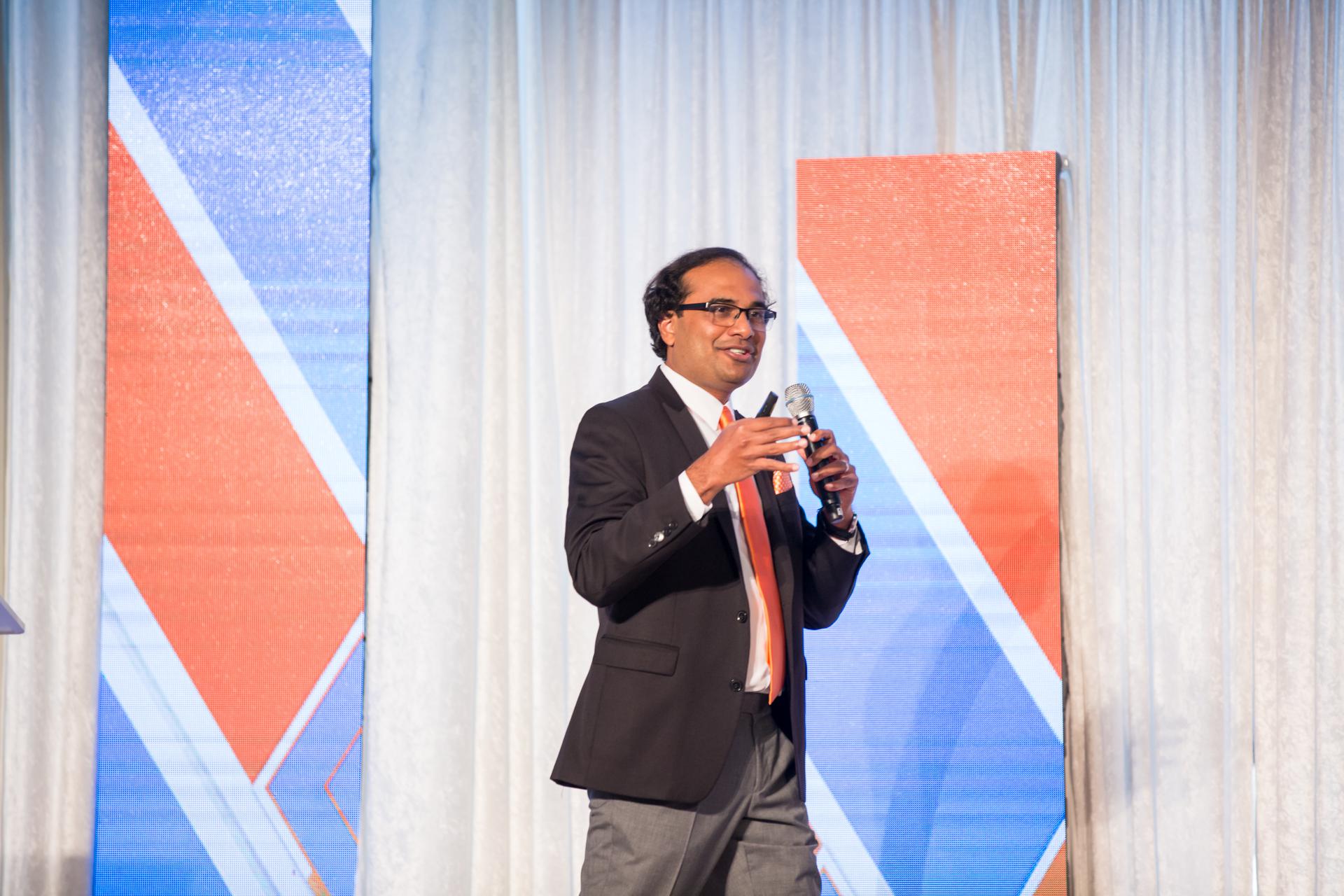
The luxury of owning the clock
Narahari’s case for self-funding is partly an argument about time. A founder and an investor may both want success while having very different experiences of failure. An investor holds a portfolio. The founder has employees, customers and years of work concentrated in a single enterprise. Their calendars can look identical until someone asks how quickly the company must grow.
Writing about venture capital in 2019, he argued that independence had given HighRadius room to change pace, work on the product and hire deliberately. He wanted customers to establish the business’s value before investors helped accelerate it. He also explicitly allowed that outside capital could be useful when the company was ready. His objection concerned sequence and pressure.
In 2017, that readiness came with an operating business. HighRadius had more than 500 employees across the United States, India and Europe. Susquehanna’s Amir Goldman highlighted both its growth and its positive cash flow when the investment was announced. The attraction was a company that had already learned to sustain itself.
Narahari planned to use the money to deepen its presence in existing markets, enter others, extend its network and develop partnerships and products. The ambitions were substantial. The cheque bought more ways to pursue them. It did not need to invent the reason the company existed.
“I don’t think that VC funding is real validation.”
Sashi Narahari
A cheque with a longer horizon
The amounts grew. A $125 million Series B in 2020 was followed by the $300 million Series C announced on March 30, 2021. D1 Capital Partners and Tiger Global led that round, with ICONIQ Growth and Susquehanna participating. The $3.1 billion valuation belongs to that transaction and that moment in the company’s history.
The investor list also included software operators: Snowflake’s Frank Slootman and Michael Scarpelli, Procore’s Tooey Courtemanche, and Airtable’s Howie Liu. Narahari’s stated ambition was to build a business capable of lasting beyond its founders. Capital, in that account, needed a sufficiently long horizon to match the institution he wanted to create.
He had little patience for every fashionable financing vehicle. In 2021, discussing the possibility of a public listing, he favoured a traditional IPO and dismissed SPACs with characteristic bluntness. The remark fits a public persona willing to irritate an audience rather than soothe it. A finance software presentation need not be a sedative.
Announced funding amounts. Bars share a $300 million scale; they do not represent revenue.
Now put the promise in the contract
At Radiance 2026, Narahari put a deliberately uncomfortable question over an AI keynote: could generative AI be a Ponzi scheme? An AI software founder raising that question knows where the discomfort will land. His answer directed attention toward the buyer’s own investment decision, the choice of technology and the eventual evidence of value.
HighRadius presented an outcome-based pricing proposal: no implementation or subscription fees until go-live, followed by a percentage share of gains. The commercial idea gives his older customer-validation argument a sharper edge. A vendor promising better financial performance should have an economic interest in producing it.
The proposal raises practical questions that belong beside any attractive demo. What improvement counts? How is the starting point measured? Which changes can be attributed to the software? A gain-sharing arrangement requires buyer and vendor to agree on the scoreboard. The contract becomes part of the product discussion, rather than paperwork waiting at its end.
Narahari connected the pricing change to another ambition: shortening implementation through a more automated approach to design, simulation and testing. These are bets about how enterprise software should be delivered. Presenting them as bets matters. A launch gives an idea a public starting date; customers supply the subsequent verdict.
His accompanying concept, Algo Quotient, asks finance managers to develop judgement about which technology fits which task. Rules-based automation, machine learning, language models and specialized algorithms have different jobs. In a public LinkedIn account of AQ testing, he reported scoring 65 percent himself. It is a useful number for a seller of AI to publish: even the person advocating the lesson has homework.
Sashidhar, shortened
There are less technical adaptations, too. On a Radiance panel, Narahari explained that his actual first name is Sashidhar. After years of finding that others struggled to pronounce it, he adopted the shorter Sashi. The story came during a discussion involving Genpact’s Tiger Tyagarajan. Names offered an easier opening than the future of corporate finance.
The conversation also supplied a small lesson in changing one’s mind. Narahari said HighRadius had once regarded Genpact as a competitor. Shared customers, including adidas, helped make cooperation sensible. A business problem can survive a revision of the cast list. Sometimes the person across the table belongs on your side of it.
He keeps returning to operators’ experiences. As host of The GBS Masterminds Podcast, he interviews leaders of global business services about the work of running shared services organizations. In conversations about his own company, the horizon remains long: a business that can endure after the people who started it have left.
That ambition gives the eleven-year opening chapter its meaning. Narahari built software for companies trying to turn a promise of payment into usable cash. His latest proposal asks his own industry to make a similarly concrete journey. The vendor has made the presentation. Now the customer gets to examine the result.
Follow the conversation
- HighRadius
- Sashi on LinkedIn
- Radiance 2026 keynote
- HighRadius on YouTube
- The GBS Masterminds Podcast
- Building with a Long-Term Mindset
- The 2017 funding conversation
- His argument for bootstrapping
- The $3,400 payment, explained
- The 2021 funding announcement
- A conversation about the digital CFO
- 2026 Finance & AI discussion in Paris