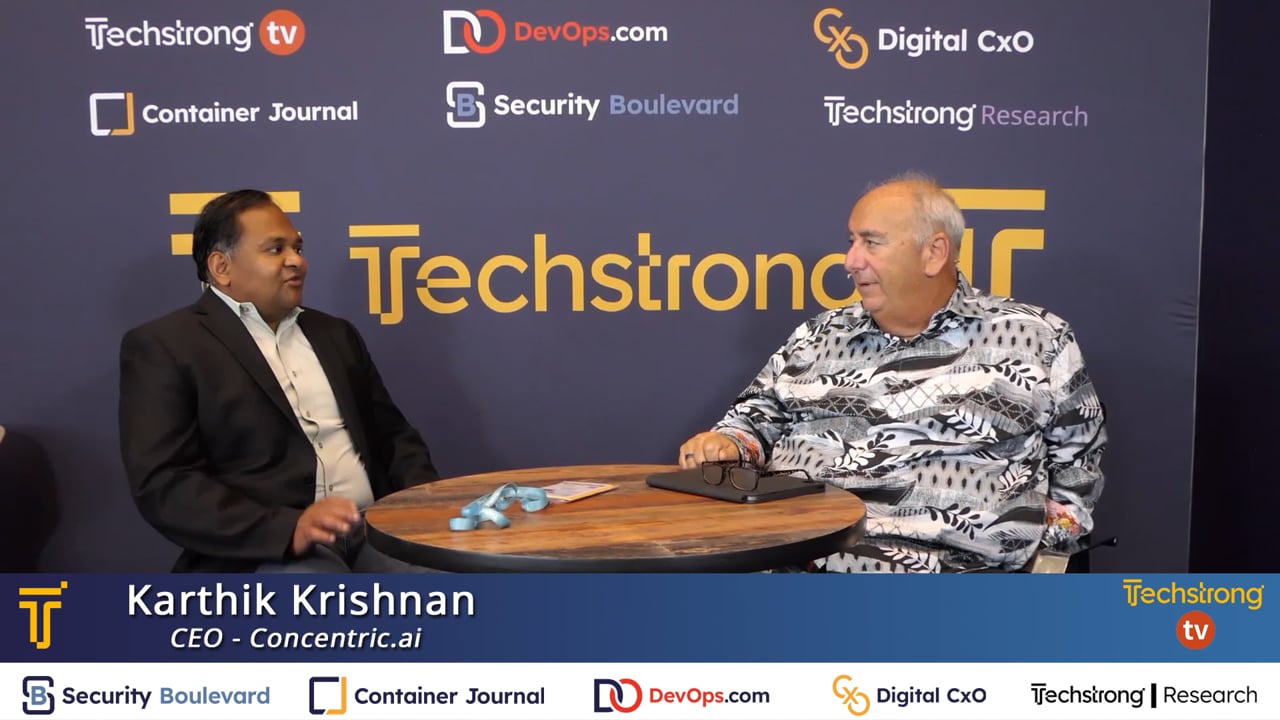
Karthik Krishnan went looking for people who did not know him. At least thirty security professionals, in fact. He and his co-founders wanted to hear what was broken, preferably without the friendly varnish that acquaintances apply to someone else’s business idea. The recurring answer concerned a surprisingly basic failure: companies could not confidently locate the valuable information they were supposed to protect.
For an enterprise, this is an awkward admission. There may be a security department, a collection of tools, and enough policies to furnish a small reading room. Somewhere underneath it all sits a document that matters. Who can open it? Who has shared it? Is anyone watching? Krishnan saw a business in making those questions easier to answer.
His route to Concentric AI runs through years of security product work, a previous startup, and a growing conviction that software needed a better grasp of meaning. The interesting part is how often the technical story comes back to a human one: whom to trust, whose complaint to investigate, when to disagree, and when the founder should stop being involved in everything.
Thirty conversations before the code
The founding group already had a history. Krishnan, Shankar Subramaniam, and Madhu Shashanka knew one another’s work. That familiarity made the people risk more manageable. Their test for the business was demanding: a problem large enough to support a company, difficult enough to reward technical work, and pressing enough that customers would pay to solve it.
One early conversation stayed with Krishnan. A security chief worried that an audit would expose how little the organization knew about its own sensitive data. He later returned to that encounter while explaining the company’s Series A. The anxiety was ordinary and specific. The organization had information worth protecting; its ability to find and govern that information had fallen behind.
Shashanka remembers another part of the beginning. After working with Krishnan at an earlier security startup, he had moved to Austin to develop machine-learning efforts at Charles Schwab. Krishnan contacted him about the gap in protecting enterprise documents and emails. Improvements in deep learning made the timing interesting. Shashanka built a prototype, saw the results, and decided the problem deserved his attention.
Learning to notice what matters
Krishnan had already worked on a related question at Niara: how can a security system recognize behavior that deserves investigation? As a founding-team member and vice president of products, he helped build a company focused on analyzing users and devices. Aruba/HPE acquired Niara in 2017. Krishnan subsequently managed security products there, including the acquired technology and network access control lines.
That career gave him experience on both sides of an acquisition and inside organizations of different sizes. His earlier roles included Juniper Networks, PGP, and Symantec. The through-line was security, but the product problem kept changing. First came understanding activity. At Concentric AI, the attention moved toward the information being accessed and what made it valuable.
His education combined engineering at IIT Madras with an MBA with distinction at Northwestern’s Kellogg School of Management, where he was an F.C. Austin Scholar. Those are useful credentials for someone whose work crosses technical and commercial decisions. They also help explain the range of his assignment: understanding what a model might accomplish, then finding out whether anyone needs it badly enough.
The document has a meaning
Krishnan credits Shashanka with a crucial insight in 2019: transformers and language models could help determine what enterprise data meant. A conventional rule can recognize a pattern. Business sensitivity often requires a wider reading. A document’s importance may lie in the subject it discusses, the purpose it serves, or the relationship between several otherwise unremarkable passages.
Consider an illustrative example: a draft acquisition plan might contain no conveniently labeled secret. Understanding its subject is one task. Establishing whether it has been shared with the wrong group is another. Acting on that exposure adds a third. Krishnan’s ambition connects those steps, moving from discovery toward decisions about access, classification, and protection.
Illustrative workflow. Meaning comes before a useful decision.
He has described customers spending three to five dollars on people for every dollar spent on tools just to operate their data security programs. That is his account of customer experience, rather than a universal industry ratio. Still, it explains the commercial complaint with unusual economy. Buying the software was only the beginning of the bill.
The company’s proposition was to reduce that burden through contextual understanding and automation. For Krishnan, identifying data was always supposed to lead somewhere. A beautifully organized inventory would offer limited consolation if the same confidential material remained accessible to the wrong people.
An hour-long meeting is a choice
His approach to running the company is unusually concrete in places. The tenets he published in 2020 tell colleagues to arrive on time, give meetings their attention, and avoid scheduling an hour when thirty minutes will do. An enterprise software founder has many opportunities to sound abstract. Krishnan took a moment to address the calendar.
Other principles concern trust, continuous improvement, and a beginner’s mind. He allows for disagreement about work while asking people to avoid making the disagreement personal. The formulation has the advantage of being usable in a room where someone has just criticized your favorite idea.
“Be hard on the problem and respectful of the people”
Karthik Krishnan’s published company tenets
The distinction matters in a technical business. Product decisions require people to challenge assumptions. Making every challenge a test of loyalty would be a slow way to discover an error. These are Krishnan’s stated expectations for the workplace, and they reveal what he wants the company’s daily behavior to look like.
The money, and the work after it
By May 2022, Concentric AI had announced a $14.5 million Series A led by Ballistic Ventures, with Citi Ventures participating alongside existing investors. In October 2024 came a $45 million Series B led by Top Tier Capital Partners and HarbourVest Partners. The company said that round brought total funding above $67 million.
Announced round sizes in US dollars. Bars share a scale; they do not represent revenue or valuation.
The 2024 announcement also reported 300 percent year-over-year growth and a tripling of customer count in less than six months. These were company-reported figures. Krishnan’s year-end account described customers using the platform for classification, permissions, old and duplicate data, and Copilot deployments. The original document problem was producing a widening list of assignments.
The breadth of customers interested him. His examples ranged from food producers to hedge funds and industrial manufacturers. Different organizations had different material to protect, yet repeatedly ran into the difficulty of finding and governing it. The customer conversations had become product deployments, and the deployments kept adding to the list of practical problems the team had to solve.
Then the files learned to travel
Enterprise AI gave that work another dimension. Krishnan has argued that employees will pursue tools that make them more productive, much as they embraced mobile computing and cloud services. Security teams therefore need workable ways to govern the use. A prohibition has a difficult career ahead of it when the prohibited tool saves somebody an afternoon.
The permissions issue becomes especially tangible with an assistant. Material that once required knowing which folder to search can become easier to surface through a question. Krishnan’s focus is the information available along that route: what the employee can access, what the assistant uses, and whether sensitive content reaches someone who should not receive it.
In July 2025, Concentric AI announced the acquisitions of Swift Security and Acante. The expansion brought additional capabilities for data loss prevention and AI governance into the company’s platform. It widened the job from examining stored information to following information through movement and use, including public AI tools and internally developed AI applications.
By May 2026, the company had announced an Anthropic Compliance API integration to audit Claude activity, including prompts, responses, and attachments. In August it added discovery based on visual signatures, such as the recognizable layout of a passport. That development extends the original question beyond text: sometimes the appearance of a document is itself a clue.
A company grows. The job changes.
Growth also changes what Krishnan has to do. In a September 2026 conversation about becoming a CEO, he discussed repeated changes in his role, the costs of switching between tasks, and the need to remain responsive to the market. Knowing the product well does not automatically settle how the next stage of the organization should work.
The month brought another concrete change: Gary Olson joined as chief revenue officer, and Will Saso as vice president of sales for the Americas. More leadership means more work can have an owner beyond the founder. It also makes trust a matter of daily operating decisions, with more people responsible for customers and execution.
One small detail from Krishnan’s public writing supplies a fitting closing image. Long before these financing rounds, he wrote about the connection between football coaching and technology hiring. He identified himself as a fan. The interest makes sense beside his working principles: decisions about people, roles, and cooperation have occupied him alongside decisions about software. At Concentric AI, the computer is being asked to read the room. Its co-founder keeps having to do the same.