A building gets only so many opportunities to be wrong. Concrete is a rather unforgiving editor. Sarah Slaughter’s answer was to give construction a rehearsal: capture the work in enough detail to examine a decision before people, materials, and money have committed to it. Her research took her and her students onto more than 200 construction sites, studying tasks and interviewing the people who performed them. The computer models came with mud, in effect, on their shoes.
The problem she described was familiar and expensive. A useful innovation could happen on one project without becoming knowledge that another project could use. Designers, builders, and owners also needed a better way to connect their separate pictures of the same job. “So we are constantly reinventing the wheel,” she observed. A wheel with an invoice attached is a particularly tiresome invention.
Her simulations connected physical components, the work needed to assemble them, and the time and resources involved. They offered a way to explore alternatives while alternatives were still available. That attention to what happens between a good idea and its practical use runs through her subsequent career.
An engineer with anthropology in the toolkit
Slaughter’s education had already crossed a departmental boundary. Her MIT bachelor’s degree combined civil engineering and anthropology. Her master’s work addressed technology and policy. Her 1991 doctorate joined civil engineering and management science, with research comparing innovations developed by users and manufacturers in residential construction.
The combination makes sense when the object of study is a construction site. Buildings involve materials and loads; building them involves people, institutions, habits, and the transfer of knowledge. Her undergraduate thesis concerned the training and socialization of MIT undergraduates. Even early in her education, the technical institution itself could become something to examine.
She taught at Lehigh University from 1991 to 1995 before joining MIT’s civil and environmental engineering faculty. Her research interests included building systems, construction management, innovation, and computer simulation. In other words, she was asking both how a structure worked and how the work of producing it might improve.
Her research portfolio makes the range tangible. Projects addressed modular construction, precast concrete floor systems, bridge designs using enhanced-performance steel, and the strategic effects of information technology on construction. A 1997 project considered design strategies for a 100-year life. A century gives the word “deadline” a different complexion.
Another project examined product development across company boundaries, where cooperation and coordination become engineering concerns of their own. A National Science Foundation CAREER award supported her construction simulation work during 1995-1999. These were questions about how improvements move through a system, and how a decision in one place changes the possibilities elsewhere.
Her publications followed those questions through particular kinds of work. In 1993 she published research comparing user and manufacturer innovations, alongside a paper about builders as sources of construction innovation. Later work addressed construction automation and robotics, the simulation of structural steel erection, and floor framing that could accommodate nonstructural requirements.
These subjects sound specialized because they are. They concern the places where one system has to make room for another, and where a proposed improvement must survive the conditions of installation. A construction innovation eventually needs people to put it together.
Her work with fellow researchers Stephen Pessiki and Richard Sause included studies of precast concrete framing systems. The bibliography gives a useful sense of scale: ambitious questions about innovation were being pursued through specific components, processes, and arrangements. The practical detail remained part of the intellectual work.
The laboratory gets a company
A German firm’s interest in commercializing the simulation research helped set the next chapter in motion. Encouraged by MIT’s Licensing Office to establish a U.S. business, Slaughter founded MOCA Systems in 1999. Former graduate students Michael Carr and John Murray joined as early employees. Fellow MIT alumni Dan Leary and Charlotte Walker took the technology and finance roles.
One founding decision deserves its own space: Slaughter says the MIT students involved in the simulation research received founding shares, as did MIT and its civil and environmental engineering department. The people who helped create the work had a stake in the company built from it.
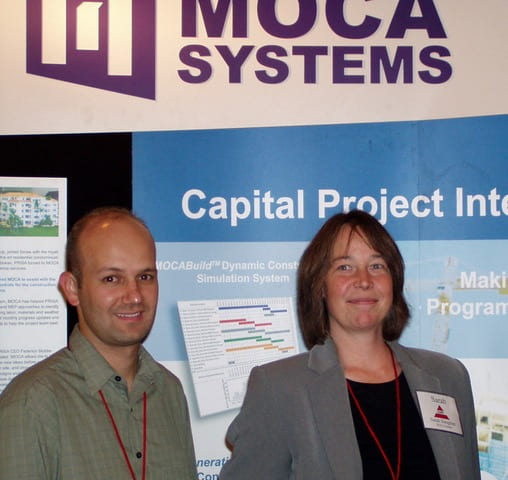
She took leave from MIT in 2000, formally left her faculty position the following year, and remained with MOCA until 2005. Early clients included the U.S. State Department, the U.S. Air Force, General Motors, Intel, and MIT Facilities. Her academic research now had to help organizations make decisions about actual projects, with actual consequences.
MOCA’s subsequent history continued beyond her tenure. The company now combines construction services and software. Its own account still dates its origins to the 1999 MIT spinout and construction simulation research. The enduring connection is the effort to make complex projects more understandable before their problems become harder to change.
physical components
resources
cost and time
Sixty students, fourteen clients
After MOCA, Slaughter co-founded and led the Sustainability Initiative at MIT Sloan. In 2007 she coordinated the Laboratory for Sustainable Business, or S-Lab. Sixty students worked with fourteen clients. Engineering, architecture, planning, management, public policy, and the humanities all contributed to the mix.
Students used simulations and analytical tools, then worked in teams on practical assignments. The clients included established businesses, younger companies, government groups, and nonprofits. Sustainability arrived with organizational constraints, competing priorities, and the need to define what progress would mean.
A team Slaughter advised developed sustainability indicators for Intel’s construction and materials division. Its members included planning student Sharleen Leurig and Sloan students Sylvia Dizon, Elizabeth Prior, and Stephen Rockwell. The assignment required a shared way to assess performance, bringing business considerations together with environmental and regulatory knowledge.
Teaching here extended the work of implementation. A useful analysis had to travel beyond the classroom and become intelligible to an organization. Slaughter worked alongside faculty including Richard Locke, Rebecca Henderson, John Sterman, and Anjali Sastry. Students had to learn enough of one another’s disciplines to produce something a client could use.
Boston already has buildings
The next construction project is only part of the built environment. Existing buildings have occupants, uses, constraints, and long lives ahead of them. In July 2013, Slaughter contributed to Building Resilience in Boston, working through the Built Environment Coalition with Linnean Solutions and the Resilient Design Institute.
The study, a project for the Boston Society of Architects, considered how property owners could reduce vulnerability to climate change and how public policies could encourage them. Its collaborators included Jim Newman, Marcus Springer, and Alex Wilson. The scope extended from sites and structures to building systems, operations, and use.
That last step matters. A building’s ability to cope with disruption involves its equipment and fabric, but also the decisions people make about operating it. The study examined municipal approaches including retrofit requirements, incentives, financing, and education. There were several routes into the problem, each with different people responsible for acting.
The perspective had widened from the sequence of a construction task to the continuing life of a city’s buildings. Preparation now included changing what already existed. Boston’s future would have to accommodate a considerable amount of Boston’s past.
“So we are constantly reinventing the wheel.”
Sarah Slaughter, on construction’s difficulty retaining and reusing innovation
Who gets a seat at the planning table?
Slaughter now leads the Built Environment Coalition as founder, CEO, and president. The research and education nonprofit works with communities, government agencies, nongovernmental organizations, and other partners. It develops approaches to resilience and sustainability and publicly distributes analytical tools, methodologies, and learning materials.
Its stated approach connects built and natural systems. Resilience involves maintaining critical functions and relationships through disruption; sustainability includes economic opportunity, social justice, and environmental regeneration. That brings questions of participation and distribution into the same discussion as infrastructure.
The coalition’s board includes technology and entrepreneurship adviser Val Livada and retired Rear Admiral David J. Nash, whose career includes large infrastructure and construction programs. Their backgrounds reflect the range of expertise involved when research meets institutions responsible for making things happen.
Slaughter’s federal advisory work has also included the General Services Administration’s Green Building Advisory Committee. In April 2022, she and Projjal Dutta of New York’s Metropolitan Transportation Authority were listed as task group co-chairs presenting proposed advice on environmental justice and equity for federal green buildings. The policy question included who benefits from decisions about the buildings government owns and operates.
A wider circle, with the details intact
The National Academy of Construction elected Slaughter in 2013. Election to the National Academy of Engineering followed in 2017. Her current service includes the construction academy’s scholarship committee, whose work supports undergraduate and graduate students in construction and related fields. The connection to students continues through another institution.
She also co-chairs the National Academies’ Resilient America Roundtable with Jessica Dandridge-Smith. The roundtable brings researchers and practitioners together with communities and local, state, regional, and Tribal governments. Its remit includes the social, economic, and infrastructure dimensions of resilience, alongside policy and governance.
At a March 2025 open session, Slaughter introduced discussions of critical infrastructure stressors and the economic benefits of investment. The agenda included infrastructure systems, the measurement of investment benefits, and parks and open space as community infrastructure. The question of preparation had acquired a larger address book.
Slaughter has a compact joke for her own institutional history: “MIT cubed.” Three degrees and three faculty roles. The shorthand makes a complicated career sound pleasantly calculable. Its practical thread is easier to follow: observe closely, make connections, and give people ways to consider consequences while they still have choices. The dress rehearsal remains useful, even when the stage is a community.