Hartley Pike had a job building things, and a recurring appointment with a pile of paper. An entire day each week went into permits. The rest of the week brought the business of getting them signed and moved through the project. Before work could begin, the documents needed their own small logistics operation. Somewhere in that procession was a civil engineer wondering why so much engineering time belonged to the stationery.
Years later, as co-founder and CEO of Sitemate, Pike would still be examining that bargain: what a working person must give up to keep an organization informed. His company makes software for construction and other industrial businesses. Its origin has the appealing specificity of a complaint from someone who has actually done the job. Pike knew the paperwork because he had carried it.
A family argument, with concrete in it
His introduction to construction came during teenage school holidays, when he travelled to Sydney to work in his father’s subcontracting business. His father had built the operation from scratch, taking jobs for property owners, builders and large civil contractors. For a young person considering a profession, this was a close view of the work behind the finished thing.
It also came with a running commentary. His father believed he often understood the jobs better than the university-trained engineers directing them. The distinction between knowing a calculation and knowing a site was being debated at home before Pike had a degree. He developed an affinity for the industry, though taking over the family business did not appeal.
His chosen alternative made for a good family punchline. “I became, a bloody engineer…” he writes. He studied civil structures at the University of Technology Sydney. The qualification put him on the other side of his father’s argument, while the school-holiday work meant he could appreciate both sides.
The permits had a travelling life
Working with Abigroup, which became part of Lendlease’s engineering operation, Pike encountered the administrative machinery of a large project. Permits had to be completed, approved and delivered. The repeated handling was work in its own right. Software would eventually offer him a way to question the whole route a document took.
That distinction matters. A scanned form can preserve every inconvenience of the original and add the pleasure of remembering a password. Pike’s eventual product direction concerned the process: who supplies information, who signs it, where it goes next, and how anyone finds it later. The paper was visible. The movement around it was the more consequential design problem.
Early sales were correspondingly personal. He called former colleagues and asked to show them what he was building. Their interest helped give the idea a foothold. His account of those years keeps returning to conversations on site, where the people using a tool could explain its faults rather more efficiently than a strategy workshop could.
A basement is a beginning, not a business model
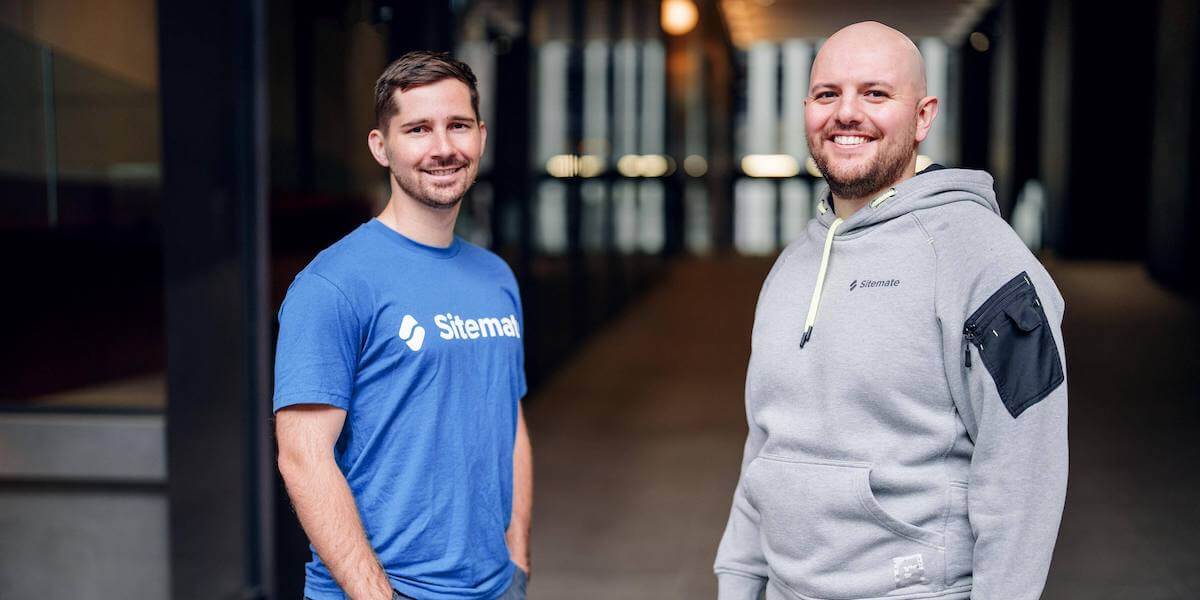
Pike and Sam McDonnell began their venture at UTS. Construction Cloud, their earlier product, launched in March 2016 as a photo-storage app. The pitch drew on a familiar consumer idea: give construction teams a shared feed of images. A site generates plenty of photographs; helping people organize them seemed a reasonable place to start.
The company entered Startmate in 2017. An accelerator can supply introductions and compress learning, but the founders still had to decide what customers would pay for. Photos became part of a broader product, with forms and workflows taking a more central role. Dashpivot launched in August 2018 as the company adopted the Sitemate name.
The partnership joined Pike’s engineering background with McDonnell’s industrial design training. Around them grew a network of advisers and other founders. Rory San Miguel of Propeller became a close mentor. Blackbird participated through Startmate and later led a funding round in 2022. The basement provided an address; the relationships supplied experience the founders could borrow.
The engineer learns to change his mind
Some decisions survived longer than Pike wished. An early architecture organized information into projects and teams, reflecting the large contractors he knew. Later customers described their work differently. They had jobs. They did not necessarily need another team layer. A structure that looked sensible on a whiteboard could become a small obstacle each time someone opened the product.
He caught himself explaining the labels away during demonstrations. That was a warning: the sales conversation was doing repair work for the interface. He later wrote about the decision as a costly mistake. The episode offers a useful glimpse of his engineering instincts meeting the limits of his own experience. Knowing one kind of site very well did not make it representative of every customer.
Hiring taught a related lesson. In early 2018, the mobile app needed help, particularly with offline use. Nick Lammertyn had relevant experience, but lived in Vancouver. Pike, accustomed to work that required everyone on site, was skeptical about the distance.
They spoke over Skype while Pike was in bed at his mother’s house, camera off. He tested Nick’s previous product, found bugs, and saw the offline experience he and McDonnell wanted. Over the following 12 to 18 months, they rebuilt the app together. A practical result changed his view of remote work. Geography had looked like a problem; the engineer across the ocean understood the problem that mattered.
A company with its workings on display
As Sitemate became more distributed, communication needed its own design. Pike favors written discussion that other people can inspect and return to. Internal email is reserved for calendar use; project conversations belong in shared working spaces. The point is to keep useful knowledge from disappearing into private exchanges or being available only to whoever attended a meeting.
A new enterprise salesperson repeatedly asked him for calls. Pike replied, “Can you write to me with what you want to ask?” The adjustment was frustrating at first. Later, the same colleague recognized the disruption when another newcomer wanted to talk through everything. For Pike, writing forces a person to arrange the thought before asking somebody else to carry it.
His preferred vocabulary has a construction flavor: Everything Engineered, Quality Certified, Fast Tracked, High Vis. These values put intention, workmanship, pace and visibility into the company’s daily language. They also reveal a founder comfortable with systems. Even the way people acknowledge good work can be given a recognizable mechanism.
Then the mechanism needed adjusting. At the 2024 offsite in Vietnam, after spending much of the year working in North America, Pike heard that speed and visibility could sometimes be applied too bluntly. He introduced Handle With Care. Feedback could be private when a public airing would do harm; changes could be discussed before implementation. The adjustment gave his own system a little less swagger and a little more tact.
“The best do great work, and the great work gets seen.”
Hartley Pike, on the working environment he wants to build
From site forms to a wider toolbox
By December 2024, Sitemate was serving 2,000 customers. Pike announced an A$27.5 million Series A led by Blackbird. The customer examples reached well beyond the Sydney sites of his early career: renewable projects in New Zealand, nuclear work in Switzerland, and a Subaru electric-vehicle production facility near Chicago.
The money was intended to support several products at once. Dashpivot handled forms and field reporting. Flowsite connected systems and automated processes. Gearbelt addressed asset management. Each sat near another part of the same working day. The company was expanding the number of practical problems it could take on.
A$27.5 million Series A announced
Forms and field reporting
Integrations and automation
Tools, fleets and assets
Earlier that year, Sitemate had acquired Nomad for A$2 million in cash and equity. Nomad founder Will Smith joined the business, bringing an asset-management product that linked jobsite, office and workshop. For Pike, the deal accelerated a roadmap covering equipment from small tools to vehicle fleets. A contractor’s paperwork concerns the things moving through a site as well as the people doing the work.
North America required another kind of proximity. Pike made Canada a base for expansion, with teams in Vancouver and Toronto. He cited similarities in regulation and working culture, access to talent, and Vancouver’s direct connection to Sydney. In January 2025, he described plans to spend months in each regional operation while helping it establish traction. His current public profile places him in Greater Toronto. The business had become international; the habit of getting close to the customer remained.
The next form may begin with a voice
A conversation with a North American customer sharpened Pike’s ambitions for AI. The customer described Spanish-speaking workers for whom written reporting could be difficult. Pike began imagining an induction completed by speaking in Spanish, with information translated into a form that could be read in both languages. The interface would meet the worker in a more useful place.
This remains an ambition with a practical test attached. Before Sitemate’s first AI release, Pike said the company had discarded two earlier builds because they were not ready for frontline users. On 1 June 2026 it launched Storm 1.0, an AI data-capture agent. An enterprise shared-data offering followed, intended to keep templates, lists and users consistent across workspaces.
Pike’s own January 2026 account of an ordinary Wednesday shows how far his working tools had already moved. AI research ran overnight. Meeting tools recorded conversations. He spoke ideas into drafts, listened to synthesized audio to catch errors, and worked on prototypes. Between it all came the commute, recent YouTube interviews in his ears, and occasional complaints about Slack.
The impatience is recognizable from the permits. He wants the tools to carry more of the administrative load so the person can get on with the job. Years of building Sitemate have added qualifications to that wish: understand the user, revise the design, make the decision legible, handle people carefully. The day he wanted back is still a useful measure. Somewhere on a site, somebody has work waiting.