The useful thing about a four-hour daily commute is that it makes abstraction difficult. Time becomes brutally physical: a steering wheel, a stream of brake lights, another hour that will not be returned. Before Sara Holtz became a mortgage-technology executive, she ran marketing for a San Francisco Bay Area credit union and drove two hours each way to do it. The job gave her leadership experience. The road supplied an ultimatum.
Holtz moved to Ellie Mae, then a cloud-based mortgage platform, and brought a slightly mischievous idea with her: internal communications could be run like marketing. Start with an objective. Understand the wider system. Build a strategy, choose tactics, measure the response and adjust. Employees were an audience worth understanding, not a distribution list waiting to be filled.
That move contains the shape of her career. Holtz is not a technologist pretending that words are easy, nor a wordsmith pretending technology is simple. She sits in the useful middle, where systems need stories and stories need evidence. More than 20 years after beginning her marketing career, she is chief marketing officer at Optimal Blue, the mortgage capital-markets technology company. Her work is to make a dense machine legible: pricing, eligibility, hedging, market data, loan trading, risk and the human consequence at the far end of all that machinery, a borrower trying to buy a home.
The writer enters the machine
There was language before there was lending. Holtz studied English and creative writing at the University of North Texas, earning a master's degree and a 4.0 GPA. The detail is more than academic decoration. Mortgage technology suffers from an excess of nouns. Platforms, indices and analytics pile up quickly; meaning does not. A marketer with a writer's ear can ask the unfashionable question: what is this actually for?
At Ellie Mae, Holtz rose through communications roles while the company itself changed around her. ICE acquired Ellie Mae in 2020, folding it into ICE Mortgage Technology. By the end of 2021, Holtz had been asked to combine demand generation and communications into one unit. The new team aligned paid media, account-based marketing, customer communities, advisory boards and regional groups. In 2022, those efforts contributed to $12 million in influenced annual contract value.
It is tempting to treat that number as the conclusion. Holtz treats metrics as feedback. The point of measurement is not to admire a dashboard; it is to decide what to do next. Her earlier internal-communications experiments followed the same loop. Strategy becomes useful when it can learn.
“One of the most important decisions I made was to stop equating performance with leadership.”Sara Holtz
The promotion after the promotion
Many executives arrive at the top carrying the habit that got them there: be the person with the answer. Holtz has been candid about discovering the limit of that habit. Delivering, executing and proving value through outcomes helped her rise. It could not, by itself, help everyone around her rise too.
Her next professional upgrade was less visible than a title. She shifted from supplying answers to creating clarity, alignment and momentum through other people. In practice, this means resisting the nervous executive's appetite for control. It also makes self-awareness operational. How a leader behaves under pressure changes the room, the quality of dissent and the decisions that follow. “Self-awareness isn't a soft skill,” Holtz has said. “It's a leadership requirement.”
The line could become conference wallpaper if she left out the uncomfortable portion. She does not. Her most formative lessons, she says, came when plans broke, feedback stung and decisions landed differently from how she intended. The value was learning to separate identity from outcome: a failed decision becomes information, not a verdict on the person who made it.
This is the logic behind her phrase “launch and iterate.” Put the work into contact with reality before perfection turns into camouflage. Test. Learn. Adjust. Failing earlier is not carelessness; it is a way to buy better evidence while there is still time to use it.
A brand finds its verbs
Holtz joined Optimal Blue in March 2024. The company is part marketplace, part data source and part operating infrastructure for mortgage lenders. It connects primary lenders with the secondary market where loans are sold, while helping teams manage pricing, margins, hedging and risk. This is economically important work with all the natural romance of a wiring diagram.
Her first chapter included the “Optimize Your Advantage” campaign, two podcasts called Optimal Insights and Market Advantage, and the company's first Summit user conference. Each created a different doorway into the same room. Market data could become a weekly conversation. Clients could meet across the boundary between primary and secondary markets. A product story could be useful before it became promotional.
In 2025, Holtz led a wider rebrand around the phrase “Modern. Proven.” It is an intentionally tense pairing. Modern speaks to cloud-native systems, APIs, automation and generative AI. Proven insists that infrastructure cannot survive on novelty alone. Lenders need systems that work when rates move and margins narrow. The semicolon between innovation and trust is invisible, but it is doing most of the labor.
The work brought industry recognition. HousingWire named Holtz a Marketing Leader in 2023 and 2024, then a Woman of Influence in 2025. The later award cited her role in building the podcasts, summit, campaigns and cross-functional alignment. Holtz used the occasion to redirect attention toward diverse perspectives and cohesive innovation. Awards point at one person; functioning teams reveal what that person values.
The chief of staff who lives in a prompt
By 2026, Holtz was applying the same appetite for clarity to artificial intelligence. At HousingWire's The Gathering in Austin, she framed AI as a chief of staff. The metaphor is deliberately modest. A useful chief of staff does not replace the executive's judgment. The role organizes inputs, finds patterns, guards attention and makes the next decision easier to see.
She offered five principles: prompt with clarity, solve real problems, target small and repeatable wins, strengthen relationships, and cultivate decision confidence. Notice what is absent. There is no invitation to hand authority to the machine. The framework assumes that expertise remains accountable for the result.
The AI chief-of-staff framework
That restraint matters in mortgage capital markets, where a confidently wrong answer can travel quickly and expensively. AI can help sort variable data and growing workloads. It cannot carry responsibility. Holtz's version keeps a person at the center, with more capacity to think and fewer excuses for failing to do so.
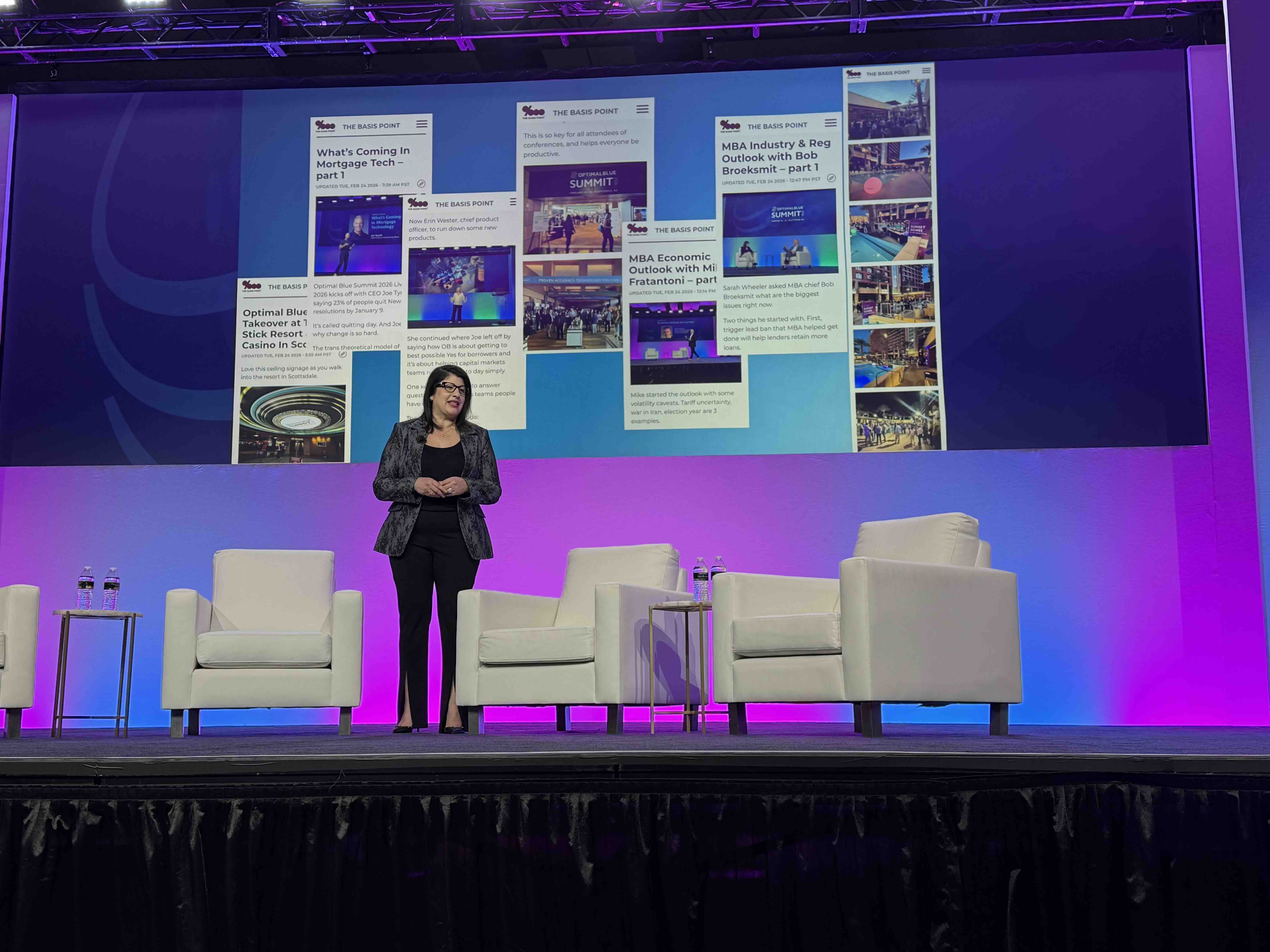
She also makes room for humor. Opening her Austin talk, she looked at a room gathered for the Women of Influence Forum and announced that three days of 85 percent humidity had put her in a ponytail. The joke did what a good opening should: made the speaker human before asking the audience to consider machines.
“Learn to fail earlier - and use it.”Sara Holtz
Purpose is the ballast
Holtz's professional language returns often to purpose. Mortgage software can sound remote from a kitchen-table decision, but she connects operational efficiency and lender profitability to the borrower's chance at homeownership. The connection is not automatic, and marketing cannot manufacture it. It can keep the end user visible while teams argue over features, timelines and market share.
The same instinct appears outside the product story. Holtz mentors women in real-estate finance through industry programs and one-to-one relationships. She has served as a parent adviser on a school site council. On LinkedIn, she has written about balancing boardrooms with ballgames, strategy sessions with school projects, and business travel with parent volunteering. Showing up, in her telling, is frequently unglamorous and usually the whole point.
Her latest public reflections sound less like a victory lap than a set of working notes. Think differently, not merely faster. Know how pressure changes you. Let feedback edit the plan. Use AI to expand attention, not outsource judgment. Keep the borrower in view.
There is an appealing symmetry here. The creative-writing student learned to shape a sentence. The credit-union marketer learned to understand an audience. The internal communicator learned to measure attention. The CMO learned that leadership is not the final draft one person delivers; it is the conditions under which many people can make the draft better.
Mortgage markets will remain complicated. Rates will move, technology will change, and every platform will promise speed. Holtz's wager is quieter: clarity compounds. It helps a team choose what deserves acceleration and what deserves another question. In an industry packed with engines, that may be the more useful form of horsepower.