The machinery of retirement has the glamour of plumbing and roughly the same public-relations problem. When it works, nobody throws a parade for the pipe. When it fails, everybody notices the ceiling. Susan Canavari has chosen this unphotogenic machinery as her latest subject. In October 2025, she became chief marketing officer of IRALOGIX, the company whose cloud software lets financial institutions offer their own branded individual retirement accounts. Her assignment is not merely to make the name familiar. It is to explain why account opening, integrations, data movement and compliance matter to a human being who would prefer not to think about any of them.
Canavari's answer begins at the far end of the system. She has written about the teacher, nurse or small-business employee whose future can be shaped by infrastructure they will never see. The useful technology is the technology that lets an account open cleanly, money follow a worker and information feel secure. Her phrase for the idea is crisp enough to survive a boardroom: Infrastructure is the new trust signal in retirement.
It sounds like a distinctly modern CMO brief, but her route to it runs through a quarter-century of changes in advertising. She learned the business inside agencies, where a brand arrived as an account and left as a campaign. Then she crossed the table into financial institutions, where a brand could also be a branch interaction, a product design, a newsroom, an employee experience or a maddening form. The canvas kept getting larger. Eventually it reached the software underneath.
The account walked into the agency. She followed it out.
Her early career included senior roles at Digitas and Ogilvy & Mather. She worked on businesses as varied as Kraft Foods, Time Warner Cable and Lenovo, and her published biography adds Microsoft, General Motors and Disney to the list. At Digitas, she became the first managing director of an integrated team created for Kraft, an early clue that she was comfortable dissolving the neat borders between disciplines. Media, creative and measurement were becoming less like neighboring offices and more like roommates arguing over the thermostat.
By 2011 she was at mcgarrybowen, helping lead the JPMorgan Chase business. In 2014, Chase hired her as chief brand officer in a newly created position. The move had a pleasing bit of geometry: the executive who had worked intimately with the bank's leaders from the agency side now carried the responsibility inside the building. Her remit covered the consumer and card brands, advertising, media, agency oversight, creative services, content and social marketing.
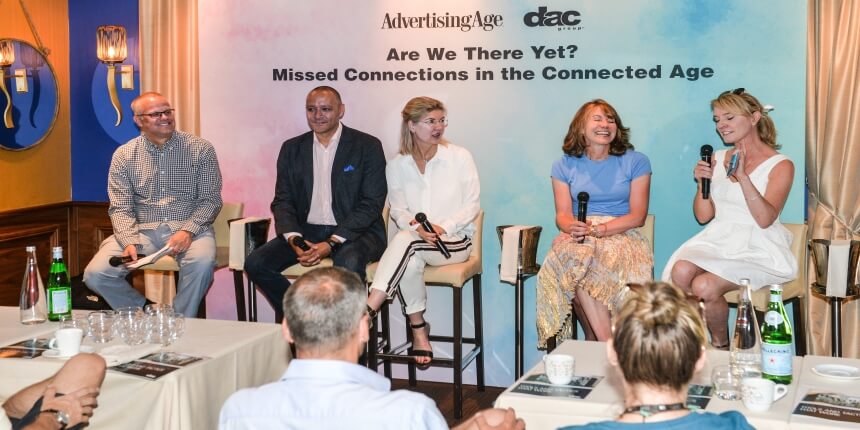
At Chase, the traditional ad campaign was only one instrument. The bank built a newsroom that published stories intended to help customers manage their lives, and Canavari framed content as a way to deepen relationships. The company also brought more capability in-house. Its internal agency, Inner Circle, handled work including search and programmatic media. To a customer, that organizational chart was invisible. To the brand, it meant faster learning and greater control over how an enormous institution spoke.
“We are acting as a real wingman to our customers.”Susan Canavari, during her Chase tenure
The language is revealing. Banks generally prefer to appear in marble. A wingman is beside you, less ceremonial and more useful. During those years, Chase was sharpening the identities of products such as Sapphire while keeping the master brand as an endorsement of trust. Canavari argued publicly that a passionate customer wants to share a brand with like-minded people. The goal was not recognition at any price. It was belonging with a reason attached.
A career moving closer to the machinery
The rising bars show expanding proximity to product and operations, not rank or company size.
Creative instinct meets the spreadsheet
Canavari has repeatedly resisted the false choice between the lyrical and the legible. At a data summit during her Chase years, she and analytics leader Sandra Nudelman made the case for creative and quantitative teams learning together. Testing mattered. Surprise mattered too. Nobody in a fast-changing market possessed the complete answer, so the organization had to create the conditions for several kinds of intelligence to collide productively.
That balance appeared again after she joined real-estate marketplace Sundae as CMO in 2022. The company served two audiences with different anxieties: homeowners looking for a sale and investors looking for properties. A former colleague credits Canavari with building a balanced brand and performance team, using qualitative research to find what created loyalty and what created obstacles for both groups. Those findings did not stay inside a presentation. They influenced product and sales priorities.
The same account says her team forecast with sales, analytics and finance; optimized lead flow by market; reduced dependence on paid acquisition; and achieved positive return on advertising spend. It also built partnerships and an agent-referral program. This is marketing as an operating system rather than a decorative layer. The customer insight enters through one door and walks out through product, distribution and economics.
People who have worked with her reach for a similarly balanced description. One calls her analytical and inquisitive, collaborative and flexible. Another, who worked for her twice, pairs business and growth focus with generosity as a leader. Those are endorsements, not laboratory measurements, but they match the work record: teams built across specialties, customer findings carried across functions, brand treated as both feeling and result.
A quieter definition of access
IRALOGIX brings Canavari back to retirement, a field she knew from TIAA, but with a different vantage point. TIAA placed her inside a century-old financial institution serving education and nonprofit communities. IRALOGIX sells the cloud-native layer that institutions can place behind their own brands. It is a B2B platform whose effects land in individual households. Marketing has to speak fluently to partners while remembering the eventual person.
Her public writing in 2026 has been an exercise in translating that position. Infrastructure is not presented as a stack of acronyms. It becomes the ease of opening an account, the continuity of savings after a job change and the confidence created by a clean audit trail. Education belongs beside access because availability alone does not create participation. In her formulation, even an excellent investment platform falls short when someone does not understand why it matters or feel that it was built for them.
She is equally alert to the emotional problem in the category. After hearing the founder of Liquid Death describe his company as entertainment that happens to sell water, Canavari considered the deadly language of retirement marketing. A phrase such as “tax-advantaged savings vehicle with long-term growth potential” may be technically sound and socially comatose. Retirement is easy to postpone precisely because it arrives wrapped in distant abstractions. The marketer's job is to return a pulse to the sentence without weakening the truth.
“Education and access go hand in hand.”Susan Canavari on investing participation
Recent posts have put family pressure at the center of that truth. In July, on Women's Retirement Security Day, she highlighted research finding that three quarters of Americans would delay retirement by as much as five years to support someone they love. Her focus was not the neatness of the percentage. It was the uneven weight of caregiving and the confidence needed to bring everyday financial decision-making into long-term investing. The spreadsheet described the gap; empathy decided how to speak about it.
The boards tell a second story
Outside her executive roles, Canavari's affiliations form an eclectic little cabinet. She has served the Potential Energy Coalition, which applies creative and analytical talent to climate communication. Her public profile also lists board service with Oscar's Place, a donkey rescue and adoption sanctuary, and a secretary role with Voices From Within, which works through peer support, storytelling and educational media with incarcerated people and communities.
She is also secretary of the CMT Research Foundation's board. The details belong to separate causes, but the connective tissue is visible: institutions trying to turn difficult subjects into action, often by helping an overlooked audience be seen or heard. Even the menagerie has range. A published professional biography once placed her on Manhattan's Upper West Side with her husband, John, and pets named Bojangles and Spike. Corporate biographies seldom improve after the pets arrive, but this one does.
Canavari earned her bachelor's degree in communication and management at Miami University and an MBA in marketing from Boston College's Carroll School of Management. In a 2019 alumni conversation, she discussed the daily habits behind the résumé: waking at five, handling email and staying current on the news. Her career advice was blessedly free of furniture: Work really hard and be flexible.
Flexibility, in her case, has not meant wandering without a thesis. It has meant carrying the same thesis into different rooms. At an agency, understand the client's business. At a bank, make content useful and the customer relationship human. At a marketplace, let research change the product and acquisition plan. At a retirement platform, show how the invisible system earns visible trust.
The pipes remain unglamorous. That may be their charm. Canavari's newest work suggests that the next important financial brand will not be built by painting over the machinery. It will be built by making the machinery reliable, translating what it does, and remembering who is standing beneath the ceiling.
Continue the conversation