A bus stop has a way of reducing a city to one question: when? You may admire its architecture later. You may forgive its traffic eventually. For the moment, you would like to know whether to stand still, walk to another stop, or abandon your dignity and run. Sam Vermette has built much of his working life around making that decision easier.
He is the co-founder and CEO of Transit, the Montreal company whose app brings nearby departures and journey planning onto a phone. Its subject is familiar enough to disappear into the background: people getting somewhere. Vermette’s story becomes interesting when you notice how much attention he has given to that apparently modest task. A readable screen leads to a data problem. A data problem leads to an institutional relationship. Eventually, someone must figure out how to pay for all the attention.
Transit launched on iPhone in 2012, with Vermette and fellow co-founder Guillaume Campagna behind it. Fourteen years later, the original question remains recognizable. The company surrounding the answer has changed considerably.
Paper skyscrapers, real streets
As a child, Vermette constructed skyscrapers out of paper. He grew up in Île Bizard, in Montreal’s West Island, an environment he later described as suburban and organized around cars. Many of his high-school friends had one. He did not. The child assembling a skyline and the teenager getting around without a car offer two early views of the same interest: how a place is put together, and how someone actually lives in it.
He also taught himself to code and made websites for fun. Programming gave him a way to produce things without waiting for a commission, a factory, or anyone else’s invitation. Yet he did not immediately decide that software should be his profession. He studied industrial and product design at Université de Montréal between 2006 and 2010.
The iPhone arrived during those university years. Here was a new object with an unusually accommodating surface: a designer could alter what it did by writing software. Vermette’s experiments moved from the web to the phone. His eventual occupation would draw on both sides of that education, the formal study of design and the informal habit of figuring things out in code.
There is a pleasing continuity between a paper skyscraper and an app. Both let their maker rearrange a little piece of the world. The app, however, has customers who can tell you exactly which piece you have rearranged incorrectly.
A city in a glance
Vermette and Campagna were dissatisfied with the transit apps available to them. Their response relied on a capability the smartphone already possessed: knowing where its owner was. Open Transit, and nearby transportation information could appear immediately. The user would have less preliminary work to do before reaching the useful part.
That is a particular design choice. A journey planner begins by asking where you want to go. Someone who already knows the route may have a more immediate concern. Putting departures near the beginning of the experience acknowledges that regular riders bring knowledge of their own. The interface can meet them halfway.
In March 2013, Vermette described an app covering 36 North American cities and drawing on open information from 102 agencies. He wanted agencies to publish dependable, current data and communicate with developers. A polished screen could only pass along what the underlying information allowed. If a schedule had gone stale, the person at the stop experienced the error as an app failure.
His technical work is visible elsewhere. At CocoaHeads Montréal, he gave talks titled “Snapping the pixels” in 2011 and “Designing The Transit App” in December 2012. His public iOS projects include SVPullToRefresh, a component for adding familiar refresh and scrolling behavior to other developers’ apps. Its credits acknowledge contributors, a talk by Sebastien Morel, and Loren Brichter’s invention of pull-to-refresh. The work belongs to a conversation among people making small interactions less awkward.
Two seconds on the wrist
The Apple Watch gave Vermette a smaller surface and a tighter deadline. In 2015, he described designing for a glance that might last only a second or two. Transit’s watch experience put nearby arrival information within that brief encounter. A watch is an excellent place to be reminded that time is passing; it helps if the reminder contains something useful.
Vermette described the team’s principle as “content is the UI.” The phrase suits a product whose main attraction is often a number. The arrival time carries the value. The surrounding design needs to make that value legible quickly, under circumstances less comfortable than a designer’s desk.
“Content is the UI.”
Sam Vermette, on designing Transit
Later that year, Transit introduced stop notifications. A rider could select a bell near the intended stop and receive a prompt to get off. Vermette explained that users had been asking for the feature since the app began. Getting stop accuracy right had posed an early difficulty for the development team.
The feature addresses another unglamorous piece of the journey: keeping watch through the window to make sure you have arrived. Alongside departure information, it gives the app a role on both sides of boarding. The question changes from whether the vehicle is coming to whether your destination is coming. The designer’s job follows the passenger.
In December 2017, Transit’s relationship with its home city took a concrete step. Montreal’s STM made real-time bus schedules available to the public through its own channels and Transit. Vermette emphasized the link between current information and riders’ confidence. The underlying bus operation belonged to the agency; the passenger needed its movements translated into a useful answer.
The difficult fare
Making something useful and building a company around it require different kinds of learning. Vermette has described arriving at entrepreneurship without a developed background in management. He and Campagna went through an accelerator and learned from mentors. The product had users before the founders had a comfortable answer to the business question.
This is a less photogenic stage of a design career. A working interface makes its success visible. Revenue has to sustain the invisible labor as well: maintaining information, handling exceptions, and keeping the service dependable after the initial enthusiasm wears off.
In August 2021, the founders introduced their case for Royale, Transit’s subscription offering. Their explanation described a team that had grown from two people to 60. Some established functions would move behind a subscription, while core trip information would stay free. They also offered a route to free subscriptions for people who could not afford them and planned agency arrangements that would cover riders’ access.
There was a real tradeoff here. Charging for something previously available changes the bargain with a user. The founders tied their choice to keeping the app running without financing it through intrusive advertising or selling personal information. Sustaining the product had become a design problem with consequences beyond the screen.
Agency support offered another way to distribute the bill. RideKC described providing Royale to its riders, alongside features such as personal themes and GO crowdsourcing leaderboards. It is an interesting reversal of the solitary app purchase: the institution operating the journey can also support the information that helps someone make it.
Pull up a chair
By October 2022, Vermette could open a gathering at Transit’s Montreal headquarters and look back over a decade. The company brought Canadian transit agencies together for its first Roundtable while an industry conference was in town. He welcomed them, reviewed the company’s path, and introduced what came next.
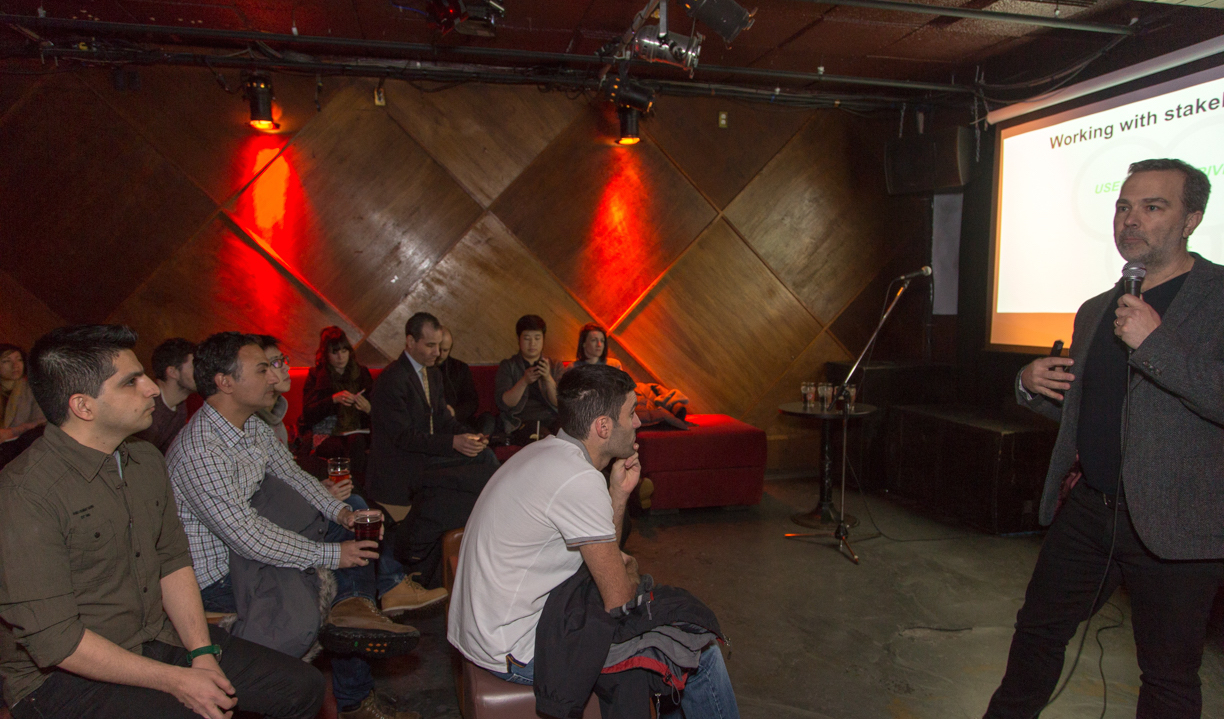
The Roundtable’s agenda had the specificity of people dealing with actual service: detours, data standards, rider reports, and ways to communicate. Colleagues including Christine Mongeau, Marisa Henry, Jeremy Steele, and David Block-Schachter led sessions. Lunch, despite the event’s name, took place at a rectangular table. Even transportation people must occasionally tolerate a misleading diagram.
The gathering shows a founder working in a different setting from the early developer forums. Transit had become a place where agencies could compare needs and talk with the team building their riders’ tools. Vermette’s role now included bringing those conversations into the same room.
The passenger has information, too
In July 2026, Vermette discussed the work with more than 200 agency partners and the information passengers contribute through GO and Rate-My-Ride. A rider experiences a journey in ways that operational statistics alone may fail to express. Feedback can tell an agency where crowding or an unexpected change is affecting the trip.
The partnership scale Vermette discussed in July 2026. Behind the number: individual journeys and local services.
His argument was that this participation deserves a place in civic infrastructure. Helping a passenger receive information and helping an agency hear from that passenger are related tasks. Both depend on maintaining a connection across the space between an institution and the people using it.
Vermette’s ambition reaches toward greener, fairer cities where living without a car is easier. The practical route there remains full of particulars. A rider needs a departure they can understand. An agency needs feedback it can use. A company needs to keep doing the work tomorrow.
The paper skyscrapers make a fitting beginning. They were a child’s way of assembling a city. Vermette’s adult project deals with the movements between its buildings, and with making those movements a little easier to choose. The next bus is still the next bus. Enough people being able to catch it changes what a city makes possible.
Follow the route
More from Vermette, his work, and the conversations along the way.
- Transit
- Twitter / X
- GitHub
- Dribbble
- L’École du Succès: watch the interview (French)
- Le Wagon Live: listen to the founder interview
- The early open-data interview
- On financing Transit for the long haul
- Rider participation and reliable transit
- The ProductTank transportation discussion
- How I Created an App That Helps Millions Navigate Transit