A timetable describes a city that behaves itself. The bus leaves when it should. The connection holds. Nobody has moved the stop. A commuter, standing on the pavement, inhabits a less cooperative place. Moovit has spent its life trying to close the distance between those two cities. Its most revealing discovery was that the people annoyed by the gap could help fill it.
- Riders get routes, alerts and live arrivals where data is available.
- Local volunteers help build and maintain the transit map.
- Agencies buy the software underneath: apps, APIs, tracking and analytics.
The Israeli company launched in 2012 with three founders: Nir Erez, Roy Bick and Yaron Evron. Today it belongs to Mobileye. You may know its orange app, but you can also encounter its technology inside an agency’s application, with someone else’s name on the screen. That second identity explains much of the business.
Barcelona’s missing map
Early expansion produced an awkward mismatch. App stores distributed Moovit by country; its transit coverage grew city by city. A Barcelona resident could download an app available in Spain, then discover it had information for Madrid but none for Barcelona. Ratings fell. Meanwhile, obtaining official transit data was proving difficult.
Bick proposed asking disappointed users to help map their cities. Erez was skeptical. The experiment changed his view. Bick built a dedicated editing system, with training and ways to review and validate contributions. Barcelona became an early test of whether people would work on information useful to their own community.
“But we tried it and it worked!”
Nir Erez / Co-founder / 2018
There is a practical lesson here for anyone building a data-dependent product: make contribution possible, then make it manageable. A request for goodwill needs an interface, instructions and a checking process. Otherwise the missing map becomes somebody else’s homework.

Moovit also reports more than 1.7 billion users reached across its platforms over time. That is cumulative reach, rather than a monthly active audience.
A bus app with a business upstairs
For a rider, the proposition is pleasantly ordinary. Enter a destination. Compare journeys. Follow directions through walking legs and transfers. Check service alerts and, when the operator supplies the necessary information, arrival predictions. The benefit is fewer decisions made while squinting at a bus shelter.
Accessibility also changes what counts as a usable route. Moovit supports VoiceOver and TalkBack, provides larger interface targets for people with motor impairments, and identifies wheelchair-accessible routes. Those features matter because a journey has several points of failure: finding the stop, boarding the vehicle, making the connection. A route can look sensible on a map and still be unsuitable for the person attempting it.
The familiar alternatives include Google Maps, Apple Maps, Citymapper, Transit and the local agency’s app. Moovit’s distinctive combination is transit specialization, community editing and products for the organizations running transport. Which app serves you best still depends on the city, the route and the freshness of the information.
The consumer app remains free, with advertising. Moovit+ adds a subscription: no ads, route comparisons, arrival updates and features such as sharing a journey with safety contacts. Monthly and annual plans are offered through app stores. The amount a rider pays depends on the market and the plan shown at purchase.
For institutions, Moovit supplies branded apps, transit APIs, fare-payment integrations and mobility analytics. These customers include cities, operators and campuses. Boston University, for example, uses Moovit technology to bring its shuttle information together with other travel options. A university’s private bus can become part of the same journey as the public train.
+ local editors
+ route planning
+ agency software
TimePro goes further upstream. Its driver app runs on an Android device and transmits vehicle location to Moovit’s servers. Agencies get a browser dashboard; passengers get arrival information. This addresses a problem that prettier navigation cannot solve: a route planner needs to know where the vehicle actually is.
The $900 million connection
Building that system required capital. In February 2018, Intel Capital led a $50 million Series D. Moovit said the money would expand sales, improve consumer products and develop its mobility platform. The company reports $133 million raised across its early funding rounds.
The team has continuity behind those product changes. Nir Bezalel joined in 2012 as VP of research and development, became CTO in 2020 and took over as CEO in 2024. His biography describes an engineering organization that grew from six developers to more than 150. The company’s expertise therefore includes the unglamorous work of keeping a transit application stable while adding cities, features and institutional customers.

In May 2020, Intel acquired Moovit for approximately $900 million, or $840 million after accounting for Intel Capital’s equity gain. The stated logic joined Mobileye’s driving technology to Moovit’s transport data and rider experience. Knowing how a vehicle drives and knowing where passengers want to go are different pieces of a mobility service.
That ambition remains a work in progress. In June 2026, Mobileye announced plans to operate a robotaxi business in a US city beginning in 2027. Moovit’s mobility platform and consumer applications are part of the proposed system. An announced deployment belongs in the future tense.
Six apps become one
There is a more immediate example in Los Angeles. In June 2026, LA Metro announced a Moovit-powered app consolidating six standalone applications. It brings planning and payment together across transport modes, with live directions and alerts. For visitors arriving around major sporting events, fewer separate apps means fewer opportunities to get lost between systems.
In New York’s Capital Region, Moovit and CDTA reported 90% fixed-route arrival prediction accuracy in April 2026. Their Navigator app had 30,000 monthly active users and more than 450,000 trips planned monthly. Those are deployment-specific figures. They show what one agency reports, rather than establish an accuracy guarantee for every Moovit journey.
The next bus still needs a signal
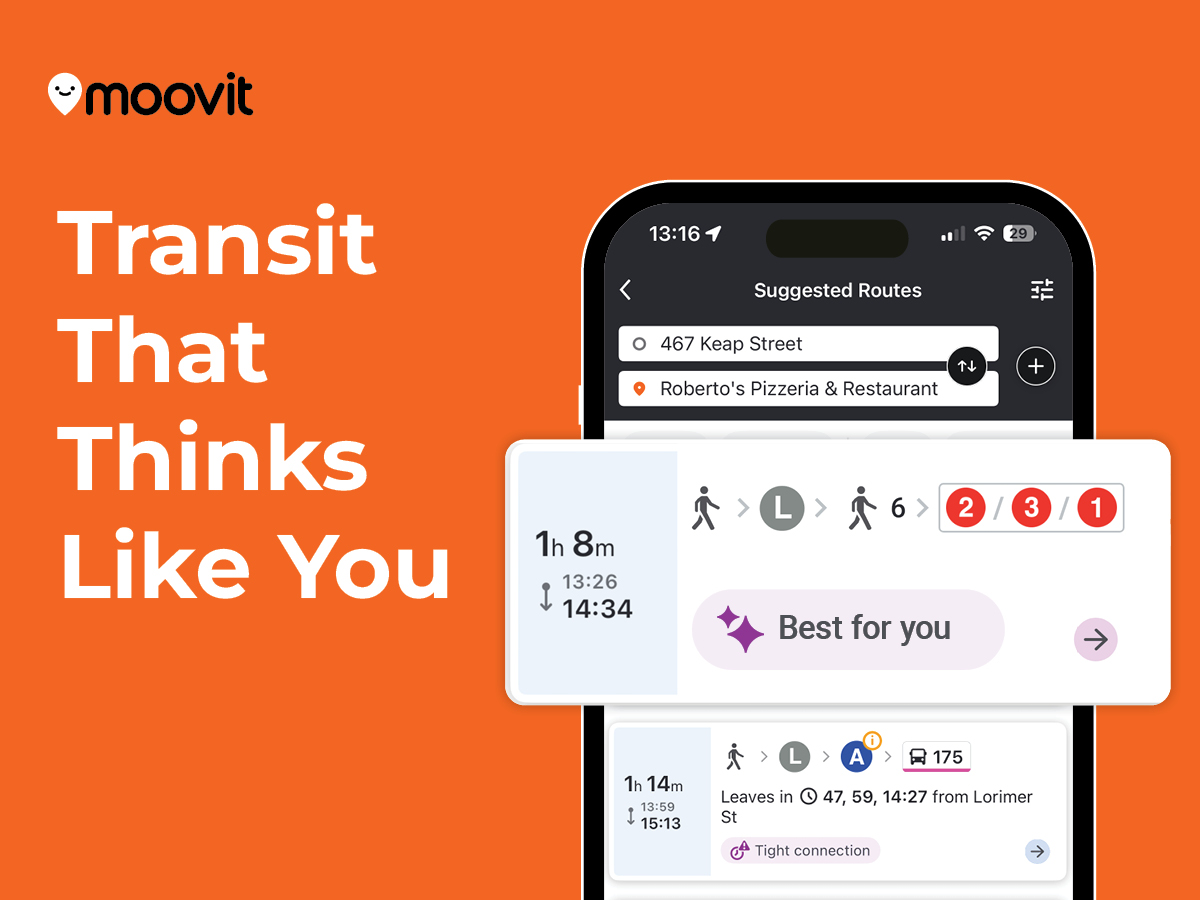
Moovit’s May 2026 AI announcement adds personalized recommendations, weather-aware route insights and warnings about tight transfers. These target recognizable commuter choices: more walking or another connection; a shorter journey or less exposure to rain. Useful advice has to survive those small, specific tests.
The limits are equally specific. Live vehicle locations require accessible real-time data. Ticket purchases require participating services. A volunteer map needs people to maintain it. Moovit can help you choose and understand a journey; the operator still has to run it. At the stop, the question remains beautifully resistant to corporate ambition: when is the bus coming?