Most people leave a memorable pizzeria with an opinion about the crust. Sam D’Amico left with a question about electrical power. He was in Japan for a haptics conference, working in the world of virtual reality, when he watched a wood-fired oven produce his pizza in roughly 30 to 45 seconds. Back home, he wanted that kind of heat in a tabletop appliance. The ordinary wall socket presented a rather dull objection.
He began thinking about infrared lamps, concentrated heat and the limits of a 120-volt plug. A battery could collect electricity while the appliance sat unused, then release it quickly when dinner demanded it. The thought grew past pizza. An oven, a dryer, a water heater: each spent much of its life waiting for someone to need a short burst of work.
D’Amico started Impulse in the summer of 2021. The first product became an installed induction cooktop, a departure from the little pizza oven that had occupied his imagination. Dinner had supplied the question. Building a company required him to choose which part of the kitchen to tackle first.
There is something pleasingly domestic about that origin. The ambition now involves batteries, appliance manufacturers and electricity networks. Its initial customer requirement could have been written on a napkin: make the pizza happen faster.
A battery pack, somewhere in the outback
The battery idea had a history. At Stanford, where D’Amico studied electrical engineering and completed his undergraduate degree in 2012 and a master’s in 2013, he worked on the Solar Car Project. He wrote battery-pack firmware and helped race solar-powered vehicles across Australia. The journey ran from Darwin toward Adelaide, taking a student engineering project into conditions considerably less forgiving than a laboratory bench.
He remembers the experience as stressful and enormously rewarding. A solar car makes the relationship between stored energy, available power and physical performance difficult to ignore. You build the machine, take it outside and discover whether your calculations survive the trip. That education would prove unexpectedly useful in an appliance startup.
Solar-car racing also supplied a connection: D’Amico says he met Impulse’s future CTO in 2010, when they were working with different university teams. Years before there was a cooktop to build, there was a shared understanding of what it took to make electrification work under pressure.
His recommendation to people looking for engineering interns is correspondingly specific: try the solar-car teams. It is easy to see the appeal. Their members have already experienced the awkward moment when software, batteries, mechanical parts and the weather decline to behave as separate departments.
From things you wear to things you cook on
D’Amico’s career then moved through Google Glass, early Oculus, another spell at Google and work at Facebook, now Meta. His projects involved head-mounted displays and, most recently before leaving, the Quest Pro controller. He has pointed out that the controller shipped after his departure. Hardware careers have these long tails: a product can arrive in someone’s hands after its engineer has moved on to a different industry.
The move to stoves sounds like a sharp turn until you look at the work underneath. Sensors have to measure the physical world. Electronics must fit into a constrained object. A person needs to understand the controls. A factory has to assemble it repeatedly. These are familiar problems for someone who has spent years working on consumer electronics.
A kitchen adds its own verdict. People already know what they like, and many like cooking over gas. D’Amico’s approach has been to compete on the experience of cooking: speed, control and the practical business of fitting an appliance into an existing home. The cook must have a reason to change.
That makes him an unusually literal hardware founder. His argument can be put in a pan and heated. The most useful demonstration ends with something a visitor can eat.
A VERY PRACTICAL QUESTION“How crispy do you want your egg?”
Sam D’Amico, during a cooktop demonstration
The stove borrows time
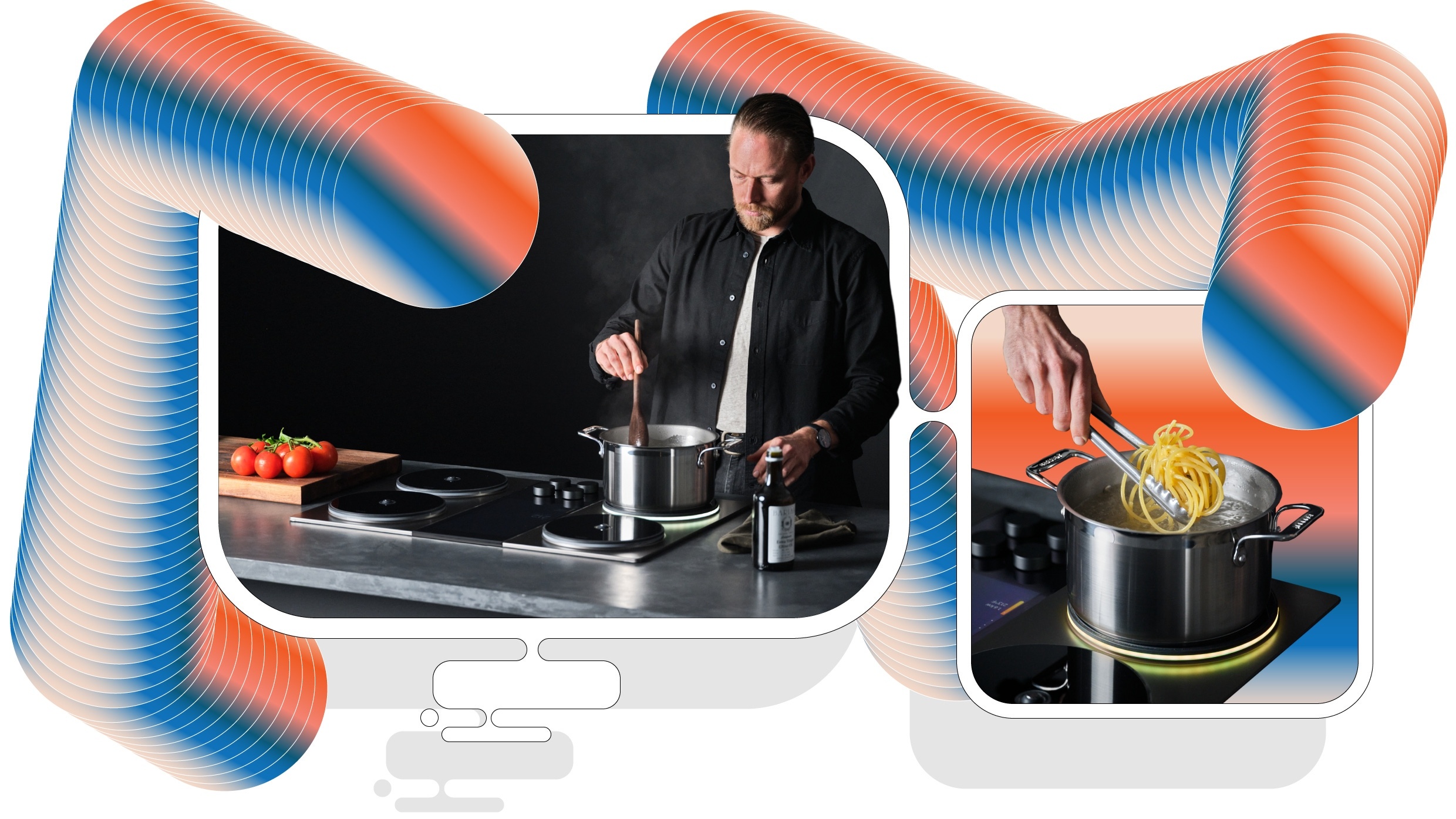
Impulse’s cooktop contains a three-kilowatt-hour battery. The company specifies up to 10 kilowatts of peak power per burner and a sub-40-second boil for a liter of water. It supports 120-volt and 240-volt connections. These numbers describe different things: kilowatt-hours measure stored energy; kilowatts measure the rate at which energy is delivered.
That distinction is the center of D’Amico’s idea. A meal needs a quantity of energy, but it rarely needs maximum power continuously. Bringing water to a boil and holding a gentle simmer make different demands. Storage lets the appliance accumulate energy over time and deliver a brief burst that exceeds what its wall connection alone supplies.
The cooktop also has an answer to the other end of the cooking problem: turning the heat down accurately. Its sensing system measures through the glass and adjusts power to maintain a selected temperature. A high-power burner becomes more useful when it can also be trusted with something delicate.
During a demonstration at the San Francisco headquarters, D’Amico asked a visitor how crispy they wanted their egg. The answer was only mildly crispy. He selected 275 degrees Fahrenheit and produced a fried egg with a runny yolk. After all the talk about power density, this was the result: a small personal preference, expressed as a temperature.
Four years before the first deliveries
The public debut did not make the engineering disappear. Preorders opened in January 2024. In June 2025, Impulse announced that its cooktop had been certified and listed to UL 858 by MET Laboratories. The company said that work had taken 20 months. Combining an electric cooking appliance, a substantial battery and an inverter meant working across systems normally treated separately.
By August 12, 2025, Impulse was announcing customer shipments. Four years had passed since incorporation. The company had developed its induction platform, worked with battery and electronics manufacturers, and built the operating software needed to support the device after installation. People who had placed early orders had waited more than a year and a half.
For D’Amico, this is where the consumer-electronics background becomes especially relevant. The product includes software that can be updated after it reaches a kitchen. Shipping begins a continuing engineering relationship with an installed machine.
There is an irony here. A business inspired by a dinner that took less than a minute needed years to put its first product in customers’ homes. Making the waiting shorter for the cook required accepting a great deal of waiting elsewhere.
The unglamorous education of a shipped machine
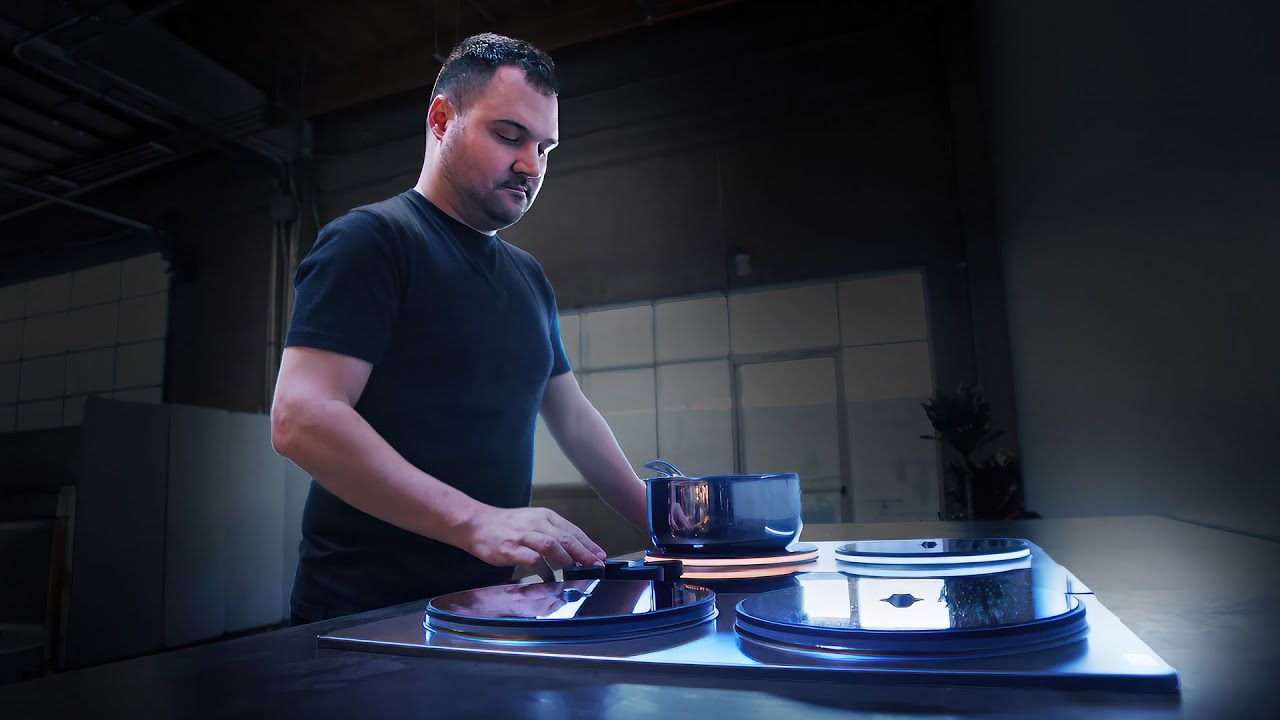
In September 2026, Impulse described three problems uncovered in the field. A display cable could press against a reset button during transportation, leaving a new cooktop with a black screen. The team removed the button from later builds. It is an almost comic failure: an elaborate appliance defeated by a cable touching something it should not.
Certain pans presented another problem. Their magnetic behavior at high power could cause electrical trouble. Impulse changed its firmware to monitor power spikes continuously. Temperature-sensor issues prompted changes to production testing. Each fix involved a different part of the system: physical design, software and manufacturing.
The company reported a 6.71 percent service-call rate for its first 30-inch production run, compared with 1.21 percent for subsequent 30-inch builds. Those are company-reported figures, and service calls are a narrower measure than lifetime durability. Still, the specificity matters. This is the stage when an engineer’s elegant concept meets shipping vibrations and the pans people actually own.
It also changes the founder’s job. Persuading someone to try a new appliance earns you the opportunity to support it. The reset button deserves a place in this story alongside the pizza. One explains why the company began; the other explains the work of keeping it going.
- 2021Impulse begins
- 2024Preorders open
- 2025Customer shipments
- 2026Partner expansion
Other names on the kitchen counter
D’Amico’s next move puts Impulse’s technology inside appliances sold by other companies. Its Impulse Core platform brings together battery storage, power electronics, sensing and software. The premise is practical: an established appliance maker can use that engineering without recreating every subsystem itself.
The partners give the idea several routes into a kitchen. Zephyr has introduced its HyperCore induction cooktop, powered by Impulse. Thor Kitchen is developing ranges using the platform. In April 2026, Impulse announced a partnership with Italy’s BS Service Group for Eximius, a four-zone cooktop with integrated downdraft ventilation, to be manufactured under the Uniqa brand in Fabriano.
That Italian agreement extended the story into Europe. The announcement described European preorders as expected later in the year, followed by plans for the American market. A partnership announcement and a delivered appliance are different milestones; D’Amico has already spent four years learning the distance between them.
The business implication is straightforward. His battery architecture can reach buyers through a name they already recognize. For a founder trying to introduce an unfamiliar technology into a familiar room, the badge on the front need not always carry the whole argument.
A larger ambition, behind the cabinet door
D’Amico ultimately wants batteries distributed through the home’s appliances. In that vision, a stove, an oven, a dryer and a water heater each contribute storage. They could charge when electricity is cheaper or renewable generation is plentiful, then use stored energy when demand rises. Aggregated across homes, the batteries could become useful to the electricity system.
The appeal of this route is that buyers have their own immediate reasons to participate. They need to replace an appliance, remodel a kitchen or get more control over dinner. The energy-storage ambition travels with a household purchase. Whether that develops into a large coordinated network depends on deployment, the products and the programs connecting them.
Away from the specifications, D’Amico describes liking to cook socially and hosting barbecues with friends. His personal website links to an investing venture, Indicator Fund, and his newsletter, Cross Dysfunctional. The engineer who keeps talking about appliances has other interests, but the dinner table remains a useful place to understand this particular one.
A pizza offered him an inconvenient comparison with his own kitchen. He followed the inconvenience through batteries, factories, certification and now other manufacturers’ products. There are grand ways to describe that ambition. D’Amico’s original question remains the more inviting one: could he make something like that at home?