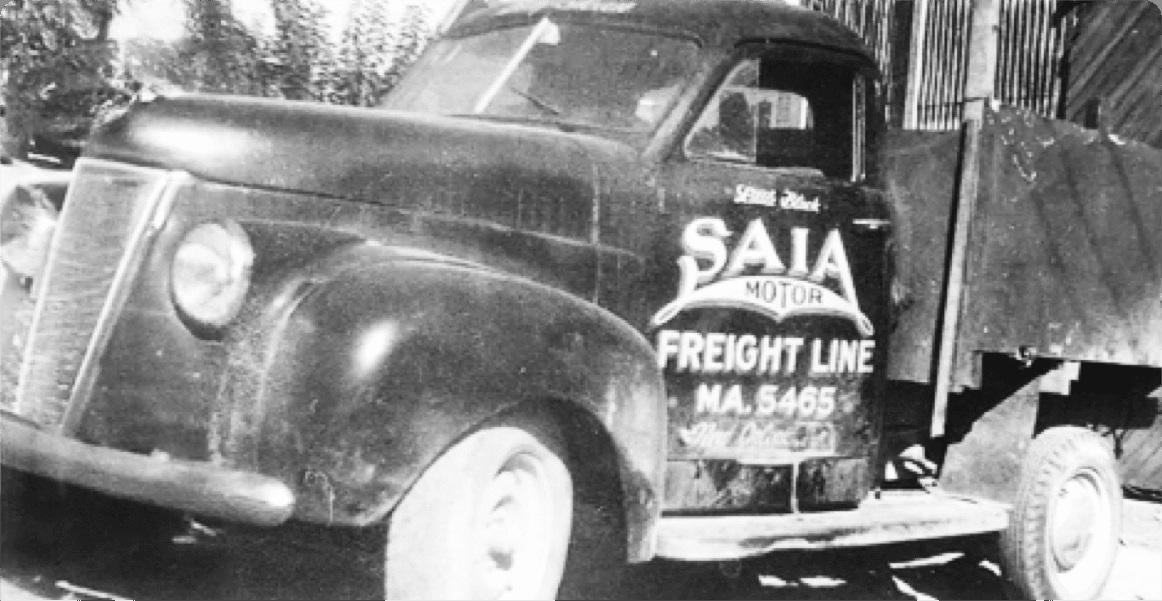
Before Saia had terminals, it had a back seat. Then it removed that, too. In 1924, Louis Saia Sr., a produce dealer in Houma, Louisiana, kept receiving requests from customers: while he was going to New Orleans, could he take their goods along? The family automobile, relieved of its rear seats, became the first truck. Customers had identified a second business hiding inside the first.
- Saia combines smaller business shipments in shared trailers.
- Its 2024 expansion brought direct service to all 48 contiguous states.
- The spending came first; filling the new capacity takes longer.
The back seat was the first warehouse
That origin supplies a useful way to understand the company today. Saia sells a journey to businesses whose goods are too substantial for an ordinary parcel but too modest to justify an entire trailer. The industry calls this less-than-truckload, or LTL. Imagine several businesses splitting the cost of the same vehicle, with a network of terminals doing the sorting.
The cargo might belong to a manufacturer, distributor or retailer. A local store and an enterprise account have different purchasing power, but both need goods to arrive somewhere specific. Saia’s customers are buying transportation and coordination: pickup, consolidation, movement between terminals and delivery. An empty shelf does not care how handsome the truck looked on the highway.
A billion dollars buys a different map
In January 2024, Saia bought 17 freight terminals from bankrupt rival Yellow for $235.7 million. It separately acquired interests in 11 terminal leases for $7.9 million, plus certain liabilities and cure costs. These were physical locations in places where freight could enter, leave or move through the network. Their usefulness depended on where they sat.
Over the year, Saia opened 21 terminals and relocated nine. It finished its centennial year with 214 terminals and direct coverage across the 48 contiguous states. Net capital expenditures reached $1.0409 billion, compared with $437.2 million in 2023. Buildings were part of the bill; equipment and technology also needed to follow the expanding map.
Annual net capital expenditure, USD. The 2024 total includes the Yellow property purchases.
Here is the commercial logic. A customer already using Saia in one market may also need deliveries in another. Add the second location and the carrier can sell another route to an existing account. A national footprint broadens the conversation before anyone has to find a wholly new customer. The truck is local; the purchasing relationship can travel.
That helps position Saia against established LTL alternatives such as Old Dominion, XPO, FedEx Freight, Estes and ABF. National coverage gets it considered for more work. The sale still depends on the particular lane, price and service requirement. A larger map earns an invitation to compete, rather than a universal right to win.
The bill arrives before the freight
A terminal is an awkward asset. It requires people and equipment before its business is mature. Saia’s second-quarter 2025 revenue slipped 0.7%, while operating income fell 27.8%. Its quarterly filing attributed the income decline to lower revenue and higher labor and depreciation expenses associated with network expansion. The first visible strain was in the economics.
Management’s July 2025 discussion offered a more revealing comparison. Facilities opened less than three years earlier had moved from breakeven in the first quarter to an operating ratio in the mid-90s in the second. That means expenses still consumed roughly ninety-something cents of each revenue dollar. New markets were improving, but they had not become mature profit engines overnight.
For all of 2025, revenue rose 0.8% to $3.234 billion, while operating income fell 27% to $352.2 million. Management adjusted costs to softer volume rather than abandoning the national strategy. A network can be strategically useful and financially uncomfortable at the same time. Concrete rarely accepts an argument about long-term potential in lieu of payment.
One name for the whole journey
In January 2026, LinkEx, Saia’s logistics arm, began operating as Saia Logistics. The explanation was practical: customers should understand that the carrier also offers truckload, expedited transportation, warehousing, distribution, final-mile and international services. The separate name had become less helpful than the shared relationship.
“For our customers and our teams, this is really about clarity and connection.”David Miller, Saia Logistics, January 2026
June brought REV, short for Rapid, Expanded and Visible. Saia announced more than 2,000 transit-time improvements, enhanced guaranteed services, better shipment visibility and expanded final-mile capabilities, including room-of-choice and two-person delivery. These are company-announced improvements; a shipper still needs to check which options apply to the shipment at hand.
The business underneath remains freight-heavy. Approximately 97% of revenue comes from LTL transportation. Expertise here means assembling loads, managing transfers, matching capacity to demand and handling freight without making the customer chase it. Software supports those decisions; drivers and dock workers perform them.
Borrow the question, not the cheque
The copyable lesson is to ask where existing customers need you next. Then track the new locations separately, so a flattering company-wide number cannot conceal expensive unused capacity. This is an interpretation of Saia’s expansion, not a guarantee that spending on geography creates demand.
It works poorly when recurring shipments are scarce, capital is tight or service deteriorates during expansion. For shippers, LTL itself has limits: a full trailer or a shipment requiring unusual urgency may call for another service. Compare the actual route, delivery commitment and complete quote, including surcharges and extra handling, before choosing a carrier.
By the second quarter of 2026, Saia reported $956.5 million in revenue, up 17.1%, and operating income up 26%. Its September update showed August tonnage per workday up 8.7%, while shipments rose 1.1%. More freight was moving through the system. The question Louis Saia’s customers asked a century earlier remains a useful one: since you are going there, could you take this?