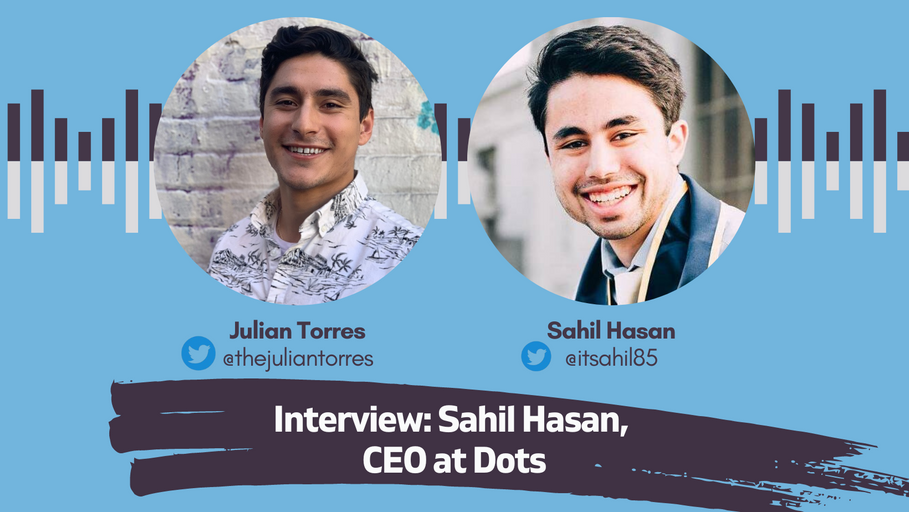
Mid-Stride in the Payout Economy
There is a specific problem that Sahil Hasan can describe in under ten seconds: most payment innovation - Stripe, Square, Adyen - is built for the company receiving money. Nobody bothered to build the other side. Gig platforms, creator marketplaces, freelancer networks - every one of them is stuck bolting together ACH transfers, PayPal webhooks, and manual W-9 collection like it's 2009. Sahil built Dots to end that.
Today, Dots moves $150M per month to over a million gig workers, creators, and contractors across 190+ countries. It does this through a single API. The company has 15 people and is profitable. When you do the math, that's roughly $10M in monthly volume per employee - a number that makes traditional enterprise fintech teams wince.
The $8.9M Series A in February 2026, led by DCM Ventures, was not a survival round. It was the moment Dots decided to accelerate what was already working. Ibrahim AlSuwaidi from DCM joined the board. The press release was tidy. The signal was clear: this is infrastructure, and infrastructure compounds.
Before the API, There Was an Atomic Clock
Sahil did not arrive at fintech through banking or finance. He came through precision engineering. After completing a Regents scholarship at UC Berkeley in EECS, then a master's in computer science at Carnegie Mellon, he joined Google X - the moonshot factory where projects are designed to be failures unless they're extraordinary.
His work there involved building tightly synchronous, scalable computer architecture for data centers. The specific challenge: coordinating relative time across distributed machines without touching atomic clocks. This is the kind of problem where being off by microseconds breaks everything. It rewired how he thinks about systems - not as abstractions, but as precise, failure-intolerant infrastructure where every edge case matters.
Google X Research
Worked on distributed computer architecture that required precise synchronization across data centers without atomic clock dependencies - an early lesson in building systems where failure is not an option.
Also worked at Google Research on AI projects alongside Kartikye Mittal, who would become his co-founder at Dots.
His co-founder, Kartikye Mittal, is a Stanford CS graduate who came through the same Google ecosystem. They were not strangers when they started Dots in May 2021 - they had already seen each other's work in high-stakes environments. That matters. Fintech infrastructure is not a solo project. You need someone who knows what breaking production actually costs.
The 20-Cent Idea That Became a $12M Company
Dots was not always about B2B payout infrastructure. The original concept was about micropayments for content. The pitch: instead of $15/month for the Wall Street Journal, you pay 20 cents to read a single article. A frictionless wallet for content creators. The problem was self-evident; the market was not.
What emerged from that exploration was a more durable insight. The friction was not on the reading side - it was on the paying side. Getting money to people, especially many people, at scale, across currencies, with tax compliance baked in - that was genuinely broken. And it was broken for everyone: marketplaces paying sellers, gig platforms paying drivers, eSports running tournament payouts, expert networks paying advisors.
So they pivoted to the infrastructure layer. Y Combinator backed them in Summer 2021. The rest has been execution.
"Everyone talks about the future of payments, but most of that innovation has focused on companies receiving payment, not paying others."- Sahil Hasan, CEO, Dots
What Dots Actually Does
The short version: Dots is a developer-friendly API that lets any platform send money to any payee anywhere, automatically. The long version involves 300+ payment rails - ACH, PayPal, Venmo, Cash App, Zelle, mobile money, digital wallets, and stablecoins - plus automated KYC, IRS TIN verification, real-time fraud detection, and year-end 1099 e-filing. All wrapped in one integration.
For a marketplace paying 50,000 independent sellers, what previously required a treasury team, a compliance team, and multiple vendor contracts now requires a single API call and a monthly subscription starting at $19. The routing logic selects the fastest, most cost-effective payment method per transaction automatically. The compliance layer handles the W-9s and W-8BENs digitally. The tax automation files the 1099s at year-end without a human touching them.
The use cases stretch wider than gig economy clichés. Dots handles eSports tournament payouts, music royalty distributions, class action settlements, telehealth platform payments, and accounts payable for companies that need to move money to large contractor networks. The common thread: someone has to pay a lot of people, and they need it to work everywhere, compliantly, on the first try.
2026 Product Updates
Self-Service Integration - New model enabling customers to onboard and customize without heavy engineering support.
Anti-Fraud Features - Recipient flagging, suspicious payment identification, and automated custom rules engine.
Vision Ahead - Expanding into credit card processing, full accounts payable/receivable, and deeper international coverage.
The Dots Stack: Lean by Design
Fifteen people. One hundred fifty million dollars a month. The math implies serious infrastructure leverage, and that's intentional. Dots is built on React and Python, runs on AWS, and uses GitHub, Linear, and Notion for internal operations - a modern, boring stack that stays out of the way of the product work. The engineering decisions prioritize reliability over novelty, which is exactly correct for financial infrastructure.
Sahil's Twitter handle, @itsahil85, is a remnant of a 2014 account he hasn't changed. He describes himself there as "Co-founder and CEO of @dots_dev (YC S21)" - four words of bio for a company processing a billion dollars. The personality matches the product: no theatrical branding, maximum substance.
His personal site, shasan.me, is similarly understated. The GitHub profile lists him as "Cofounder and CEO of Dots." For someone building the financial layer beneath creator economy platforms used by millions, the public-facing modesty is almost conspicuous.
The Market They're Running Into
The global payout market is projected to triple by 2033. The gig economy alone moves over $582 billion in payments annually. Platforms that once duct-taped payout solutions together are now looking for dedicated infrastructure - the same way they once moved off custom auth toward Auth0 and off custom payments toward Stripe.
Dots is betting that the payout infrastructure layer consolidates the same way inbound payments did. One API. One compliance layer. One tax reporting system. And because they're already profitable and growing 400% year-over-year with 15 people, the bet is looking credible. The Series A from DCM is capital to go faster on what already works - not capital to find out if something works.
Sahil's stated ambition is to expand Dots from payouts into a full financial operating system for platforms - credit card processing, accounts payable, accounts receivable, the whole stack. The atomic clock problem at Google X was about coordinating precision across distributed systems under constraints. Dots is the same problem, different domain: coordinate precision financial flows, globally, under regulatory constraints, at scale. The training fits.
"We started with an idea about micro-transactions for content. That evolved into a frictionless wallet for content creators, and then into what Dots is today."- Sahil Hasan, Creator Kit Podcast
What's Next
The February 2026 Series A filing was accompanied by two product announcements that preview the direction: self-service onboarding (bringing the time-to-integration down for smaller platforms) and an anti-fraud layer with automated rules (addressing the second-biggest complaint after compliance in the payout space). Both are moves that extend the market without changing the core product.
The longer horizon involves going after the full financial stack for marketplace businesses. Inbound + outbound. The same company that collects marketplace fees would also pay the sellers through Dots. That's the competitive surface area that turns a payout API into a platform - and platforms, unlike APIs, tend to be stickier than their competitors would prefer.
Sahil Hasan is 15 employees and a Series A into a problem that affects every platform business in the world. At $150M/month and growing 400% annually, the company is already large enough that its silence in the market is notable. The next move, presumably, is noise - the kind made by infrastructure that becomes too load-bearing to ignore.