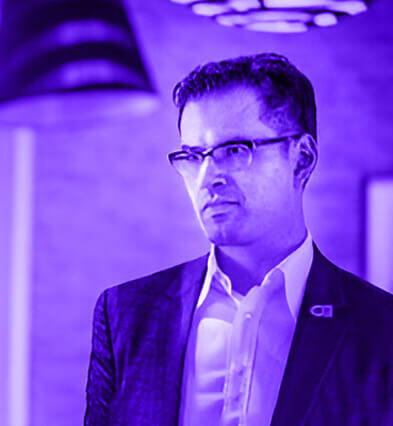
Farming Radish in Japan, Then Fighting the Pentagon's Cyber Threats
Before Sage Wohns was running a company that won the U.S. Department of Defense's first-ever generative AI contract, he was farming radish in rural Hokkaido, Japan. Not as a gap-year metaphor. As a thing he actually did - hands in the dirt, miles from anything resembling a pitch deck - before returning to New York to build what became one of the more consequential AI companies of the decade.
That detail says something about how Wohns operates. Not everything needs to be linear. Not every step is a step toward the next funding round. The cellist who learned Japanese while leading multilingual engineering at Rakuten in Tokyo, the self-described "proud nerd" who built a Google- and Microsoft-backed NLP company from scratch, and the CEO who taught the Air Force how to defend against AI-powered phishing attacks are all the same person - and none of those phases were accidents.
Jericho Security, the company Wohns co-founded in 2023 alongside Tim Hwang (who built FiscalNote into a billion-dollar SaaS company) and Dan Chyan (a decade-deep cybersecurity professional and Princeton grad), is now the defining AI-vs.-AI cybersecurity training platform for enterprise and government. It trains people - and AI systems - to recognize and resist hyper-realistic phishing attacks, voice clones, and deepfakes crafted by adversarial AI. Its premise is almost uncomfortably simple: the attackers are already using AI. The defenders aren't. Jericho Security is fixing that gap.
Within minutes, a sophisticated attacker can now create a voice clone that sounds exactly like your CFO requesting an urgent wire transfer.
Sage Wohns - Jericho SecurityThe Attackers Got Smarter. The Training Didn't.
Phishing attacks account for more than 80% of reported security incidents. Roughly 90% of data breaches trace back to phishing. Those numbers existed before ChatGPT. Since generative AI became widely available, spear phishing attacks have increased 800%. Global cybercrime costs are projected to climb from $8.4 trillion to $23.75 trillion within five years. In 2025 alone, deepfake fraud cost businesses an estimated $200 million.
The old training model - a quarterly click-the-phishing-link test with a scolding email afterward - was never great. Against AI-generated attacks personalized to each target using scraped LinkedIn data, corporate org charts, and voice clones of known colleagues, it's essentially useless.
Wohns explains the asymmetry plainly: attackers are running AI red teams. Defenders are showing employees 2019-era slides about not clicking suspicious links. Jericho Security exists to close that gap by putting equally sophisticated AI on the defense side - and making sure the humans in the loop are trained by the same threats they'll actually face.
The platform delivers hyper-realistic, personalized phishing simulations. It runs multi-channel attack scenarios across email, SMS, and social engineering. It provides deepfake detection integrated directly inside Microsoft Teams - flagging calls before a wire transfer can be authorized. It builds training from a company's actual internal policies, which Jericho Security found reduces real security incidents by 40%. And it ships security performance KPIs so organizations can track not just compliance, but culture.
The Pentagon's First-Ever Generative AI Contract
In December 2023 - fewer than six months after Jericho Security was founded - the U.S. Department of Defense awarded the company a $1.8 million STTR Phase II contract through AFWERX. It was the first-ever generative AI defense contract from the Pentagon. The client: the Department of the Air Force. The mission: developing advanced AI-powered cybersecurity solutions for military personnel against sophisticated AI phishing attacks. Military-grade encryption. Regulatory compliance. A five-month execution. Delivered.
A Decade Building AI Before AI Was the Story
Wohns isn't new to this. He spent roughly a decade as the CEO of Agolo, a natural language processing company he co-founded that specialized in AI-powered summarization for finance and news organizations. Agolo was backed by Google and Microsoft and won Citi's Top Business Intelligence Tool prize. It was the kind of company that quietly powered infrastructure decisions at firms that would never publicly say "we use AI" - back when that admission felt speculative rather than table stakes.
The through-line from Agolo to Jericho Security is straight: Wohns has been building commercial AI products for over a decade, watching the technology move from novelty to necessity to threat vector. When generative AI made it trivially easy to craft personalized, convincing attacks at scale, he recognized the moment as an inflection point - and moved toward it rather than away.
Before Agolo, there was Rakuten in Tokyo, where Wohns led multilingual engineering for the company's international development group, building software and pioneering global strategy initiatives. The Hokkaido radish farm came somewhere in that stretch. Then NYC Seed, where he served as an accelerator and venture associate, developing a feel for what early-stage companies need and where they break.
He holds a B.A. from the University of Chicago and an MBA in Entrepreneurship from Columbia Business School (Class of 2012) - credentials that are notably less interesting than the résumé surrounding them.
The Arc
$18M and a Pentagon Badge
Jericho Security's funding story is short and fast. A $3M pre-seed in 2023 to build the product and land the first clients. Eighteen months later, a $15M Series A led by Era Fund (Jasper Lau, CEO), with participation from Lux Capital, Plug & Play, Metalab, Gaingels, Distique, Fog, Textbook, KBTG, and others. Wilson Sonsini handled legal advisory. Total: $18M across 22 investors.
The capital goes toward hiring cybersecurity talent, expanding R&D on the agentic AI platform, and scaling go-to-market. The 30+ enterprise clients the company acquired in its first year were proof of demand. The Series A is the machinery to meet it.
Humans and AI, Co-Evolving
Wohns's framework for Jericho Security isn't just a product pitch - it's a thesis about how the next phase of AI development plays out in security contexts. The phrase he returns to is: "We train people to train systems. Humans and AI, co-evolving."
The idea is that neither humans nor AI systems can keep pace with adversarial AI on their own. Humans lack the speed and pattern recognition at scale. AI systems lack the contextual judgment and social awareness that good security decisions require. Together - with humans training AI on what good looks like, and AI training humans on what attacks look like - there's a feedback loop that can actually keep pace with the threat landscape.
Jericho Security operationalizes this with what it calls AI red teams and blue teams. The red team generates attacks - personalized, realistic, multi-channel. The blue team defends, adapts, and feeds what it learns back into the red team's next generation of simulations. The loop tightens with each cycle. The humans in the middle get harder to fool and more aware of what "sophisticated" actually looks like today, not in 2019.
This philosophy extends to leadership. Wohns has written about wartime CEOs - leaders who operate effectively under sustained pressure and resource constraints. His Inc.com pieces, including "7 Things That Make a Great Wartime CEO" and "Your Founder Role Model is... James Bond," reveal a leader who thinks about preparedness as infrastructure, not personality. The argument: wartime CEOs are made through deliberate practice, not born into a disposition. Which is, conveniently, exactly what Jericho Security is selling to the enterprise market.
By pitting these two teams against each other, we can create a feedback loop that can help us adapt to the changing landscape of AI and stay ahead of the curve.
Sage Wohns - on AI red teams vs. blue teamsRSA 2025 and the Robotics Pivot
At RSA Conference 2025, Jericho Security won four Global InfoSec Awards from Cyber Defense Magazine - recognition for innovation in AI-driven cybersecurity and anti-phishing solutions. The company also launched three new capabilities at the conference: a self-service agentic AI platform for enterprise security teams, real-time deepfake detection built directly inside Microsoft Teams, and the launch of Jericho Robotics - a new division taking the company's AI security framework into physical security contexts.
The deepfake detection in Teams is particularly pointed. One of the cases Wohns references regularly is a Singapore finance executive who was deceived by AI-generated deepfakes of company leadership into authorizing a $500,000 transfer. The attack happened in a video call that looked exactly like a legitimate company meeting. Jericho's real-time detection runs during the call - before the transfer happens, not after.
The robotics division signals an ambition that goes beyond the software training market. Physical AI security - securing systems where AI models interface with the physical world - is the next frontier, and Jericho Security is making an early bet on being there when it matters.
"Wartime CEOs are made, not born, and here's how you can become the leader your company needs when times get tough."
"Your Founder Role Model is... James Bond" - on preparedness and resourcefulness as the core of great leadership.
"The teams that figure this out early will run circles, at a fraction of the cost, around the ones that don't."
"We train people to train systems. Humans and AI, co-evolving."
The Record
- Won the Pentagon's first-ever generative AI defense contract (December 2023) via AFWERX - $1.8M STTR Phase II for the Department of the Air Force
- Raised $18M total funding for Jericho Security, including $15M Series A in April 2025 led by Era Fund and Lux Capital
- Built Agolo into a Google- and Microsoft-backed NLP company; won Citi's Top Business Intelligence Tool prize
- Grew Jericho Security to 30+ enterprise clients in the first year of operation
- Won 4 Global InfoSec Awards at RSA Conference 2025
- Launched real-time deepfake detection inside Microsoft Teams
- Achieved 40% reduction in security incidents for clients using policy-based AI training
- Launched Jericho Robotics to expand into physical AI security - a new category entirely
Fun Facts
Accomplished cellist. The discipline required to play well translates, apparently, to building AI defense systems under pressure.
Avid mountaineer. When he's not outmaneuvering AI attackers, he's climbing things most people photograph from below.
Spent time farming radish in rural Hokkaido, Japan. Between a Tokyo engineering role and New York startup life.
Fluent in Japanese. Developed during his years at Rakuten in Tokyo and the Hokkaido farming detour.
Self-described "proud nerd." Seattle native who built his career between Tokyo and New York.
His company won a Pentagon contract when it was less than six months old. Not a typical milestone for a pre-revenue startup.