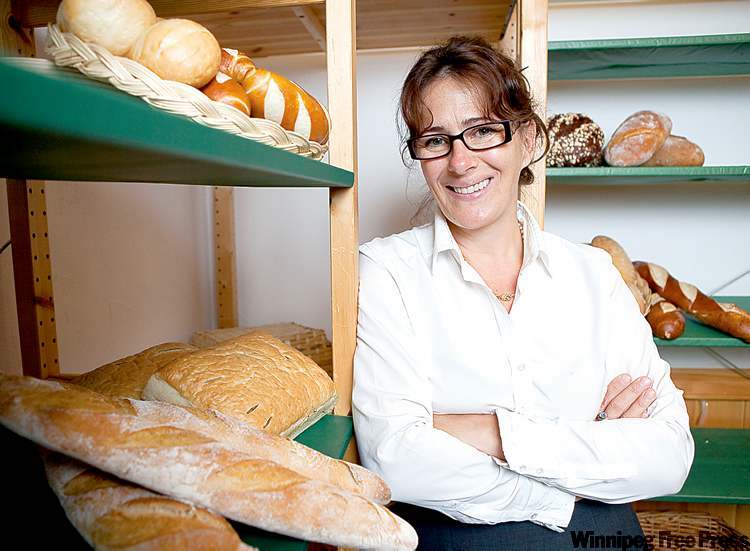
Sabine Veit’s family knew how to bake bread. What she had to discover was how far it could travel. In Canada, the European bakery tradition she carried with her eventually acquired a decidedly practical companion: a freezer. The combination took her business beyond the early-morning delivery route and into a market stretching across North America.
There is a temptation to make a family business sound inevitable. A grandfather bakes, a father bakes, a daughter opens a bakery. The verbs line up so neatly that the decisions disappear. Veit’s career is more interesting when those decisions remain visible. She changed the format of the product, narrowed the range, developed a manufacturing business, and eventually sold it. An inheritance provided her starting material. She still had to decide what to make of it.
A family business, with an ocean in between
Her grandfather Albert’s German bakery brought the shop, bakehouse and family living quarters together. The working day ran through the night, with fresh goods delivered in the morning. Veit grew up with that relationship between making something and getting it to the person who would eat it. Bread had a family history long before it had a Canadian business plan.
She came to Canada at 16. Opening a bakery was not her original intention. When she eventually started one, her father helped her get it going. In 1987, she established Bäckerhaus Veit, beginning with retail bakeries and a small manufacturing operation. The fresh-delivery business supplied European breads, cakes and pastries to local retailers.
The Canadian venture required its own commercial answers. A recipe can survive a journey more easily than the assumptions surrounding it. The market, customers and distances change. Veit’s early business gave her a way into that market, but the operation she would lead for more than three decades would develop well beyond those first shops.
The freezer changes the map
By 1993, Veit was moving into par-baked frozen bread. The practical attraction was shelf life: fresh delivery limited the business’s room to grow. Par-baking meant bread could be partially baked, frozen and finished later. The last stage could happen closer to the customer’s moment of need, rather than being dictated entirely by the supplier’s oven.
That changed what the bakery could offer a retailer or restaurant. The product came with a different timetable. A business buying bread had to think about the interval between delivery and sale; a business making it had to think about how much geography that interval allowed. The freezer belonged in the answer to both questions.
The change was substantial enough that, by 1995, Veit was discussing par-baked and pre-proofed products at an industry symposium in San Jose. She addressed the usefulness of baking frequently in small batches. The argument concerned the customer’s operation as much as the loaf itself: when to bake, how much to bake, and how to have something ready when people wanted it.
- 01Partially bakeBegin at the bakery
- 02Freeze & deliverGive the journey time
- 03Finish bakingCloser to service
Her product range became more focused too. Cakes and pastries left the business as bread and rolls became its centre. There is a small act of discipline in deciding that an oven’s versatility does not require its owner to sell everything it can produce. A good bakery can be full of possibilities. A workable business needs a selection.
A rabbit-shaped argument for flexibility
Focus still left room for play. Bäckerhaus Veit made ciabatta shaped like a rabbit for Easter, as well as custom shapes for customers. Bread could be round, oval or rectangular; height, weight and cut could change. The bunny had a serious commercial point underneath its ears: a manufacturer could offer customers something particular.
“Our strengths are flexibility and product innovation,” Veit said. The bakery combined handmade work with mechanised production. Her family’s approach to equipment began with the dough and asked the machinery to accommodate it. That principle made craft a consideration in how the factory worked, rather than merely a word on the packaging.
A customer buying a distinctive sandwich bun is making a choice about the finished sandwich as well as its bread. Shape determines how it looks. Size affects the portion. A change in ingredients alters what the customer can offer. Veit’s business dealt in these specific decisions, where a baker’s knowledge meets someone else’s menu.
“Our strengths are flexibility and product innovation.”
Sabine Veit
The invitation to ask Sabine
By 2013, customers could find a direct invitation on the company’s refreshed website: Ask Sabine. The site served business buyers, brokers and sales staff, with product information, recipes and a route to the president. For a manufacturing business, it was a pleasantly human name for a line of communication.
“I think it’s extremely important to stay in contact with our customers,” she said. The invitation gave that intention a practical address on the website. Visitors were being encouraged to bring their questions to the person whose surname was on the company.
The business also worked as a private-label manufacturer, producing for customers whose own identities would appear on the goods. Veit’s account of the operation emphasised responsiveness and a management and production team that included people with more than 20 years at the company. That accumulated knowledge mattered when a customer needed a particular result.
Recognition arrived along the way. Her career biography records an Ernst & Young Entrepreneur of the Year finalist place in 2010 and an earlier regional finalist place in the Canadian Women Entrepreneur of the Year awards. Those distinctions sit alongside the less ceremonial achievement of keeping an operation developing over decades: customers, people, products and investment, repeatedly brought into alignment.
The owner’s next decision
In 2018, Veit sold Bäckerhaus Veit to Swander Pace Capital. By then, the Mississauga business supplied European-style breads, rolls, buns and soft pretzels to retail and foodservice customers across North America. She described the buyer as a partner for the next phase, with further distribution among the opportunities ahead.
The sale followed more than 30 years of leadership. It also separated two questions that can become entangled for a founder: what the company needs next, and what its owner wants to do next. A growing manufacturing operation keeps asking for resources. Experience does not make those requests disappear.
Establish the Canadian bakery.
Move into par-baked frozen production.
Sell to Swander Pace Capital.
Veit later discussed the transaction with Mario Nigro on the podcast Views from the Market. She spoke about a business whose growth required capital and the importance of specialist advisors when entering the unfamiliar territory of a sale. Building the company had given her one body of experience. The transaction required another.
That is an appealing detail in a founder’s story. After decades in charge, she still had an occasion to be the person learning how something worked. Selling before retirement also left her time for another venture. The business could continue its development while its founder found a different use for her attention.
A different kind of growing
Veit has owned Hirondelle Estate since 2018. The 200-acre Ontario property lies east of Guelph, with fields, trees and restored buildings. Its name refers to the barn swallow, and the land includes habitat for the birds. Her interests in conservation and regenerative farming have a physical setting here.
In December 2023, local council approved rezoning for seasonal special events, subject to further conditions before a venue could operate. The permission contemplated up to 75 guests, with events between May and October. Farming would remain the principal use. Book readings, professional gatherings and celebrations were among the possibilities for a former barn.
The estate’s agricultural work includes crops such as buckwheat, rye and garlic. Woodlands, wetlands and the Eramosa River also belong to the property. Those uses make the setting more than a backdrop for gatherings. Any plans for visitors have to fit around a place that already has things growing, water moving and animals living on it.
The details keep this second chapter from dissolving into a postcard. There are limits on frequency, guests and parking. There are neighbours and planning requirements. Welcoming people onto agricultural land takes its own kind of organisation. A pleasing landscape does not exempt an owner from the practical business of arranging access to it.
Two residents with no interest in the balance sheet
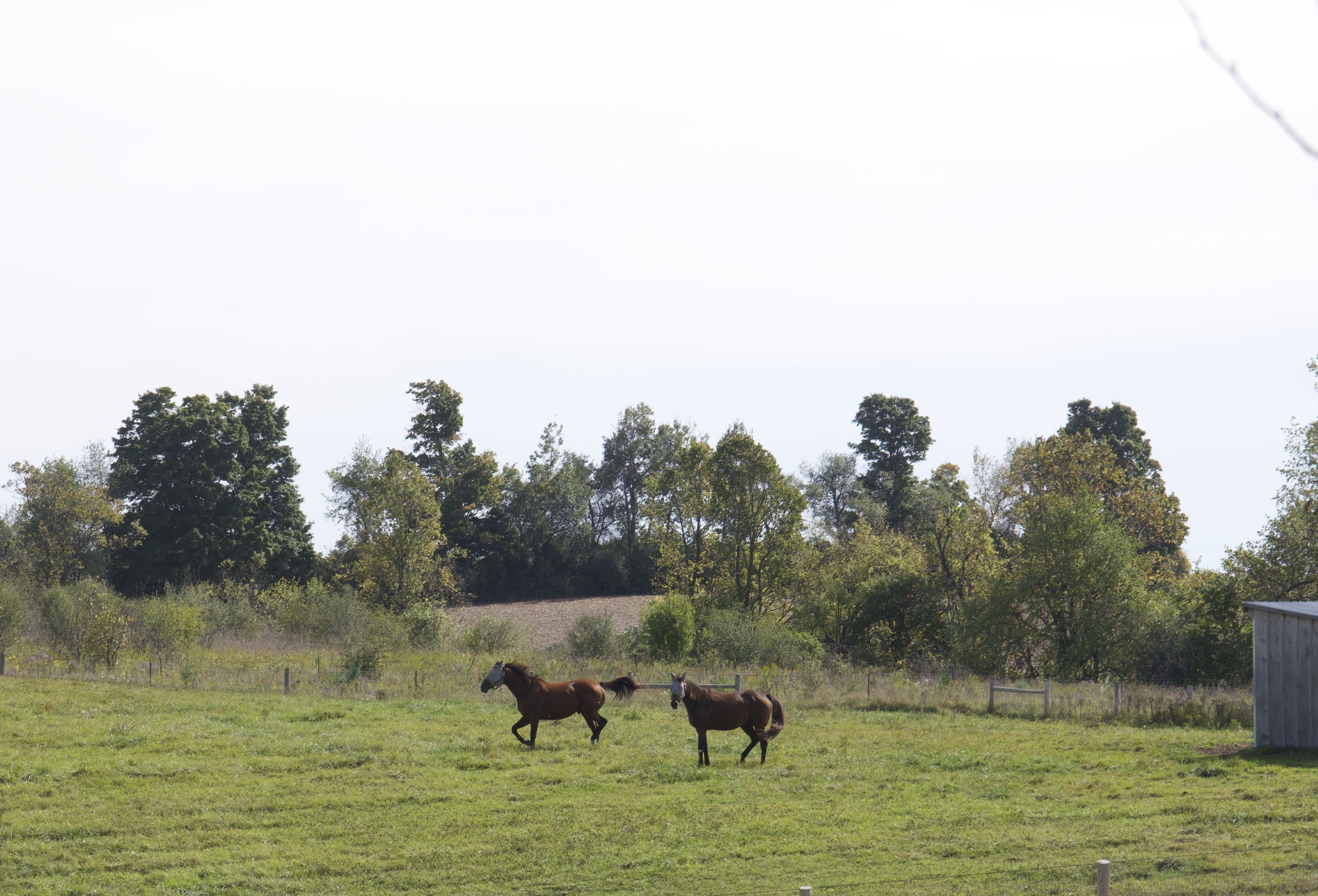
In spring 2024, two retired racehorses joined the estate through LongRun Thoroughbred Retirement Society. Their racing names were Cat’s Whisper and Low in the Forest. At Hirondelle, they are Rocky and Hulk. Veit visited LongRun after a friend suggested the organisation, and the pair came home with her.
They brought distinct personalities. Veit described Rocky as gentle and appreciative of attention. “Hulk is the boss,” she said. Both enjoyed being brushed. The particulars are endearing because they are so ordinary: after years of production decisions and distribution plans, here are two animals with preferences of their own.
Her aim for the property brings its different inhabitants into the same picture: family, visitors, crops and wildlife. That wish gives a different scale to the question running through her working life. What belongs here? What should change so that it can continue? At the bakery, the answers shaped a business. At Hirondelle, they help shape how a piece of land is used.
Veit’s story makes room for both the inheritance and the departure. She kept the bread tradition while changing its route to market. She sold the company after spending decades building it. Now a property named for a bird has her attention. There is work in deciding what to preserve, and freedom in knowing when to begin something else.