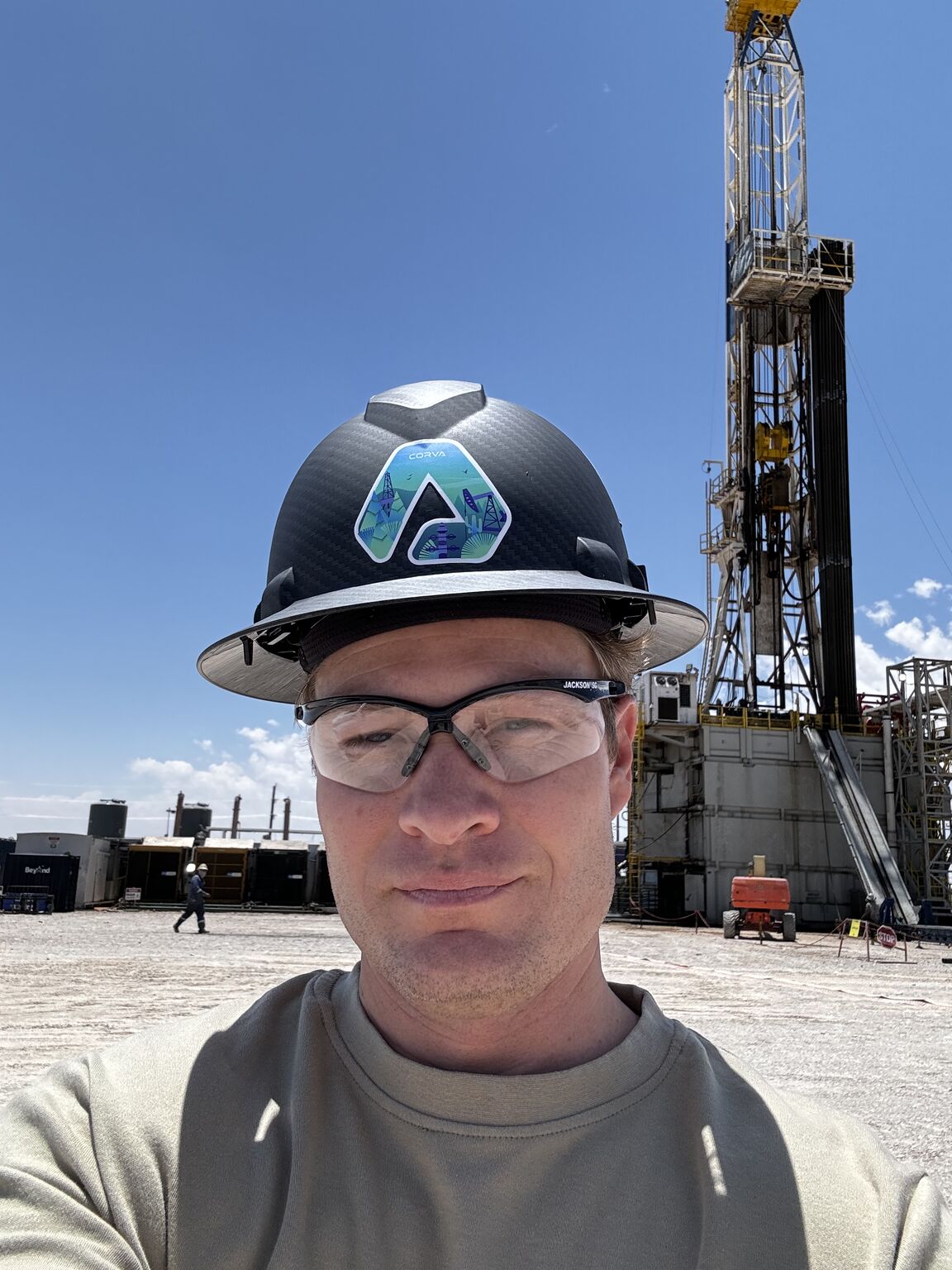
Ryan Dawson took a selfie at a drilling rig. Behind him stood the machinery; above him, a blue sky. He wore protective glasses and a hard hat carrying a Corva sticker. The photograph, shared during a 2024 visit to rigs using his company’s predictive drilling technology, puts a useful face on an abstract business. Someone has to leave the software conversation and go see where the software works.
Dawson arrived in oil and gas with a background in consumer technology. That makes the picture more interesting. His professional past included a product design business serving companies whose software people encountered in everyday life. Now his attention was on equipment turning below the ground, and on whether information could help a crew make a better decision while the work was happening.
The connection between those worlds is the person looking at the screen. An application can contain an impressive calculation and still be an irritation. It can display a great deal of information while leaving its user with the same unanswered question. What, exactly, should I pay attention to now?
A consumer-software education
Before Corva, Dawson co-founded thirteen23, a product design incubator whose customers included Netflix, Microsoft and Twitter. Its work also included mobile strategy for the Obama campaign. His earlier business placed him close to the craft of making technology legible: arranging complicated capabilities so that someone could understand them, choose them and return to them.
He spent 15 years working on projects in Austin before entering the oil and gas industry. The opportunity he saw was a drilling analytics platform that people could use through the cloud. A different industry supplied a different set of problems, but the interest in the user travelled with him.
By 2019, Dawson was talking about adoption in unusually human terms for a business involving drilling data. Corva watched which applications people used, listened to their reactions and backed the software with experienced drilling specialists. An early enthusiast inside a customer’s organization could help colleagues learn the system. Purchasing software and making it part of a working day were separate accomplishments.
“Customers come up with the best ideas,” Dawson said. The sentence leaves the founder in a useful position: close enough to hear the answer, and willing to receive it. A product team can admire its own dashboard indefinitely. A customer with a well to drill has a shorter appointment available.
“Customers come up with the best ideas.”
Ryan Dawson, 2019
There is a practical modesty in that approach. The software builder brings a skill the customer needs; the customer understands circumstances the builder has to learn. The relationship works when information travels in both directions. The polished interface is only the visible part of that exchange.
The engineer gets an app store
Dawson’s impatience became explicit in 2020. He argued that the oilfield’s way of developing technology was moving too slowly. Mechanical expertise did not automatically supply expertise in software. Guarded data and fragile partnerships made cooperation harder. He wanted established equipment businesses and digital startups to combine what each knew.
That argument gave his outsider’s background a purpose beyond fresh presentation. The industry already contained people who understood wells, tools and operating conditions. Software specialists understood another part of the job. Bringing them together required more than hiring both groups and hoping the office seating plan would do the rest.
In 2021, he made a related case for engineers building their own applications. Much of their time, he argued, disappeared into obtaining and preparing data. Even a specific analytical task could involve databases, processing code, an interface and deployment. The useful idea arrived carrying a small software department in its luggage.
His proposed approach gave energy professionals shared infrastructure and reusable components. They could concentrate on an operational problem while retaining ownership of the resulting application. For Dawson, the question was how to remove the repetitive groundwork without removing the judgment of the person closest to the work.
How much work must an engineer do before the useful work can begin?
Dawson’s case for reusable software foundationsCorva’s commercial drilling platform launched in 2018, followed by completions in 2019 and Dev Center in 2021. That sequence widened the company’s role. It could supply applications and also provide somewhere for customer and partner applications to live. The platform made room for expertise beyond its own payroll.
A 2023 deployment in Buenos Aires offers a concrete example of what that could mean. Tecpetrol connected five rigs across Argentina, Mexico and Colombia to a real-time operations center using Corva. The deployment included training and dashboards fitted to Tecpetrol’s workflows. The setting was international; the work remained particular to the people using it.
- 2018Drilling platform
Commercial launch - 2019Completions
A second operational setting - 2021Dev Center
Tools for other builders
Chief Corvanaut, with doubts
Dawson also goes by Chief Corvanaut. His colleagues are Corvanauts, which gives an energy software company the faint air of a space programme. There is room for a little theatre in a business that asks people to spend considerable time looking at operational data.
The language sits beside an explicit set of working expectations. Corva names ownership, transparency, direct feedback and repeated experimentation among its values. Those ideas ask something concrete of colleagues: finish the work, share what is happening and make criticism useful. Whether an organization lives up to them is decided in its ordinary interactions.
In his tenth-anniversary reflection in December 2024, Dawson admitted uncertainty about whether he should be CEO. Following other people’s leadership playbooks had not always felt natural. He also acknowledged building applications that customers did not take to, and learning that distribution deserved attention alongside the product.
Those admissions give the career a less tidy shape than a sequence of launches. The person responsible for a company can remain a learner inside it. An unsuccessful application supplies feedback, however expensive the feedback might be. A borrowed leadership manner can become another thing to revise.
The attraction of the Corvanaut title is easy to understand in that context. It allows the founder to describe himself as part of the expedition. The harder question is how the expedition behaves when a customer is frustrated, an idea fails or someone needs to challenge the person in charge.
Fifteen seconds at the rig
The move toward automation brings his design problem into a different relationship with the machinery. An analytical tool can help someone understand an operation. Connecting that intelligence to rig systems introduces the additional task of getting a recommendation into the place where it can affect the work.
Corva’s partnership with Nabors joined its applications and development tools with SmartROS rig technology. The connection gave the software a route into an existing operational environment. It also illustrated the cooperation Dawson had advocated: different companies contributing different parts of a working system.
Corva later shared Dawson’s account of an early breakthrough. An integration with Nabors began sending predictions and new operating set points to a rig every 15 seconds after a week of integration work. That is a specific episode in the company’s development, rather than a promise about every deployment.
The interval Corva described for predictions and set points in an early Nabors integration.
The interval makes the ambition understandable. A recommendation that sits waiting for someone to move it between systems has a different practical value from one arriving inside an operational process. In this setting, software design includes the connections beyond the screen.
The two companies expanded their alliance in April 2025 through RigCLOUD Powered by Corva, combining rigside and cloud capabilities. Dawson’s earlier concern about getting tools into use now extended across a partner’s technology and commercial relationships. Distribution had acquired an engineering diagram.
In 2024, Dawson visited the Baker Hughes team in Stavanger, Norway. His account paired the technical language of engineering applications and complex wells with a promise to bring some Texas spirit along. It is a small detail, but a welcome one. A founder crossing borders to discuss software also carries a sense of where he works, and a little humour about introducing that place to people elsewhere.
His own posts give the ambition a human boundary. He has described people teaching smarter systems what matters. He has also questioned the emphasis on speed alone, pointing to tool failures as a problem worth preventing. Those choices reveal what he wants the technology to pay attention to.
The next well remembers
By March 2026, Corva had been selected for CERAWeek’s Energy Innovation Pioneers programme. Its announcement described operations across more than 35 countries and 500 rigs and fleets. Dawson’s emphasis remained practical: reliable technology in the field, with the everyday demands of well construction determining its usefulness.
Scale makes the original design question more demanding. The person using an application may be far from Houston. The equipment, connectivity and operating context can vary. A product has to carry its usefulness across those distances; the founder cannot personally explain every screen.
In October 2026, Corva and Oliasoft announced an integration connecting well design with live drilling information, with customer pilots being prepared. Engineering assumptions could accompany operations; actual results could return to improve later planning. The intended feedback loop gave experience a route into the next well.
That provides a fitting direction for Dawson’s story. He started with an interest in software people could use. His work now includes systems meant to preserve what those people and their operations learn. The ambition has grown, but it still depends on whether the information reaches someone in a useful form.
Look again at the rig-site photograph. There is a founder, a hard hat and a considerable amount of equipment. It is an uncomplicated reminder of where the argument has to hold up. Somewhere beyond the application, work is happening. Dawson’s software has to earn a place in it.