A dry hole is an awkward guest at a celebration. In August 2026, Eric Hambly had to make room for one. Murphy Oil’s chief executive was explaining why the company’s estimate for a discovery offshore Vietnam had come down. One appraisal well had disappointed; another had found no hydrocarbons. The business still saw a development opportunity, but the numbers had changed. For someone whose career began with chemical engineering and later moved into corporate reserves, it was familiar intellectual territory: a promising idea meeting a fresh measurement.
There is a temptation to tell an oil executive’s story through discoveries alone. Hambly’s is more interesting when the experiments stay in the picture. His public career includes a graduate laboratory, overseas operating assignments, an employee technology initiative and a carefully staged succession. The connecting question is practical: what do we know well enough to act on?
Before the boardroom, coal tar
In April 1998, Hambly submitted a master’s thesis at Brigham Young University with a title unlikely to cause a stampede at an airport bookshop: The Chemical Structure of Coal Tar and Char During Devolatilization. It examined how coal and its products change during heating. His adviser was Thomas H. Fletcher. The work involved experiments, chemical analysis and the difficult business of comparing what a model assumes with what a material actually does.
The acknowledgments supply a more human view of that education. Hambly thanked colleagues who helped perform experiments and analyses, singled out Hugh Palmer’s work rebuilding a drop tube reactor, and thanked his wife, Mary, for her support. Behind the finished document was a collection of people making apparatus and experiments work. Even a thesis with one name on its cover had a team behind it.
His research also reached a wider technical audience. A 2000 paper on coal tars and chars lists Hambly alongside Steven T. Perry, Fletcher, Mark S. Solum and Ronald J. Pugmire. It used nuclear magnetic resonance to examine chemical structures. The distance from those samples to an offshore oil development is considerable. The habit of looking inside a complicated system before deciding what it means is a useful bridge.
An operator’s education, in several time zones
Hambly earned both his bachelor’s and master’s degrees in chemical engineering at BYU. He later completed Harvard Business School’s Advanced Management Program. The degrees establish his technical and management training; the operating assignments explain the breadth of the job he eventually inherited.
He joined Murphy in 2006, beginning in its Corporate Reserves department. Reserves work sits close to a company’s central promise: how much oil and gas can reasonably be recovered, and under what conditions? It requires a vocabulary of estimates rather than certainties. A reservoir does not become more cooperative because a presentation has a deadline.
His subsequent responsibilities crossed Malaysia, Singapore, the offshore Gulf and North American onshore operations. These were different operating settings within the same company. By 2018, he was executive vice president for onshore operations. In 2020, he moved into the broader executive vice president, operations role, as offshore executive Michael McFadyen prepared to retire. The remit expanded from one part of the portfolio to a much wider operational view.
- 2006Corporate reserves
- 2018EVP, Onshore
- 2020EVP, Operations
- 2024President & COO
- 2025President & CEO
The suggestion box that produced software
One revealing episode began before his promotion to run all operations. In 2017, Hambly invited employees and contractors to propose improvements. Nearly 600 people across three countries contributed more than 1,200 ideas. Many concerned everyday automation, the sort of unglamorous work that rarely gets a launch party and regularly consumes an afternoon.
The effort helped produce Murphy Labs, or mLabs, launched in November 2018. Sean Aslam built the portal that organized internally developed tools. In its first two months, employees created 44 apps, 30 dashboards and seven videos. A flowback app, for example, let teams working on newly completed wells exchange information without the familiar relay of spreadsheets and emails.
“We’re seeing quick and elegant solutions from citizen app developers.”
Eric Hambly, 2019
The episode offers a concrete example of his interest in employee participation. Staff who knew the recurring irritation could help build its remedy. Hambly’s role was to encourage the process and test ideas in the onshore business. The ingenuity had plenty of contributors.
A succession measured in years
Murphy appointed Hambly president and chief operating officer effective February 1, 2024. Eight months later, its board announced that he would succeed Roger W. Jenkins as chief executive on January 1, 2025, and join the board. Jenkins had held the CEO role for 11 years. He stayed on as an adviser during 2025, giving the transition an extended overlap.
The arrangement suited a company whose investments take time to mature. In his message to shareholders about 2024, chairman Claiborne P. Deming explained the preference for long leadership tenures in relation to long investment cycles. Hambly had worked across the business, including overseas postings. Continuity was part of the appointment’s logic.
That continuity included obligations as well as opportunities. In his own shareholder message, Hambly emphasized financial stewardship and disciplined risk-taking. He also wrote about employees needing accountability and room to experiment
. It is an instructive pairing. Give people discretion, then ask what the experiment produced. The employee app initiative had already supplied a modest working example.
His public praise could be specific, too. When Murphy’s King’s Quay development reached first oil in 2022, Hambly used LinkedIn to congratulate the team and thank them for their work. Khaleesi, Mormont and Samurai were among the field names attached to the project. Offshore engineering apparently has room for a little dramatic casting.
Vietnam, beyond the reservoir model
On October 15, 2025, Hambly met Vietnam’s Party General Secretary To Lam in Hanoi. The formal photograph has flags, microphones, ornate chairs and a floral arrangement with a considerable command of the room. The discussion concerned investment, energy development, technology transfer and training.
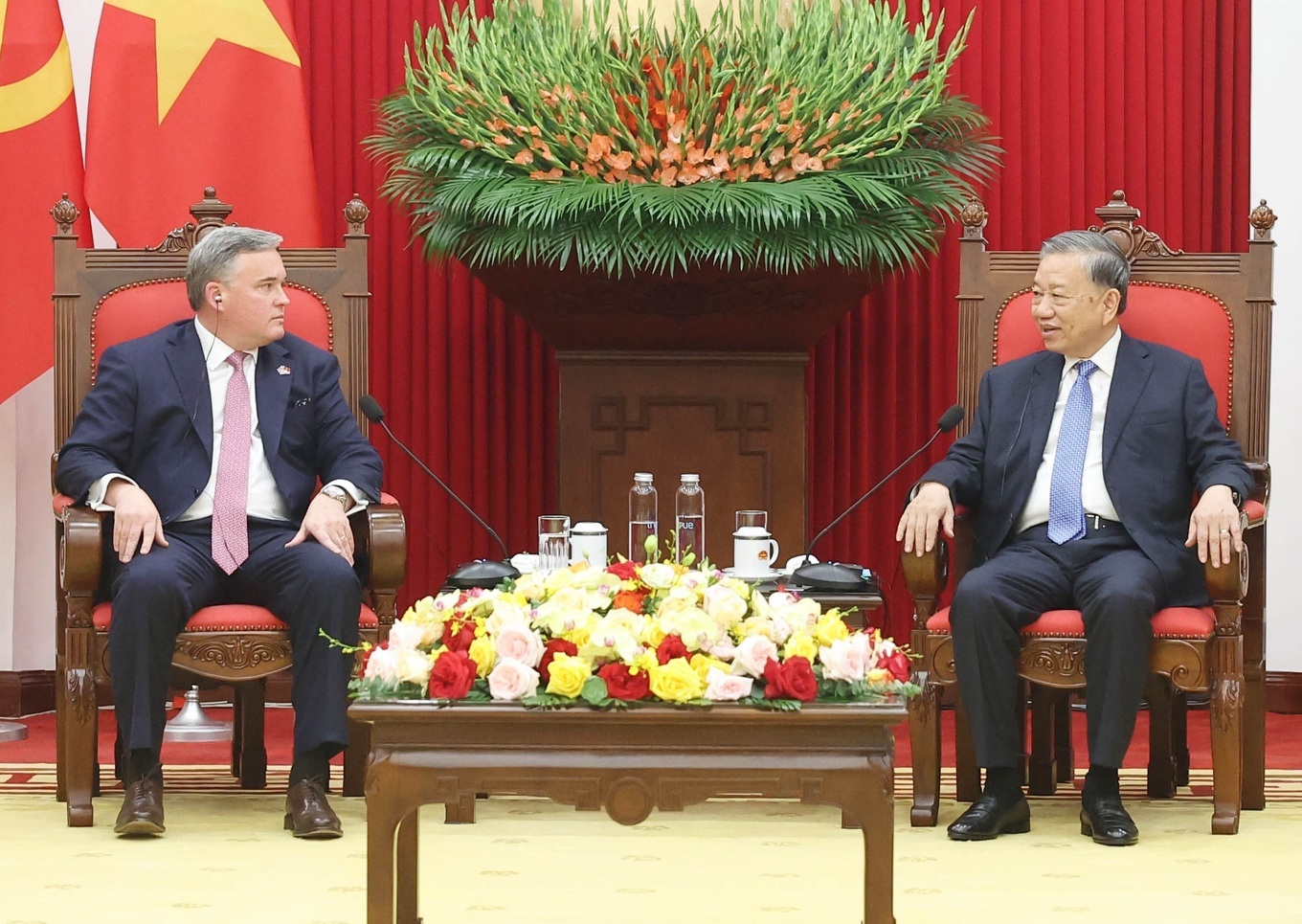
Hambly reaffirmed Murphy’s intention to expand investment in Vietnam and support the development of its oil and gas workforce. The meeting illustrates another part of an operator’s job: projects require sustained relationships with governments and partners as well as geological interpretation. A technically attractive field still needs people and institutions to agree on how it will be developed.
Vietnam also connected the new CEO’s tenure to decisions made before his appointment. Murphy’s board had sanctioned the Lac Da Vang development in 2023, targeting production in 2026. Hambly inherited a project already moving through its investment cycle. He would be accountable for the next stages, while the project’s history reached back into the previous leadership.
When the next well changes the answer
The Hai Su Vang discovery offered a separate opportunity in Vietnam. At the beginning of 2026, a successful appraisal well strengthened Murphy’s expectations. Hai Su Vang-2X encountered 429 feet of net oil pay across two reservoirs. The company said the results pointed toward the higher end of its previously guided resource range. More appraisal remained to be done.
By August, that work had produced a less comfortable picture. Murphy placed gross recoverable resources at 200 million to 300 million barrels of oil equivalent after mixed results from the next two wells. Those are estimates for the whole discovery, rather than barrels belonging entirely to Murphy. They also describe potential recoverable resources, rather than current production.
Hambly acknowledged that the outcome was below earlier expectations. He explained appraisal as a way to reduce uncertainty before committing much larger sums. It is a defensible purpose for the work, although shareholders still have to judge the eventual economics. A better-defined opportunity can be smaller than the one people hoped for.
“Exploration can be humbling.”
Eric Hambly, August 2026
The broader business supplied cash flow while exploration continued. Murphy reported second-quarter 2026 production of 169,000 barrels of oil equivalent per day and net income of $232 million, with stronger commodity prices contributing to the increase over the previous year. It also raised its full-year capital spending midpoint from $1.25 billion to $1.55 billion. Opportunity was asking for more money.
His first full year as CEO had already shown how much ordinary operating work sits beneath the exploration headlines. In 2025, Murphy increased average production from 177,000 to 182,000 barrels of oil equivalent per day. Its annual account also recorded a 20 percent reduction in lease operating expense per barrel equivalent and lower drilling costs per well in the Eagle Ford. These are company results, achieved across teams. They help explain the breadth of Hambly’s responsibility: while geologists test the next prospect, the existing portfolio must keep working.
The barrel has to leave the ground
The distinction between a discovery and a producing asset became tangible on September 27, 2026, when Lac Da Vang achieved first oil. Murphy announced the milestone on October 12, alongside appraisal success in Côte d’Ivoire, another Vietnam discovery and production from Chinook #8 in the Gulf. The operating map was moving in several places at once.
Murphy expects Lac Da Vang to build production as more wells come online through 2028. The nearby Lac Da Trang North discovery could potentially use its infrastructure, subject to evaluation. Those qualifications matter: a possible connection still has to earn its way into an approved development plan.
Hambly’s story now runs through decisions of different sizes. Some begin with a colleague identifying a tedious task. Others require years of drilling, partnerships and capital. His record makes the connection between them worth watching: ask a useful question, let the people doing the work contribute, and examine the answer when it arrives. The next well retains the right to disagree.
Continue the conversation
Explore Hambly’s work, public remarks and Murphy’s project updates.