Rupesh Sanghavi was busy when someone told him Ergode had crossed 10,000 orders in a day. There were calls to take, approvals to give, a supplier problem to resolve. He acknowledged the news and kept walking. Later, sitting in his car, he began to understand what he had walked past.
He remembered being delighted by ten orders. Now a team had processed a thousand times that number, and its founder had barely paused. When he went back to talk about it, the team lead’s response was wonderfully economical: “We figured you knew.”
Sanghavi told this story in September 2026. Its appeal lies in the small embarrassment at its centre. The person who had started the business was so occupied with its unfinished work that other people had a clearer view of its progress. A founder can become extraordinarily well informed about problems and surprisingly late to good news.
For Sanghavi, that gap leads to a larger question. What should his job become when the organization can see, know, and do things he cannot manage alone?
The textbook that refused to stay a textbook
Before ecommerce, there was chemical engineering. Sanghavi moved from Mumbai to the United States in 1999 to pursue a master’s degree at Texas A&M University-Kingsville. He went on to application-engineering roles at Invensys Wonderware and Aspen Technology, working in the world of industrial software and processes.
The route into retail was considerably more domestic. His wife needed a college textbook. Looking online, he noticed that the same book could command dramatically different prices across marketplaces. He bought and resold a copy. A shopping errand had acquired a second occupation.
The detail matters because it keeps the beginning human. He was already trained for a profession. The opportunity arrived through an ordinary purchase, close enough to inspect and small enough to try. No one needed to believe in an entire future company before he could discover whether a book would sell.
Ergode’s history dates the company’s Houston beginning, and the start of Ami Ventures, to 2007. Book selling expanded into a broader catalogue. The price difference that caught his eye was only the invitation. Making a living from such observations required suppliers, dependable fulfilment, and a way to keep the transactions coming.
An engineer meets the inventory
There is a pleasing continuity between industrial software and online retail. Both punish a process that works only when its designer is standing beside it. Sanghavi’s earlier work involved automation, simulation, optimization, and software development. Retail gave those interests a new set of consequences: an order has to reach an actual person.
He began the business part time before becoming its full-time chief executive. An engineer can understand a system without yet knowing how to run a trading business. Product demand, payment timing, supplier relationships, and the next order introduce their own curriculum. The customers do not award partial credit because the database is elegant.
His public conversations have repeatedly returned to that practical education. A 2023 appearance on The Brand Builder Show covered inventory, warehouses, outside logistics providers, and decisions guided by data. The episode described Ergode as having generated $150 million in revenue the previous year. That historical figure gives some proportion to the journey from a book sale.
It also helps explain the kind of business he built. A large catalogue creates work long before it creates a pleasing statistic. Each additional product brings information to maintain and a promise to fulfil. Growth increases the number of ways a small oversight can become somebody else’s disappointing afternoon.
When the seller becomes the owner
Selling through marketplaces was one education. Owning brands added another. In 2020, Ergode moved into brand aggregation, with acquisitions including Malco Modes and Bella Sous. Its history records Clean Bottle as its fifteenth brand acquisition in 2023.
A seller can learn which products move and where demand appears. Ownership lengthens the relationship. The job extends to what a product should become, which customers the brand should serve, and what deserves preserving from the business someone else built. A purchase agreement does not supply those answers.
For Sanghavi, this meant putting a broader operating business behind individual consumer names. Distribution, marketplace experience, and shared capabilities could support a brand’s next chapter. The premise requires judgment about where common systems help and where a brand needs to retain its own character. Uniformity can be efficient right up to the point where customers stop caring.
The expansion also changed what other people needed from him. An entrepreneur who once knew the transaction personally was now responsible for work spread across teams and businesses. Knowing every answer becomes a rather expensive way of organizing everyone else’s day.
Keeping the freedom to choose
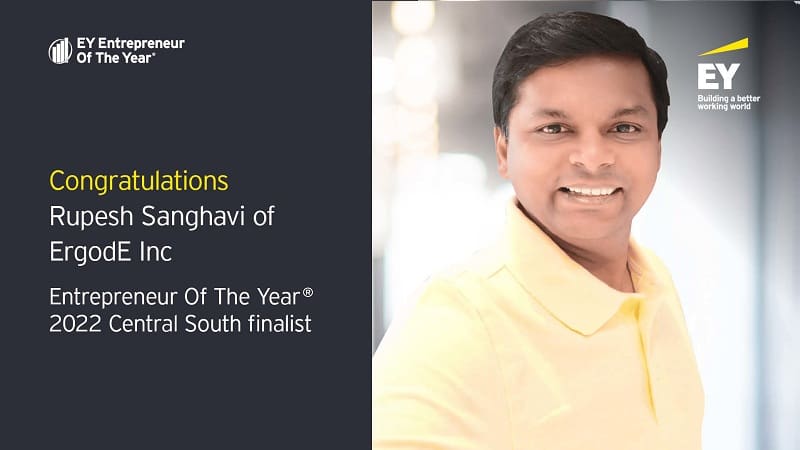
Recognition arrived along the way. Sanghavi was named a finalist for EY’s 2022 Entrepreneur Of The Year Central South award. By August 2024, he was addressing IIM Raipur’s eighth Leadership Summit as chief guest, at an event organized around building business owners.
The subject suits his public advice. In a February 2024 interview, he argued for profitability and for caution about giving away too much equity early. He described financial independence as a way to retain control of a company’s direction. He also set out an ambition to reach $1 billion in revenue by 2030.
The ambition and the preference for independence sit together. A larger company creates more choices only if its economics allow it to keep making them. For a founder pursuing acquisitions and new markets, cash and control have practical uses beyond the satisfaction of reporting growth.
That makes Sanghavi’s story especially interesting at the level of decisions. Which opportunity can the business afford to pursue? Which capability should it build? Where should it buy expertise? His public account describes a continuing series of adjustments rather than one original idea marching, untouched, towards a distant target.
A company with more than one answer
The next adjustment concerns authority. In September 2026, Sanghavi wrote about wanting Ergode to operate and make good decisions without him in the room. He described deliberately developing capabilities that could exceed what he could accomplish personally.
He still reserves a founder’s responsibility for direction, culture, and values. Those set the conditions within which other people decide. Execution, by contrast, can become teachable and transferable. The distinction gives colleagues a chance to develop judgment, provided they receive enough room to use it.
It is an awkward bargain for anyone who started alone. The knowledge that once made the founder useful has to circulate. The person who used to settle an issue may have to watch someone else take longer, choose differently, and eventually do better. Building a capable organization includes accepting evidence of your own limited capacity.
“The business outgrowing you isn’t something that happens to you.”
Rupesh Sanghavi · September 2026
Ergode’s 2022 announcement of an employee stock option plan adds a concrete ownership chapter to this discussion. Giving people responsibility and giving them a financial stake are distinct decisions. Together, they make the question of who is building the business harder to answer with a single name.
The trouble with hiring yourself
In an October 16, 2026 essay, Sanghavi described another mistake: looking for colleagues who resembled people he already knew. Familiar energy, familiar communication, familiar approaches to a problem. He had gradually recognized that this preference could narrow a company trying to work across cultures.
He wrote of teams in Houston, Mumbai, Kolkata, Siliguri, and a new Gurugram hub, describing an organization of more than 700 people. Across those settings, he had learned to look for curiosity, care for the result, and a willingness to admit uncertainty. Those qualities could arrive in very different conversational packaging.
A direct challenge in a meeting is easy to notice. A considered objection afterwards requires a leader to leave the door open. Sanghavi’s observation carries a quiet correction to his earlier habits: recognizing competence requires more range than recognizing someone who sounds like you.
There is a personal counterpoint in his reflections on sport. Having grown up with cricket, he has written about learning patience and control through golf, including an admission that he remains poor at it. It is a useful hobby for a chief executive: the ball has little interest in his organizational rank.
Back to the corridor
The nearly missed milestone brings these threads together. The team had watched the orders build. Sanghavi had been watching what still required his intervention. Both views were real; only one had occupied his attention.
His later reflection was to notice progress more deliberately. The achievement belonged to people who had been doing the work, tracking its results, and taking quiet satisfaction in them. Their understanding did not need to wait for his recognition to exist.
A textbook purchase had taught him to notice an opportunity. Years of building Ergode have made noticing other people’s capacity just as consequential. The founder’s next useful act may be to listen carefully when a colleague tells him something the company already knows.
Continue the conversation
Writing, interviews, and the business behind the story.
Sanghavi’s personal website ↗Cloverbites: his personal essays ↗Follow Rupesh on LinkedIn ↗Ergode’s history and leadership ↗Watch: Sanghavi at the Kolkata office ↗The Brand Builder Show: interview and video links ↗Read the 2024 career interview ↗The 2022 EY finalist announcement ↗