In April 2015, Ed Dineen was explaining the future of petrochemicals through a 48-foot arrangement of pipes in La Porte, Texas. His company, Siluria Technologies, had a demonstration plant and a proposition: turn methane into ethylene, a building block of the chemical industry. The chemistry was ambitious. The sales pitch still had to survive a question familiar to anyone who has run a factory: what will it cost?
Dineen had already been responsible for a $20 billion global chemicals division at LyondellBasell. He had then led LS9, which pursued fuels and chemicals through biotechnology. Now he was asking established industrial companies to consider a different route from natural gas to useful products. Across those jobs, his subject kept returning to the distance between an interesting process and a working business.
That distance gives his career its shape. The Houston executive has moved between plants with long operating histories and ventures whose technologies needed their first commercial customers. Since January 2016, he has been president and chief executive of TPC Group. His decade there has included expansion plans, a destructive plant explosion, bankruptcy reorganization and a federal environmental case against the company. Experience supplies context; it also brings responsibility.
An engineer learns the other columns
Dineen belongs to Cooper Union’s chemical engineering class of 1976. He earned a master’s in chemical engineering at Princeton and another master’s, in engineering management, at Drexel. The progression suggests a useful pairing: understanding a process and understanding the organization expected to run it. A reaction has operating conditions. So does a business, although the latter are less obliging about remaining constant.
He began at ARCO Chemical, working across engineering, planning, supply and business management. He joined Lyondell in 1998 and led several chemical businesses before becoming president of global chemicals. The portfolio included olefins, aromatics, fuel products and chemical intermediates. Those names rarely appear on a shopping list, yet they sit upstream of products that do.
By the time he became chief operating officer at LyondellBasell, his remit stretched across manufacturing, research, procurement, sales and finance. That breadth matters when considering his later moves. He brought operating experience to companies still working through commercialization. He had already worked where a promising technical answer had to agree with purchasing, production and the customer’s requirements.
The attraction of a simpler process
In December 2010, Dineen took over LS9 from Bill Haywood. The company was developing renewable fuels and chemicals using biotechnology. In an interview about the move, he singled out engineering, productivity, flexible feedstocks and the possibility of making a range of products. His explanation of the attraction was economical enough to fit beside a plant drawing.
“Simple operations are lower cap, lower cost, and generally safer.”
Ed Dineen, discussing LS9 in 2010
The sentence is revealing because it puts simplicity in financial and operating terms. A technology could offer an intriguing scientific route and still demand too much equipment or too much expense. His interest lay in how the process would behave as an enterprise. Feedstock flexibility offered choices about inputs; a wider product range offered choices about what to sell.
Later that month, LS9 announced $30 million in financing led by BlackRock, alongside returning investors. Funding was one more part of commercialization: experiments and engineering require money before they produce a dependable income. By January 2013, Tjerk de Ruiter had succeeded Dineen as chief executive. Dineen remained on the board.
His appearance at Climate One in October 2011 captures the stage the sector had reached. The event, titled Drop In, Scale Up?, placed him alongside Codexis chief Alan Shaw and Solazyme chief Jonathan Wolfson. The discussion concerned next-generation biofuels approaching a breakthrough while still short of displacing conventional fuels. Even the title contained an operating instruction. Scale had to follow the idea.
A new route into an old industry
At Siluria, where he became CEO in 2013, the central proposition shifted to methane. The company was developing oxidative coupling of methane, known as OCM, to make ethylene. A separate process could convert ethylene into liquid fuels. Dineen was again working with a venture that sought entry into an industry already equipped with plants, suppliers and established ways of doing things.
Partnerships gave that ambition a practical route. In January 2014, Braskem announced a collaboration with Siluria to study commercial opportunities and provide for a demonstration plant at a US facility. The arrangement included licensing options and possible purchases of ethylene from future Siluria plants. Those details placed a potential customer and industrial partner alongside the technology.
The La Porte demonstration plant opened in April 2015 at Braskem’s site. Here was the proposition made physical: pipes, reactors and a location where potential partners could inspect something beyond a presentation. Dineen’s role was to connect the process to the economics of natural gas and the requirements of companies that might deploy it.
When he stepped down in January 2016, co-founder Erik Scher became interim CEO. Siluria’s announcement described partnerships, technology scale-up and broader commercial activity during Dineen’s tenure; Dineen stayed involved through its board. It was a transition between executives with different histories inside the same venture, with commercialization still the organizing task.
Four carbons, many obligations
TPC appointed Dineen in January 2016, initially as chairman, president and CEO. The business occupied a particular place in the Gulf Coast chemical network: processing raw materials such as crude C4 streams into products sold to other manufacturers. His new employer already had an operating history measured in decades.
The downstream markets explain why this specialized business matters. Synthetic rubber, plastics, lubricant additives, fuels and surfactants all appear among TPC’s end markets. Its work combines chemical processing with infrastructure and logistics. Running it means paying attention to the companies that supply material, the facilities that handle it and the manufacturers waiting for the output.
feedstocksProcessing
+ logisticsRubber · plastics
fuels · additives
Industrial customers sit on both sides of the plant gate.
Early in the job, Dineen described days that could move between customers, plant visits, supplier strategy and financial planning. The attraction he identified was intellectual as well as commercial: analysis and creativity in an industry that kept presenting new problems. There is a recognizable engineer in that description, even when the calendar belongs to a chief executive.
He also spoke about accountability to the communities around the operations. That commitment would acquire a much more demanding context during his tenure. The plant gate is a boundary on a site plan. The consequences of operating decisions can travel beyond it.
The record that accompanies the recovery
On November 27, 2019, explosions at TPC’s Port Neches facility destroyed its butadiene unit and caused extensive damage. The subsequent federal investigation described fires that burned for more than a month and an evacuation order covering a four-mile radius. Butadiene production at the site stopped. The incident became a defining obligation for the company Dineen led.
TPC filed for Chapter 11 protection in June 2022. That December, it emerged from reorganization after a plan eliminated more than $950 million of approximately $1.3 billion in secured funded debt, along with contingent litigation liabilities from the explosion. Dineen thanked employees and described the improved financial and operating flexibility. The restructuring changed the company’s financial position; the events behind it remained part of its history.
of secured funded debt eliminated under TPC’s restructuring plan
From approximately $1.3bn before the plan. Company figures.In May 2024, TPC Group LLC pleaded guilty to violating the Clean Air Act. The resolution called for more than $30 million in criminal fines and civil penalties and approximately $80 million in improvements to risk management and safety. The company agreed that it had failed to implement written operating procedures, including monthly flushing of production lines, that would have prevented the explosion.
Those were corporate proceedings against TPC Group LLC. They belong in an account of its chief executive’s tenure because they concern the operation he led. A financial recovery and an operating record answer different questions. Both deserve room in the same account.
The future includes cooling towers
When Dineen discussed TPC’s plans in April 2024, the details were decidedly physical. He described an expansion expected to add roughly 180 million pounds a year of butadiene capacity in Houston, alongside spending on controls, boiler conversion, a technical center and infrastructure. These were plans described at that time, rather than a catalogue of completed projects.
He put that year’s expected capital spending at about $125 million. Cooling towers entered the conversation because rebuilding infrastructure can create assets intended to last decades. There is something useful about an executive discussion in which the cooling tower gets its turn. It brings a future expressed in strategy back to equipment that someone must maintain.
In February 2025, TPC announced a leadership reshuffle as Charles Graham prepared to retire. Adrian Jacobsen took broader commercial responsibilities, while finance chief Dan Valenzuela gained responsibilities including procurement. Dineen framed the changes around efficiency, accountability and developing employees. The decisions concerned the distribution of work, a less visible part of running a chemical business than adding production capacity.
Back to the class of ’76
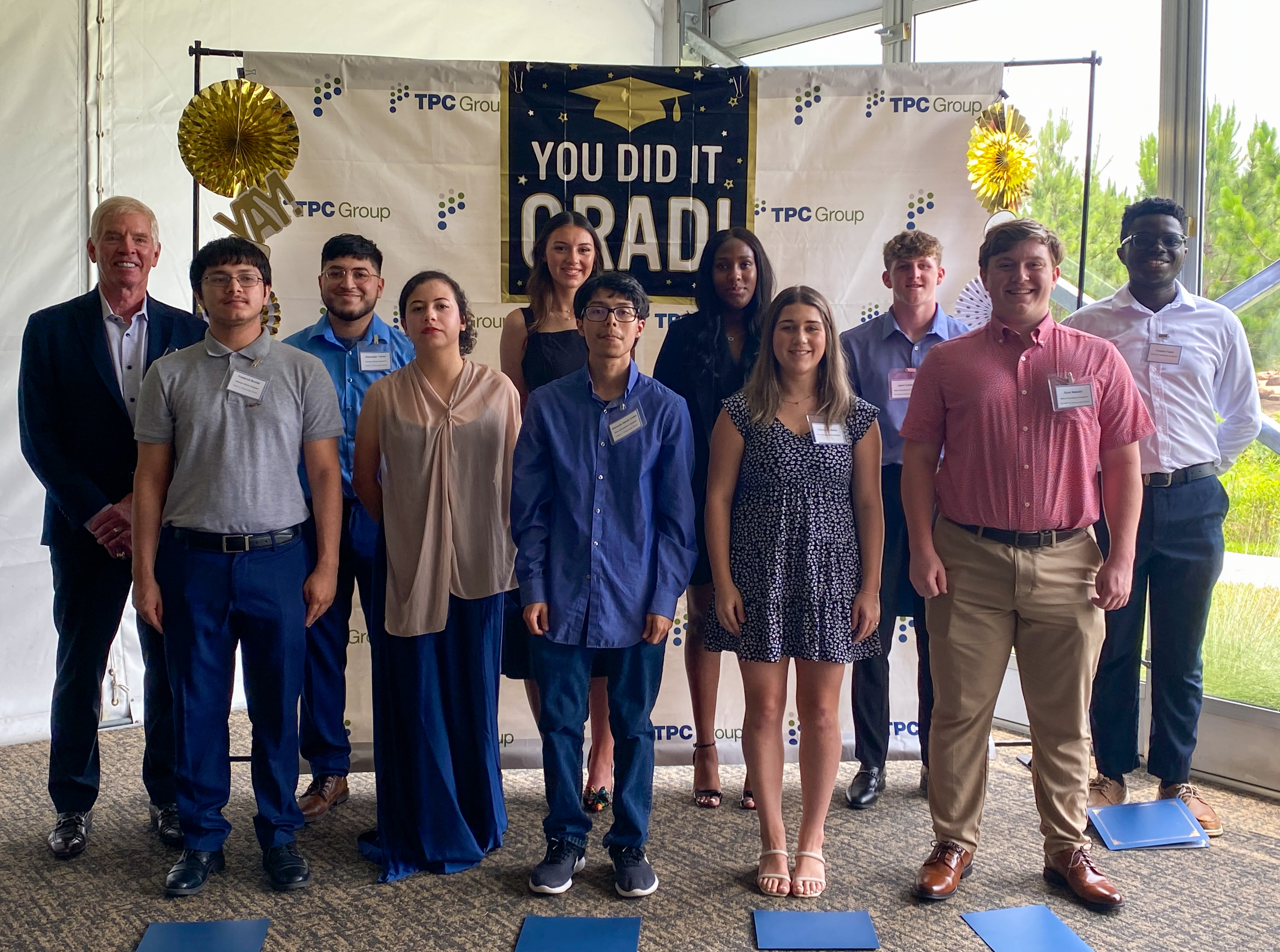
A photograph from TPC’s May 2024 scholarship luncheon places Dineen at the edge of a group of graduating students. The company awarded 12 scholarships that year. Its program, begun in 2006, had provided more than $1.1 million by that announcement. The students’ plans included several branches of engineering, connecting an industry’s future workforce to individual decisions about college.
In June 2026, Dineen was elected a Cooper Union trustee, with a term listed through 2030. Fifty years after his chemical engineering class graduated, he had a new responsibility at the institution where he earned his first degree. His other board work includes Syzygy Plasmonics and representing TPC at the American Fuel & Petrochemical Manufacturers.
The return to Cooper gives a long industrial career a concrete point of connection. Education, new chemistry, commercial contracts and the upkeep of existing plants have all occupied his working life. The record contains ambition and consequences together. For Dineen, the next process to improve still has to work in the world outside the drawing.