A digital transformation can travel a long way without reaching the person holding the clipboard. Sundeep Ravande encountered that problem while working at IBM: enterprise projects were moving ahead, yet workers he accompanied in the field were still using paper. He remembers asking why projects costing tens of millions of dollars left that part of the job untouched. The unanswered question eventually became a business.
Ravande co-founded Innovapptive with Hari Kamineni in 2012. Today, the Houston-based chief executive works in a corner of software occupied by maintenance crews, plant operators and warehouse teams. Their tasks have an unglamorous precision. A replacement part must be available. A work order must reach the right person. Someone must record what actually happened. The spreadsheet can wait; the equipment rather often cannot.
His career has followed the space between a company’s intention and its employees’ next action. Enterprise software holds the plan. The physical world supplies the complications. Ravande has made the connection between them his recurring subject, through a company, a series of essays and an increasingly pointed argument about artificial intelligence.
An engineer learns the enterprise
Ravande studied mechanical engineering at Ramaiah Institute of Technology and earned a master’s in aerospace and mechanical engineering at the University of Mississippi. His subsequent work took him into business transformation, including consulting with IBM and Accenture. The client names in his professional biography include Verizon, Shell, Coca-Cola and FMC Corporation. These were organizations with substantial operations and considerable experience buying technology.
That background matters to the kind of founder he became. He had worked within the world he hoped to sell to. Supply chains, enterprise systems and operating procedures were already part of his professional vocabulary. His eventual company would have to connect with that machinery of corporate life, including the systems customers had already paid for.
There is an engineering problem embedded in this career change: a system can have competent individual components and still function poorly as a whole. The difficulty lives at the joins. Ravande’s business gives those joins a commercial address, between the plant floor, the storeroom and the back office. The appeal is practical. Fewer gaps should mean fewer occasions on which somebody has to chase an answer.
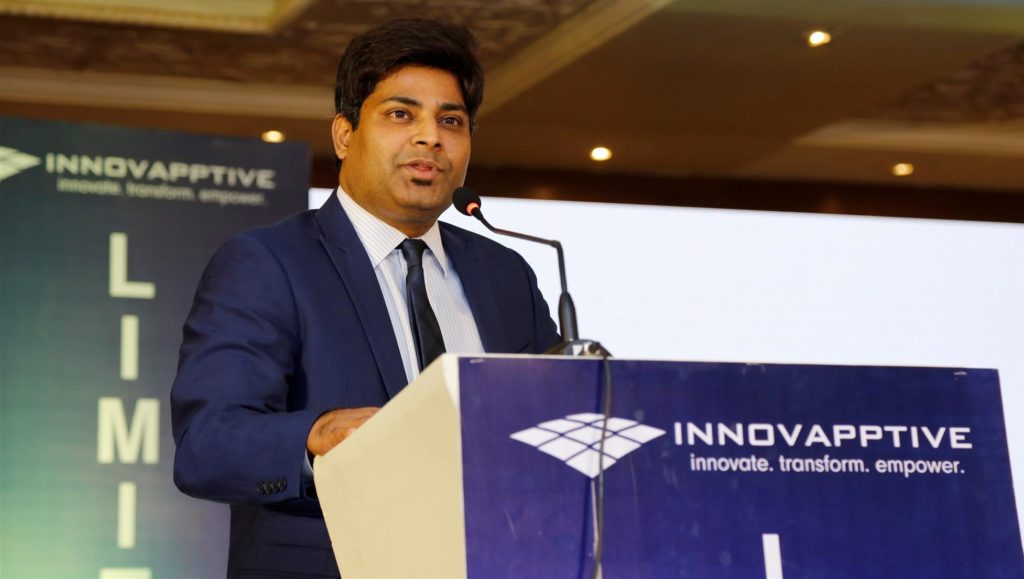
Two founders, then a change of chairs
Innovapptive’s early progress included a win in SAP’s 2014 Mobile App Challenge for its quality-management application. More than 30 applications entered; ten reached the final voting stage. Kamineni accepted the trophy, and the two founders appeared together in photographs of the occasion. It was a concrete early result for a company working inside an established enterprise ecosystem.
The next revealing moment came in May 2017. Kamineni, who had led the company for its first five years, nominated Ravande to succeed him as CEO. Ravande had been president and co-founder. Kamineni moved to chief product officer and remained on the board, concentrating on product development.
The announcement credited Ravande with customer acquisition, international partnerships and European expansion, as well as leading a $1.5 million financing in 2016. Those responsibilities help explain the handover. The two founders were dividing the demands of building products and building a business around them. A company needs somebody to worry about what ships, and somebody to worry about what sells. Occasionally they even agree.
For Ravande, the new title formalized work already central to his role. It also placed him in charge of a business whose ambition depended on adoption inside other large organizations. Winning a contract would be one step. Making the software useful enough to become part of a working day would remain the longer assignment.
A subscription needs a reason to stay
In 2018, Ravande described the move toward cloud delivery and subscription revenue as a pair of connected decisions. The company wanted easier adoption for customers and a more predictable financial model for itself. He also questioned the value of pursuing recurring revenue while losing sight of customers’ needs. The economics had to remain attached to the purpose.
It is a telling concern for a software executive. A subscription creates a pleasing rhythm in a financial model, but it also creates repeated occasions for the customer to reconsider. A tool that complicates the day will eventually have to explain its continued presence. Ravande’s emphasis on simplifying use gave the commercial model an operational test.
The same practical bias appears in the company’s name. He has explained that it brought together innovation and apps, reflecting his interest in applications that customers could adapt to their workflows. He also conceded that the result was a tongue twister. The spelling asks a little of the reader. His product argument asks that the software demand less of its user.
The money follows the handoffs
In April 2019, Innovapptive announced a $16.3 million Series A led by Tiger Global Management. The company said the financing would support international expansion and further platform development. Its description of the product emphasized collaboration among workers, back-office staff and leadership, with operating data feeding decisions about the workforce.
That investment placed Ravande’s fairly specific problem in front of a broader financial audience. A missed handoff can look small in isolation. Across a large industrial organization, repeated delays in maintenance, materials and communication become a management concern. The business proposition was to make those connections part of a shared workflow.
Vista Equity Partners led the Series B announced in May 2023, with Tiger Global participating again. Vista invested through its Endeavor Fund; Ben Benson joined Innovapptive’s board. The announced plans included product innovation and entry into additional regional markets. Ravande’s founder role now involved working with investors experienced in scaling enterprise software companies.
Later that year, he appeared among the Houston Dealmaker of the Year honorees recognized by Smart Business Network. The recognition concerned financing and business building. It belongs alongside the less ceremonial work of persuading customers to change a routine. Capital gives a company room to develop; a worker’s willingness to use the result gives that development somewhere to go.
The user gets a vote
Ravande’s writing offers another way to understand his priorities. In an August 2021 essay, he argued that buyers of connected-worker software too often neglected the end user, then faced weak adoption and disappointing returns. He put the person expected to operate the tool near the beginning of the purchasing decision.
There is a quietly demanding idea here. A software purchase has several audiences: executives approving expenditure, technology teams evaluating integration, and employees trying to finish a task. The last group gets to judge the product repeatedly, under ordinary working conditions. A persuasive presentation cannot perform those judgments on its behalf.
His public subjects have broadened without wandering far from that concern. He has written about downtime, margins and the limits of back-office modernization. A July 2025 LinkedIn essay argued for looking inside existing operations for financial improvement. Its ambitious dollar figures were a business argument about potential savings, rather than a universal result to expect from every plant.
He also makes room for the people building his own company. In a Thanksgiving reflection on 2024, he named colleagues across recruitment, customer work, operations and product development. He described a difficult, uneven year and thanked the teams involved. The post provides a less polished view of the CEO’s job: a strategy is carried by named people, with quite different assignments.
One example in that 2025 essay makes his financial vocabulary concrete. He considered a process-industry business spending more than $100 million a year on maintenance. A ten percent improvement, he argued, could mean $10 million in annual earnings improvement. It was an illustrative calculation, dependent on the spending base and the improvement achieved. The point was to translate work on the floor into a number an executive could examine. A change in maintenance practice needs an operational explanation, and a financial claim needs assumptions that can be checked. Ravande was trying to connect both conversations.
AI still has to get the job done
By 2026, Ravande was carrying his argument into the discussion of agentic industrial AI. In a June conversation with David Essex, he described intelligence embedded in workflows and coordination among frontline teams. He also emphasized the continuing role of human experience and accurate records of work as it happens.
“Insights by themselves don’t really create value.”
Sundeep Ravande, June 2026
His caution concerns context. A recommendation depends on the information underneath it. If the operational record arrives late or misses what happened in the field, a sophisticated system can reason from a poor account of reality. For Ravande, recording the work and coordinating the response are part of the AI problem itself.
- 01KnowSignals from equipment and enterprise systems
- 02CoordinateOperators, maintenance crews and stores
- 03Act & recordWork completed and the record updated
In April 2026, Frost & Sullivan recognized Innovapptive as its global Company of the Year in augmented connected worker, end-to-end platforms. A June AWS event also featured Ravande discussing the link between enterprise systems and frontline execution. The settings had changed from the company’s early app competition, but the subject remained recognizable.
His larger aspiration is to make frontline work easier to coordinate and more productive. That gives his career a useful continuity, from consulting engagements to subscriptions, financing and AI. The ambition can be described in elaborate software language. Its daily test is easier to picture: somebody knows what needs doing, has what the job requires, and leaves an accurate account for the next person. Ravande has spent years trying to shorten the distance between those three things.