The revealing detail in one Innovapptive customer story is a lost signal. A chemical manufacturer had built its own SAP Fiori-based work-order application. On paper, the work had gone digital. In parts of the plant with poor connectivity, however, the application’s limited offline capabilities caused delays. Different plants remained poorly connected; rounds, orders and schedules lived in separate tools. The screen had changed. The handoffs still needed work.
- Connect inspections, repairs and spare parts to SAP or Maximo.
- Let workers complete tasks where the work happens, including offline.
- Judge the result by completed work, adoption and less waiting.
The app that could not follow the worker
That manufacturer adopted Innovapptive’s connected-worker software across six US sites. The vendor’s 2024 case study reports $2 million in annual savings and plans for a global rollout. Its account points to mobile work orders, SAP integration and offline capability as remedies for the earlier fragmentation. These are company-reported results, but the failure is instructive: digitizing an individual task can leave the surrounding process almost untouched.
Innovapptive’s proposition begins there. A worker finds a problem. Someone must decide what to do, assign the repair, arrange the material and record the outcome. Each transition is an opportunity to wait. An industrial company can possess excellent information and still lose time moving it between people.
The spare part is part of the software
Founded in 2012 by Sundeep Ravande and Hari Kamineni, Innovapptive initially pursued mobile workforce management. Ravande’s background includes IBM, Accenture and enterprise consulting. That is a useful apprenticeship for a business whose product must converse with established corporate systems. By 2016, he was describing its focus as “connecting people, processes and things.” The phrasing has acquired more AI since then; the connecting problem remains recognizable.

Today, the company calls its offering an Industrial Execution Platform. mWorkOrder handles maintenance jobs. mRounds organizes operator routes, measurements and shift handovers. mInventory covers receiving, picking, kitting and cycle counts. Digital inspections connect findings to corrective work. The intended buyer is an enterprise with expensive physical assets; the daily users are operators, technicians, storeroom staff and supervisors.
Consider what happens during a round. The operator follows a route, records a reading and captures evidence. With mRounds, thresholds and conditional questions can turn that observation into an exception, then into tracked work in SAP or Maximo. The next shift receives a structured handover. The useful design choice is continuity: the observation retains its connection to the asset and the response. For a plant manager evaluating the software, that suggests a concrete demonstration request. Follow an abnormal reading all the way through assignment and closure, rather than stopping at the completed checklist.
The warehouse connection matters. A technician cannot complete a repair with a work order alone. Innovapptive’s refinery case describes paper forms obstructing communication between maintenance and the spare-parts warehouse. Putting those departments on mobile workflows addresses a practical dependency: the right part must reach the right job. A beautifully assigned task with no material remains beautifully unfinished.
- 01Spot itOperator finding
- 02Assign itMaintenance job
- 03Supply itParts and kitting
- 04Close itRepair + ERP record
Illustrative workflow - the value sits in the connections.
Its competitive argument is the breadth of that connection, supported by configuration tools such as RACE, the Rapid Application Configuration Engine. Buyers should still compare actual workflows. SAP’s own Service and Asset Manager also supports maintenance, inventory and offline use. Offline operation is essential in this market; it is not an exclusive invention. Innovapptive must earn its place through integration, usability and coordination across departments.
A backlog is a queue with a price
Indorama Ventures supplies a more concrete illustration. Innovapptive’s August 2025 AWS collaboration announcement describes one US facility reducing its maintenance backlog from 18 weeks to six and reaching 99.5% inventory accuracy. The release reports more than $12 million in EBITDA gains. Those figures belong to a particular deployment and its published account, rather than a promise for every plant.
One US facility. Vendor-reported deployment results; not a forecast.
Adoption is another part of the arithmetic. In an Innovapptive-hosted testimonial, Newmont’s Cary Brunson describes earlier mobile tools with poor user experience: “They’d rather use paper.” A separate specialty-gas customer case reports 90% adoption in eight weeks with an organizational change-management program. Training and implementation belong in the purchasing conversation because the process only changes when workers actually use the application.
“They’d rather use paper.”Cary Brunson, Newmont Mining, on earlier mobile experiences
The price of joining the dots
Innovapptive sells enterprise SaaS, with users and selected products shaping the subscription. One SAP-listed mWorkOrder plan gives a useful reference: $1,440 per user per year, at least 25 users, a 36-month commitment and an additional annual platform fee. That puts the listed user component at $36,000 a year at the minimum. It is one plan, not the price of a complete connected-worker deployment.
The financing is less ambiguous than the full project bill. Tiger Global led a $16.3 million Series A in 2019. Vista Equity Partners led a minority Series B investment in May 2023, with Tiger Global participating; the announcement left the amount undisclosed. AWS is a commercial and technology partner. The 2025 collaboration covers joint selling and technical work, extending a relationship that includes AWS Marketplace procurement.
AI gets a job description
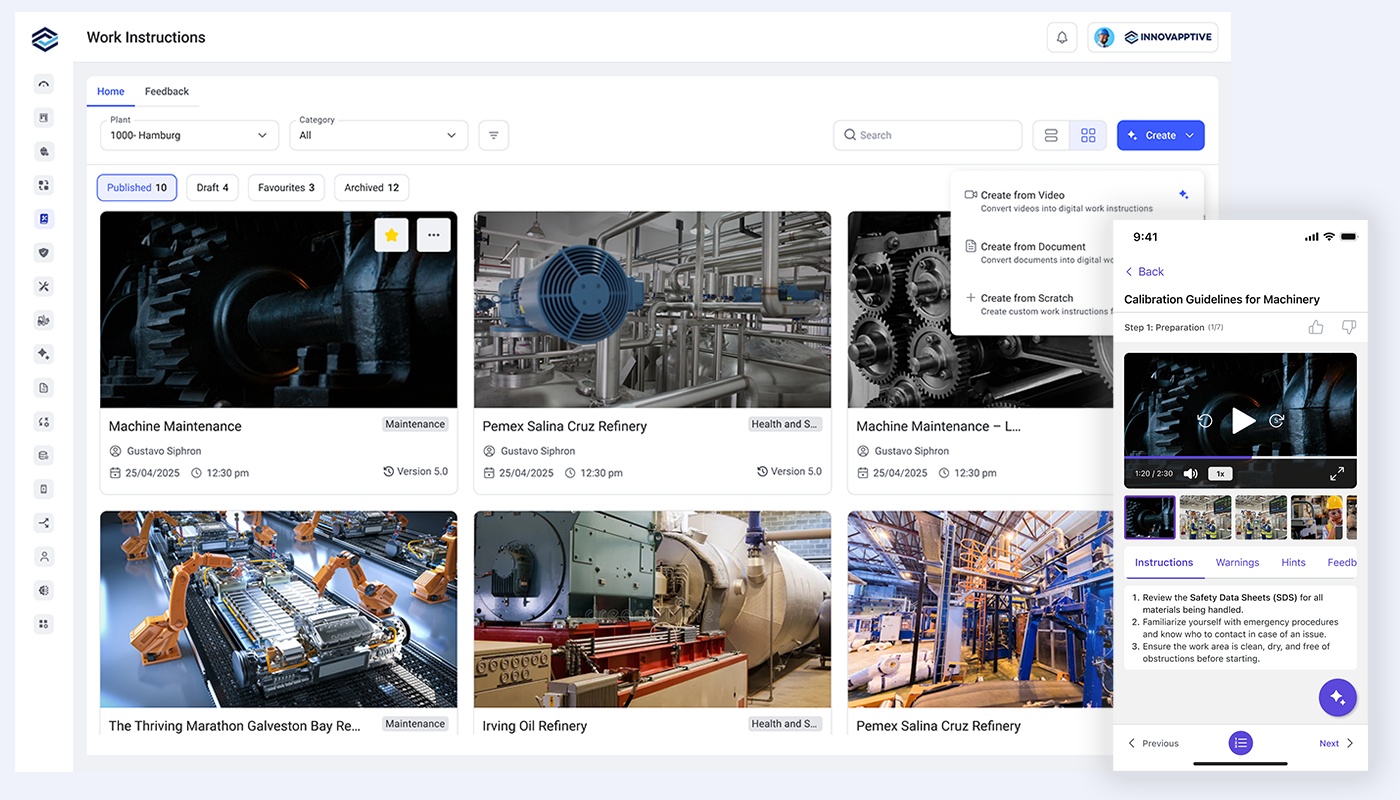
The current product pitch gives AI specific assignments: turn photos or voice notes into structured work orders, convert video or documents into procedures, and help author inspections. The work-instruction product embeds guidance in jobs and rounds. Its attraction is proximity. Instructions are more useful beside the task than buried in a separate library.
In April 2026, Frost & Sullivan recognized Innovapptive as Company of the Year in augmented connected worker, end-to-end platforms. Recognition helps establish its market position. A buyer still needs to test the mundane details: whether an exception becomes assigned work, whether the app survives a dead zone and whether closure reaches the enterprise record.
The transferable lesson is to trace one defect from discovery to completion before buying another screen. Count the waiting and name the owner at each handoff. These cases suggest a practical limit: this approach needs usable workflows, sound asset data and willing departments. Where those conditions are absent, or the operation is too small to justify enterprise integration, the subscription can add expense without resolving the queue. The repair remains the point.