A prescription is a deceptively tidy object. A doctor clicks, signs or scribbles; a medicine appears at the other end. Specialty therapy is rarely that neat. There may be consent forms, baseline tests, titration rules, pharmacy coordination, repeat labs, side effects and a frightened person trying to remember what happens next. Each handoff is a place to stall. RxPx has made those handoffs its business.
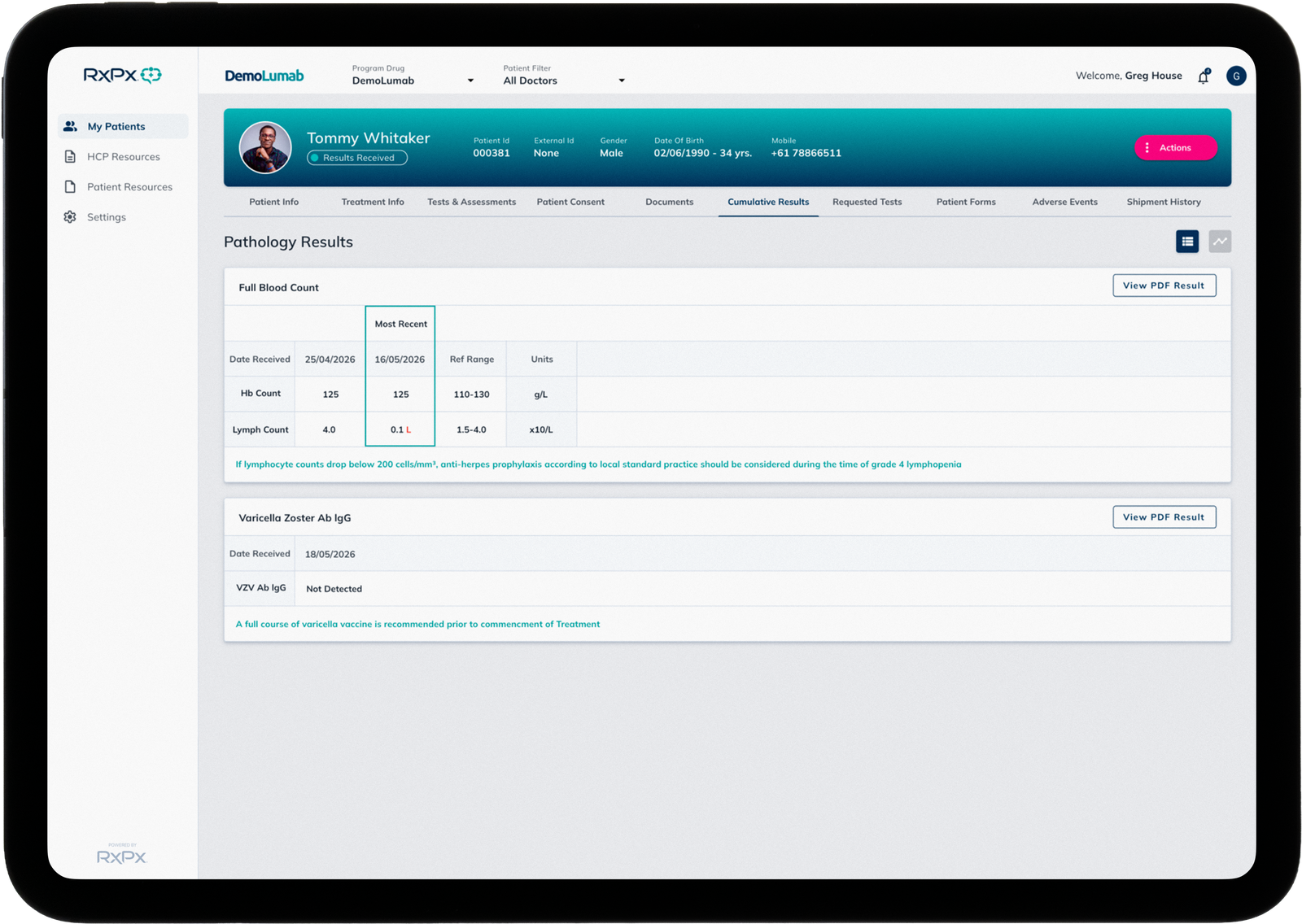
The company sells a configurable, usually white-label platform to pharmaceutical and life-sciences organizations. The buyer may be a brand or commercialization team, but the users are spread across the care chain: physicians, nurses, support staff, patients, caregivers and clinical-trial participants. One side of the product handles enrollment, consent, labs and medicine management. The other gives patients education, reminders, symptom tracking, peer communities, coaching and an AI companion that can route a problem toward a human. RxPx is less a wellness app than air-traffic control for a complicated medicine.
Two companies were solving the same journey from opposite ends
RxPx arrived in September 2022 through a Pemba Capital Partners-backed merger. Sydney's RxMx had been built by doctors who were tired of the administrative machinery around specialty medicines. Its Chameleon software automated prescribing, risk management and patient monitoring, particularly in multiple sclerosis. Vancouver's Curatio began with a patient's-eye problem: illness can be isolating, information is uneven and a clinic cannot sit beside someone every day. Curatio built private social-health communities with evidence-based content, tracking and coaching.
The merger thesis was unusually legible. RxMx knew the clinician's desk. Curatio knew the patient's sofa. Bringing them together created one program record stretching from prescription intent to long-term persistence. Even the name is a small diagram: Rx for the medication, Px for the patient experience.

“For every 3 minutes it takes to enroll a patient, it saves 3 hours.”Healthcare professional in an RxPx multiple-sclerosis program
What did that combination cost? The price of the merger was not disclosed. Pemba had invested in RxMx in 2021 and backed the cross-border deal a year later. A separate 2024 research push is easier to price: the AI Clinical Buddy consortium carries a CAD 10.5 million project budget, including CAD 3.4 million from DIGITAL, Canada's Global Innovation Cluster. Public project records allocate CAD 2.8 million of that support to RxPx. Customer pricing remains private, which is typical for enterprise programs assembled from software, integrations, approved content and optional human services.
The medicine did not fail. The experience around it did.
An RxPx oncology case study begins with a brutal leak: clinical-trial experience suggested that half of patients stopped a twice-daily oral cancer therapy within eight weeks. The reasons were mundane and therefore dangerous - side effects, an older patient population with lower digital confidence, and no durable connection between appointments. RxPx's answer was an accessible app-based community with side-effect education, peer support and daily touchpoints.
Company-reported results from one oncology program. The comparison benchmarks cited by RxPx were 31%, 18% and 17%, respectively; these are not guarantees for every deployment.
A multiple-sclerosis program attacked a different failure: waiting. Country-specific payer requirements, first-dose observation, titration and the difficulty of reaching rural patients stretched the path to treatment. RxPx reports that the program cut an approximately six-week process to 11-16 days, with adherence ranging from 83% to 98% across supported MS drugs. That does not mean an app made the medicine work. It means connected workflows removed time in which people could get lost.
One record, many anxious moments
RxPx now describes itself as a commercialization operating system for specialty therapies. Before launch, it configures consent, enrollment, monitoring and approved educational pathways. At launch, the HCP portal helps a care team move a patient from intention to activation. During the first 90 days, reminders, check-ins, content, community and human navigation try to catch the wobble before it becomes abandonment. Longer term, engagement and workflow data show the sponsor where persistence weakens.
- PrepareConfigure consent, content, integrations and protocol rules.
- StartEnroll the patient, coordinate labs and make the next action visible.
- StabilizeUse education, check-ins, community and escalation in the first 90 days.
- PersistMeasure engagement, spot friction and improve the program.
Its AI toolkit sits inside that workflow rather than floating above it. RxPx lists content recommendations, onboarding assistance, behavioral triage, community moderation and natural-language detection of potential adverse events. The more important design choice is the exit ramp. A protocol-trained companion can check in or educate; a navigator, nurse or care team takes over when software is no longer the right tool. In healthcare, a chatbot without escalation is merely a very confident waiting room.
What the customer buys
A branded, configurable program with patient and HCP interfaces, implementation, integrations, analytics, compliant content and, where required, human support.
What the patient feels
Fewer mystery steps, useful reminders, a place for questions, people with the same condition and clearer signals about when to contact a professional.
Pharma pays because fragmentation is expensive
This is B2B SaaS with a services layer. Drug manufacturers and life-sciences teams license programs; RxPx configures them around a therapy, country, protocol and brand. Patients generally do not pull out a credit card, and many may never notice the vendor behind the program. That invisibility is part of the model. RxPx can become infrastructure while its customer keeps the relationship and branding.
Its competitors do not form one neat row. Patient-engagement platforms such as Belong.Life and Wellframe compete for the support layer. Adherence specialists, pharma hub vendors and clinical-trial technology providers tackle adjacent slices. A manufacturer can also hire agencies and stitch together portals, call centers and point products. RxPx's difference is breadth: clinician workflow, patient community, monitoring, AI, analytics and optional nursing services are configured as one journey.
Where RxPx concentrates its product effort
Editorial map, not a measured score. It shows the company's positioning across connected workflow, engagement and service delivery.
The Lumia Care partnership makes the hybrid strategy concrete. Announced in July 2025, it pairs RxPx programs with in-home nurses across Australia for injections, infusions, oncology care, remote monitoring and trial support. A notification can prompt; a nurse can administer. The partnership stretches the product from coordinating care to helping deliver it.

Copy the handoff map, not the healthcare jargon
The first idea worth stealing is to design around a costly journey, not a collection of features. RxPx asks what must happen before launch, at enrollment, during the fragile early window and after a routine settles. That sequence disciplines the roadmap. A founder in logistics, education or finance can do the same: find the moment responsibility moves between people, then make the next action obvious.
Second, merge complementary loops. Curatio had engagement without owning the clinician workflow. RxMx had workflow without the patient's daily context. Together, each side generated reasons to use the other. Third, treat AI as a routing mechanism. Recommendations and check-ins are useful, but the trust comes from approved information, auditable rules and escalation to someone qualified. Fourth, sell the result in operational language. “74% faster time to treatment” is easier for a buyer to defend than “delightful digital engagement.”
The durable idea is not “put AI in healthcare.” It is “connect every handoff, then decide which ones software has earned the right to handle.”
What changed the founders' minds about going it alone was the obvious incompleteness of each view. Brown-Ganzert has said a conversation with health-tech interviewer Matthew Holt helped her recognize the chance to connect the two models. The deal then gave a patient-support company clinical workflow and gave a physician-workflow company community, coaching and daily engagement. It was not diversification for its own sake. It was completion of the same job.
There are conditions under which this playbook will not work. A simple, inexpensive therapy with little monitoring may not justify an enterprise platform. Software cannot repair a program if laboratories, pharmacies and support teams refuse to share data. Personalization is hollow without enough approved content. Alerts are dangerous if nobody is staffed to answer them. Peer communities need moderation and a population large enough to feel alive. And the case-study gains cannot be pasted onto every disease, country or medicine; protocol, access, demographics and clinical behavior all change the outcome.
That restraint is precisely why RxPx is interesting. The company is operating in the least cinematic part of pharmaceutical innovation: after discovery, before routine. Its task is to make the machinery around a powerful medicine feel less like machinery to the person taking it. If RxPx succeeds, the best evidence may be an unremarkable day - the lab arrived, the nurse called, the patient understood, and nobody fell through the gap.