In 2019, Qure.ai had the sort of problem that makes an artificial-intelligence demo look silly. Its algorithms could inspect chest X-rays and head CT scans. Hospitals agreed to trials. Doctors showed interest. Then, in the daily scramble of clinical work, many simply went back to doing things by hand. The software was used as an occasional second opinion, not a habit. Because Qure.ai’s revenue depended on use rather than installation, annual revenue was reported at roughly $113,000. Accuracy had arrived before adoption.
That awkward year explains the company better than any triumphant funding announcement. Qure.ai now says its technology has touched more than 45 million lives across 5,500-plus sites in over 105 countries. It has raised about $130 million, built 26 FDA-cleared indications across nine products, and sells into hospitals, public-health programs, radiology groups, drug companies and med-tech partners. But the central act is still modest: look at an image quickly, show a clinician what deserves attention, and make the next step harder to forget.
01 / The originA solution went looking for its problem
Qure.ai was born in Mumbai in 2016 inside Fractal Analytics. Co-founder and CEO Prashant Warier had spent years applying machine learning to logistics, advertising and other commercial problems. Physician and data scientist Pooja Rao supplied the clinical half of the founding pair. The early search was broad enough to include AI toys that might “grow” with a child and systems for fashion imagery. Radiology won for a practical reason: the field was already digital. Hospitals held years of scans, and the shortage of people available to read them was visible everywhere.
The first two wedges were chest X-rays and emergency head CTs. qXR, launched in 2017, was trained to detect patterns associated with tuberculosis and other chest abnormalities. qER followed for urgent findings in trauma and stroke, including brain bleeds and fractures. The premise was not to install a robot doctor. It was to give the human reader a fast first pass, a heat map, a draft report or a reason to move one scan to the top of the queue.

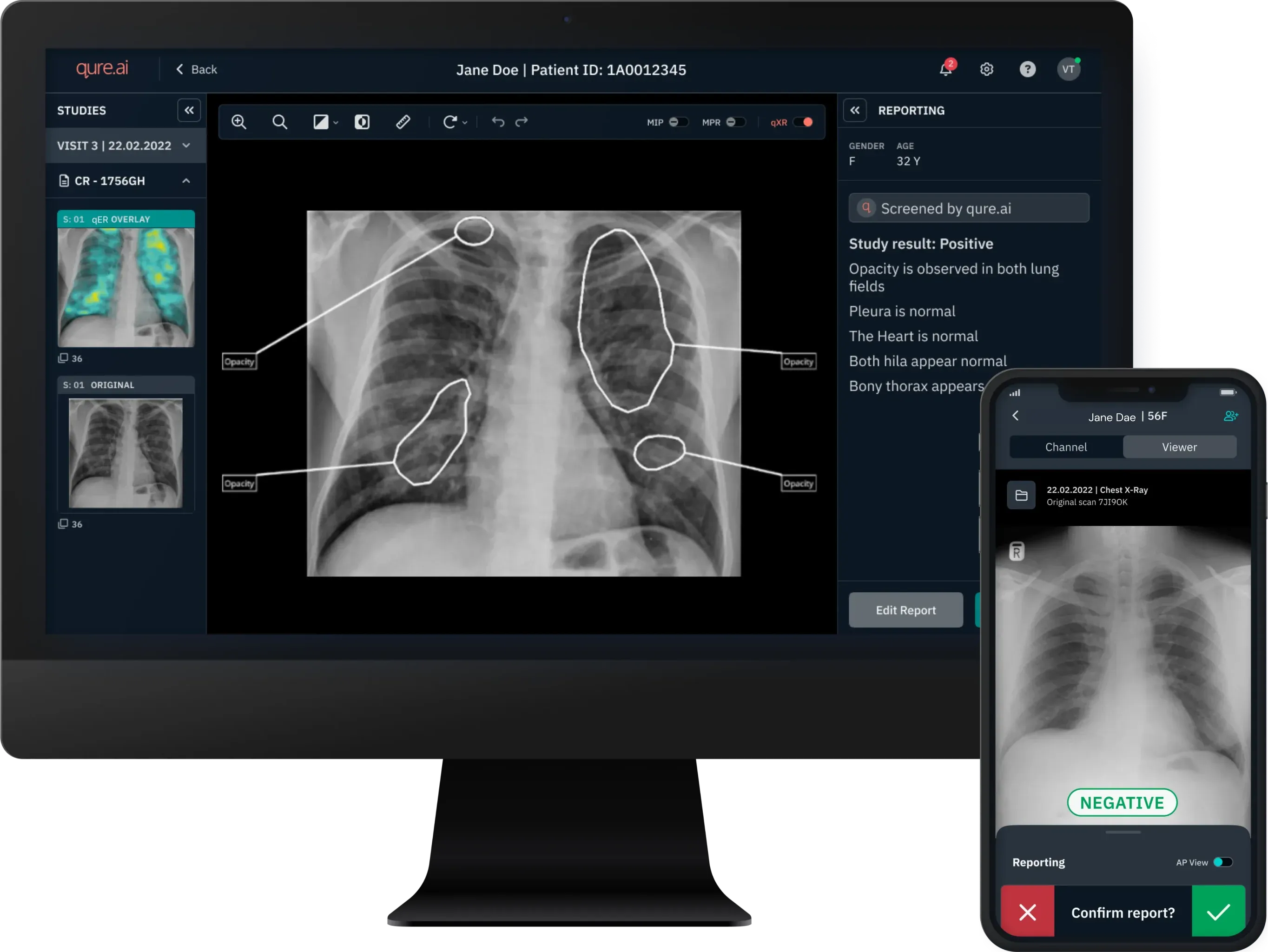
That framing matters. Medical imaging is full of high-consequence edge cases, and a model sees pixels without the patient’s complete history. Qure.ai’s cleared tools are assistants, triage devices and quantifiers. Their value is not mystical diagnosis. It is consistency at volume: separating apparently unremarkable X-rays, measuring a lung nodule, notifying a stroke team or catching an incidental finding while everyone was looking for something else.
“The first thing that failed was usage. The algorithm could be right and the business could still be wrong.”The lesson hidden in Qure.ai’s early revenue
02 / Pilot purgatoryTrust costs more than training data
Early deployments exposed three taxes. First came trust: physicians were reluctant to depend on AI, even when studies looked promising. Second came integration: software setup, image transfer, privacy rules and unreliable connectivity could turn a clean demo into weeks of negotiation. Third came the handoff: a positive screen has little value if no one arranges a confirmatory test or follows the patient into treatment.
A TB program in Nagpur offers the useful version of the story. Eight private X-ray laboratories had different systems and privacy concerns. Local radiology groups were wary. The implementation team used education sessions, transparent engagement and flexible technical setups rather than insisting on one pristine architecture. Of 10,481 people screened, 2,303 were flagged as presumptive cases by AI or radiologists; the program reported a 15.8 percent increase in case detection compared with traditional screening alone. The gain came from fitting the tool to the place.
COVID-19 changed the adoption equation. Hospitals needed ways to identify and segregate patients with pneumonia-like chest findings before tests were always available. Urgency made fast image triage useful, while a $16 million funding round in February 2020 gave Qure.ai room to pursue leads and support deployments. The company adapted qXR to score lung involvement and helped hospitals in Britain and rural India manage overloaded systems. It did not prove that an X-ray could replace a viral test; it proved that a tool already sitting in the imaging pathway could become operationally valuable when minutes mattered.
03 / The productFrom one alert to a care pathway
Today the suite stretches across the image and beyond it. qXR reads chest X-rays for lung, heart, pleural, bone and device findings. qER covers neurocritical CT and CTA workflows. qCT measures and follows pulmonary nodules. qMSK assists with adult fracture detection. qTrack manages referrals and incidental findings. AIRA, launched in 2025, moves outside the radiology room: it helps frontline workers capture symptoms, follow protocols and aggregate population-health information in resource-constrained settings.
This breadth separates Qure.ai from a single-algorithm vendor. Aidoc and Annalise.ai offer broad imaging suites; Viz.ai and RapidAI are formidable in neurovascular coordination; Lunit and Riverain compete in chest imaging; Delft Imaging’s CAD4TB is familiar in tuberculosis programs. Qure.ai’s position sits at the intersection of regulated radiology software, public-health deployment and care coordination. Its history in low-resource settings is more than a charitable side project: it forced the product to tolerate varied hardware, patchy networks and users who do not have a radiologist down the hall.
The business is B2B, though the buyer changes with the disease. Hospitals and radiology groups pay for clinical software; public agencies and nonprofits assemble screening programs; pharma and device companies sponsor case-finding and care-pathway partnerships. Products run in the cloud or on premises. In the United States, some lung and neuro workflows can align with billable CPT codes. Qure.ai does not publish a price list, and the available evidence points to negotiated enterprise, program or usage-linked contracts rather than a consumer subscription.
Funding followed the expanding scope: $40 million in 2022, then $65 million in 2024 led by Lightspeed and 360 ONE Asset with participation from Merck’s health fund, Kae Capital and existing investors. The Series D was earmarked for US expansion, foundational models and possible med-tech acquisitions. In 2026, a multimillion-dollar Gates Foundation grant added point-of-care ultrasound and an open multimodal lung-health database to the research agenda.

04 / DistributionPartners carry the software the last mile
Qure.ai’s customer list is less revealing than its partner list. AstraZeneca has worked with the company on lung-cancer screening. Johnson & Johnson MedTech’s Project BreatheEZ is establishing incidental pulmonary nodule clinics in Indian hospitals. Medtronic partnered on stroke management. Erasmus MC created an imaging innovation center. Microsoft, Roche, PATH and VillageReach each bring a different piece: cloud reach, commercialization, implementation science or public-health logistics.
The pattern is copyable. Qure.ai uses partners not as logo wallpaper but as missing infrastructure. A drug company benefits when eligible patients are found earlier. A device company benefits when nodules enter a treatment pathway. A health ministry needs surveillance, staff training and procurement. The AI vendor needs distribution and credibility. Each party carries a part the others do not own.
Five things builders can steal
- Choose a workflow that is already digital. Qure.ai picked radiology because the data existed and the insertion point was clear.
- Sell assistance before autonomy. A second reader lowers the trust leap and keeps a qualified person accountable.
- Measure operations, not only accuracy. Reporting time, cases found, referrals completed and patients retained make a stronger buying case.
- Build the handoff. An alert without tracking is an observation. qTrack turns it into a managed queue.
- Recruit distribution as product infrastructure. Hospitals, governments, pharma and med-tech firms can open pathways a software sales team cannot.
05 / The boundaryWhere the playbook breaks
The conditions are not optional. Imaging must be digitized or reliably digitizable. Hardware and networks must move files without losing studies. Staff need time to learn what an alert means and what it does not mean. Thresholds must suit the local prevalence and the cost of false positives. Confirmatory tests, specialists and treatment capacity must exist downstream. If the software finds twice as many suspicious nodules but the clinic has no CT slots, it has created a more precise waiting list.
AI is weakest when it arrives as an isolated answer. It will not repair a missing referral network, a rejected workflow or a health system with no capacity to act. The Qure.ai approach works best when scans are plentiful, specialist attention is scarce, time changes outcomes and somebody owns the next step.
There is also a familiar medical-device tension. Wider detection can save people whose subtle findings would otherwise be missed, but it can also generate unnecessary work or intervention. That is why clinical validation, transparent localization, calibrated thresholds and human review remain central. Twenty-six FDA-cleared indications are not a permission slip for automation everywhere; they are 26 carefully bounded claims.
Qure.ai’s decade looks, from a distance, like the standard AI arc: data, models, venture money, global expansion. Up close it is a story about queues. Which scan gets read first? Which patient gets called back? Which clinic owns the incidental nodule? Which health worker can make a protocol-compliant decision without a specialist nearby? The software became valuable as those questions became part of the product.
That is the company’s place in the market. It is not merely selling image recognition, and it is not running hospitals. It occupies the thin, consequential layer between an image and a clinical action. Plenty of competitors can draw a box around a suspicious patch of pixels. Qure.ai’s bet is that the durable business belongs to whoever makes sure the box leads somewhere.