Roy Rubin traces one of the consequential customer relationships in his career to a fifty-cent advertisement. The click brought in a client whose work helped finance Magento. There is something pleasingly unceremonious about that beginning. Before the acquisitions, conference stages and commerce platforms, there was an advertising bill small enough to lose between the sofa cushions.
Rubin was a student trying to support himself. His web development business, Varien, took on the assortment of jobs that keeps a young services company occupied: websites, content systems, online stores. The company’s early ambition was practical. He wanted to keep learning, keep working and make enough money to maintain a student’s life. The grand plan would have to arrive later.
The change came through choosing a narrower field. Around 2003 or 2004, he saw an opening around osCommerce, an open-source shopping platform with a following and a shortage of sophisticated service providers. A few hundred dollars spent on Google advertising brought more demand than he could handle. One especially inexpensive click turned into the customer that helped make a product business possible.
“There was no real vision.”
Roy Rubin, recalling the early services business
He had taught himself web technologies from thick programming books, learning HTML, JavaScript, CSS and Perl. College occupied the mornings; freelance work supplied another education. That combination put him close to the people paying for software. A merchant’s request was an assignment with a deadline, a budget and consequences if the thing failed. The syllabus was unusually direct.
At UCLA, the business grew to roughly 25 full-time people. Rubin left with ten weeks of school remaining. By his account, the decision came from seeing a company that needed his full attention. It is an awkward detail for anyone hoping for a tidy graduation story. The business had become substantial before the student had finished being a student.
A reluctant web developer enters the picture
Yoav Kutner, Magento’s co-founder, entered through a mutual friend. Rubin was running an earlier consulting business, iRubin Consulting, before Varien. Both were at UCLA. Kutner’s initial response to the prospect of working together was distinctly unromantic: he did not want to do web development. An eventual commerce platform depended, in part, on getting past that objection.
The two ran into each other again in a classroom. Kutner, arriving late for an exam, was surprised to see Rubin there and assumed it was a computer science class. Rubin pointed out that Kutner was in his class. The partnership took shape after that. Their later work would involve considerably more complicated coordination, but the classroom encounter remains a useful reminder that co-founder introductions can need a second attempt.
Years of client work gave the team a detailed view of merchants’ frustrations. Existing software could be modified, but those changes created their own problems. As customers grew, their expectations outgrew the tools. Kutner took the technical opportunity forward. Rubin’s business had accumulated something harder to put in a pitch deck than a clever idea: repeated exposure to the same troublesome requests.
Give the merchant the keys
Magento development began in January 2007, with a public beta planned for August. Rubin’s early explanation concentrated on everyday obstacles. Customizing osCommerce could make future upgrades difficult. Adding features could require editing code by hand. Magento’s proposed architecture would allow extensions to the base system, giving merchants a way to change their stores without making each upgrade an archaeological expedition.
Rubin also resisted promising that a single product would satisfy every merchant’s needs. The important promise was control: a merchant could address what was missing. That distinction helps explain his approach to commerce software. Stores differ, their requirements keep changing, and the software has to leave room for someone else’s ingenuity.
By June 2008, Magento was appearing in roughly 45 languages. Its distribution invited participation well beyond the original team. For a merchant, open source meant access to the underlying software. For the surrounding developers, it meant an opportunity to build something useful on top. Each translation and implementation carried the product into another business setting, complete with another collection of demands.
In August 2010, Magento estimated that more than 75,000 stores used the platform. The company had about 200 employees worldwide, while downloads had passed 1.5 million. Rubin credited an economic arrangement that let technology providers, consultants and integrators earn money around the product. A growing platform could support businesses other than its own. Those businesses had reasons to help it grow.
Flexibility carried a bill. Merchants and commentators questioned the platform’s complexity and the need to hire developers. A tool with many possibilities asks its users to make many decisions. That trade-off belongs in Rubin’s story alongside the adoption figures. Magento gave merchants considerable latitude, and latitude often arrives with an implementation partner and an invoice.
A bigger company, a smaller room to move
eBay completed its acquisition of Magento on August 17, 2011, after taking a minority stake the previous year. The purchase terms were undisclosed. Magento joined X.commerce, an effort to bring eBay’s commerce assets and partner technologies together around developers and merchants. On paper, the combination put the young platform beside resources that would have been difficult to assemble independently.
The announcement also described Magento Go, a hosted service for smaller and growing merchants. That detail matters. The business already had to serve customers with different appetites for operating their own software. A downloadable platform and a hosted service ask different things of both the merchant and the company providing them. The distribution question was becoming a product question.
Rubin later described Magento’s original delivery with admirable economy: a zip file. The merchant, often helped by a partner and hosting company, handled the infrastructure. As cloud delivery became more important, the company needed to adapt. He recalled gathering a team around 2009 or 2010 to consider how Magento would change its own business. Success had supplied a model; the market was already asking for another.
He also recalled returning to Magento’s board after its separation from eBay, working again with Mark Lavelle. Rubin spoke warmly about Lavelle’s understanding of the community and what the Magento name represented. The continuing relationship suggests how much of his attachment lay in the people and the product, even after daily management had ended.
Fourteen months, very little itinerary
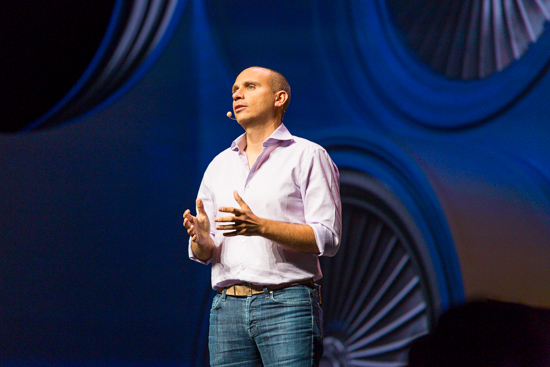
In May 2014, Rubin left eBay after Magento’s Imagine conference. The event offered a very public ending to a long stretch of building. A photograph from the conference catches him onstage, headset microphone in place, speaking to the room. It is an ordinary pose for a founder. What followed was a less ordinary change of calendar.
Rubin and his wife took their children out of school and went traveling. Only the first couple of weeks were planned. They stayed away for fourteen months, moving through Central America, South America, Asia and Europe. Their children were four and seven when the trip began. The plan made family time the organizing principle rather than something fitted between business commitments.
He has described wanting to rediscover himself and get reacquainted with his family after years of travel for work. An acquisition gives a founder a conspicuous milestone; leaving the role creates a quieter question about how to spend the following morning. Rubin’s answer involved being away long enough for the next morning to stop resembling the old one.
There is a useful looseness in an itinerary measured initially in weeks and ultimately in months. Entrepreneurs are accustomed to making commitments before they know exactly how to fulfill them. Here, the open question concerned where the family would go next. For once, the unfinished plan could stay unfinished without requiring a board presentation.
- 2007-08Magento development, beta and full release
- 2011eBay completes the acquisition
- 2014Rubin leaves; a 14-month family trip begins
- 2015Oro advisor, alongside old collaborators
- 2026Investing and debating enterprise software
Old collaborators, new customers
In April 2015, Oro announced that Rubin was joining as an advisor. The move reunited him with Kutner and put his experience with merchants and open-source communities to work in business software. The relationship had traveled from consulting to Magento and now into another company. Connections built while solving one set of problems could be useful when the customers changed.
When OroCommerce launched its first full version in January 2017, Rubin was identified as director of Oro’s advisory board. The product addressed the less picturesque machinery of business purchasing: corporate accounts, customer-specific catalogs, price lists and workflows. A buyer purchasing for an organization has requirements that a conventional consumer storefront may never encounter. The familiar shopping cart conceals some very unfamiliar paperwork.
Rubin’s advice to companies considering B2B commerce was specific. Choose an implementation partner carefully. Define the problems the business needs to solve. Think about where the company wants to be in three to five years, and select technology that can evolve with it. The advice sounds like someone who has watched an exciting purchase turn into a long relationship.
Adobe completed its acquisition of Magento in June 2018. That transaction belongs to the platform’s later history: Rubin had already left its operating leadership. His Magento connection runs through its beginnings, its community and subsequent board work. Keeping the dates straight preserves the more interesting shape of his career, which had continued beyond the chief executive’s chair.
The investor still has programming habits
Rubin now works with Roy Erez at R-Squared Ventures. The firm presents itself as an operators’ fund, drawing on the partners’ experience of building, selling and working inside larger companies. Its network includes more than 80 founders, executives and venture capitalists as limited partners. The proposition is personal as well as financial: the people answering a founder’s call have made comparable decisions themselves.
The interests extend from commerce enablement and marketplaces to fintech, enterprise software and AI. The common thread is a customer problem substantial enough to support a business. Rubin had already discussed merchant profitability and the limits of discounting in a 2022 conversation with Fondue founder Oren Charnoff. Years after Magento, the merchant’s economics still occupied his attention. An elegant tool has to survive the customer’s arithmetic.
In a May 2026 conversation about enterprise software, he returned to customer-funded growth and the changing economics of building applications. He also discussed coding tools and the firm’s own portfolio-management software. The founder who once learned programming to pay rent now has new tools capable of pulling an investor back into the workbench.
That creates a familiar temptation: when making software gets easier, another project becomes difficult to resist. Rubin has publicly reflected on the time spent coding instead of investing. The old question of focus has acquired new equipment. His career began by narrowing a services business to commerce; the present version asks where an investor’s attention earns its keep.
The fifty-cent click remains a good place to leave him. Its value came from the work that followed: a client relationship, an understanding of merchants, a product and the people who gathered around it. Rubin’s later choices added another consideration to that calculation. Building something can change a life. He has also made room to decide what goes into the life around it.