In a small Spanish village, four people were trying to explain a very large catastrophe. The financial crash had left ordinary savers bewildered, while some people inside finance had been discussing the dangers for years. Over wine, the future founders of Real Vision arrived at a question with commercial possibilities: why did understanding the economy depend so much on whom you knew?
- The offer: expert interviews, macro and crypto research, education, tools and investor conversation.
- The customer: the curious individual investor through to the financial professional.
- The wager: people will pay to understand an argument, then discuss it with others.
Raoul Pal, Grant Williams, Damian Horner and Remi Tétot launched Real Vision in 2014. Finance, advertising, writing and design supplied the founding ingredients. Video production, the company later confessed, was something they knew nothing about. One can admire the confidence required to enter television without having mastered television.
01 / Let the guest finish
Their useful insight concerned the shape of an explanation. A financial expert can announce a conclusion in seconds. Explaining the assumptions behind it takes longer. Real Vision chose subscription video over the traditional newsletter, giving investors room to describe the machinery of their decisions. The difference was visible in the format before it was visible in any feature list.
“People’s financial future deserves more than a 3-minute soundbite of information”
Real Vision’s account of its founding
Its guest list has included Stanley Druckenmiller, Lyn Alden, Mark Cuban and Jim Bianco. Such access matters because investing knowledge is often practical and conditional. What evidence does this person trust? How do they size a position? What would make them abandon it? A long interview allows those questions to survive the edit.
For a reader choosing among financial media, that places Real Vision alongside several different alternatives. CNBC supplies market television; Bloomberg supplies news and financial information; independent newsletters supply research. Real Vision’s particular combination puts filmed reasoning, macro analysis, digital assets and member discussion inside one subscription environment. The appeal depends on wanting that combination.
02 / The audience buys a chair
By September 2022, the company reported more than 300,000 members across over 100 countries. That historical figure includes its broader membership, rather than establishing a current paid-subscriber total. Its audience stretches from individuals learning market vocabulary to family offices and experienced financial professionals. Each can watch the same interview and come away needing something different.
In Real Vision’s reported member footprint in September 2022. A financial conversation with a very long guest list.
That diversity helps explain the membership ladder. Connect emphasizes community, education and trade ideas. Alpha adds dashboards, deeper analysis and chart discussions. Pro offers macro and crypto research, portfolios and direct expert sessions. The price rises with the amount of research and access. Expertise has acquired a seating plan.
At this research snapshot, those annual prices were $399, $899 and $4,999 respectively. Connect also advertised $49 monthly, Alpha $99 monthly and Pro $1,499 quarterly. Free membership provides a way to sample the company’s programming. The separate Exponentialist service, created by Pal and David Mattin, connects technological change with investment research; its app listing showed $799 per six months.

03 / The channel that needed another try
In its tenth-anniversary account, Real Vision discussed an earlier trade-ideas channel with unusual candour. Pal wrote that the timing had been premature and “our execution was lacking”. The company later returned to trade ideas through a community feature. Its birthday competition rewarded both high returns and well-reasoned entries, making argument quality part of the occasion.
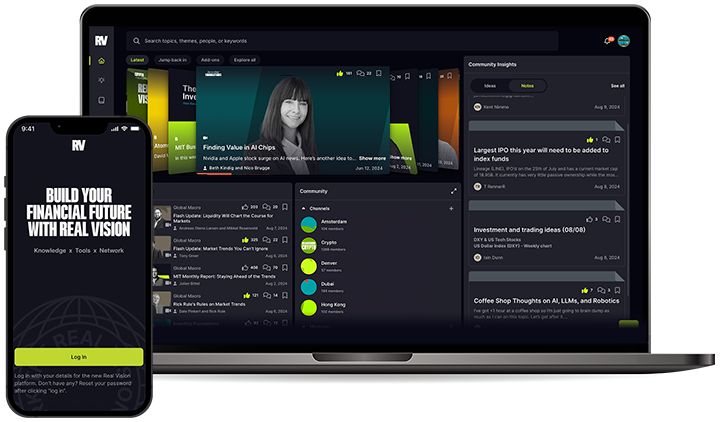
The important change was who participated. An interview business asks members to listen. A community product asks them to contribute. Today the website emphasizes member trade theses, targets, updates and leaderboards, alongside a social feed. Real Vision’s own account says it gradually recognized that its business had become a community. The audience had material of its own.
There is a practical lesson here for publishers: let a knowledgeable audience do something with the material. Give an idea a thesis, an update and an opportunity for scrutiny. A discussion can reveal a missing assumption; a recorded trade can make an opinion easier to revisit. Participation needs structure if it is to produce anything more useful than applause.
04 / Customers with a second job
The subscription relationship also reached into financing. In June 2021, reporting on a planned $35 million Series C described $25 million secured and $10 million being finalized. The backers included subscriber family offices, institutions and accredited investors. Pal earmarked the expansion for acquisitions, product development and education. Customers were helping finance the business they already used.
More recently, software has joined the conversation. Real Vision promotes an AI assistant for questions and summaries, alongside a market heatmap and performance leaderboards. MarketReader has publicly demonstrated its analysis powering market recaps delivered by a digital avatar of Pal. The commercial logic is understandable: a growing library becomes more useful when members can interrogate it and find relevant material quickly.
05 / Bring your own judgement
A sensible way to use the service begins with a question: how might a change in liquidity affect a market, or what invalidates a particular trade? Watch an explanation, examine its assumptions, then compare it with another view. That suggested routine turns an interview into work you can inspect. Merely collecting confident opinions leaves the hard part untouched.
Real Vision’s publishing terms put a boundary around the promise: its information is general, rather than tailored to a particular investor. A model portfolio cannot know your cash needs. Community agreement cannot remove market risk. The service fits people prepared to study and test arguments; someone seeking a personal financial plan needs a different relationship. A chair at the conversation still leaves the decision in your hands.