Consider five characters: $AAPL. On an ordinary social network, Apple might mean a company, a telephone, or somebody’s lunch. Add the dollar sign and the ambiguity disappears. The people discussing the stock can find one another. Stocktwits built a business around that small reduction in effort. Its history is a reminder that a useful online community often begins with an unusually good answer to a mundane question: where should this conversation go?
- Cashtags gather investors around particular stocks and crypto assets.
- Sentiment tools describe the crowd’s conviction, not tomorrow’s price.
- Stocktwits sold its brokerage accounts to Public in 2024 and concentrated on community, information, and data.
Five characters, one meeting place
Howard Lindzon and Soren McBeth started Stocktwits in 2008 as an application built on Twitter. The organizing device was the cashtag: a dollar sign followed by a ticker. In November that year, investor Fred Wilson described their Firefox extension turning ticker mentions into links to Stocktwits. The early product helped people navigate conversations they were already having. It did not require them to acquire a new enthusiasm.
The setting mattered. Writing in October 2008, journalist Mathew Ingram described traders exchanging tips, rumors, jokes, and profanity amid violent market swings. Finance had plenty of formal commentary. What these users wanted was closer to the running conversation across a trading desk. An elegant annual report cannot answer the emotional question of what everyone else thinks right now.
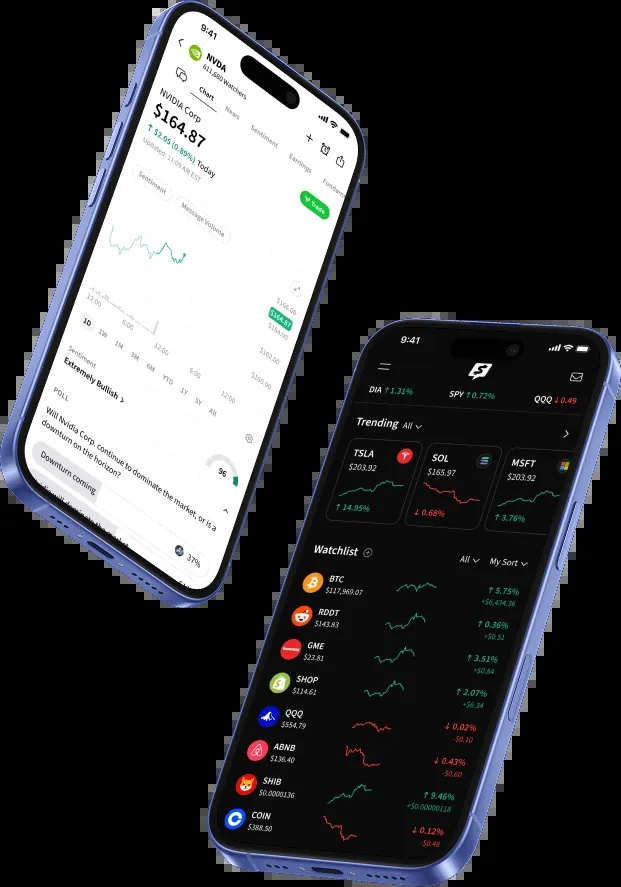
Today, Stocktwits operates independently, with web and mobile experiences for stocks, ETFs, and crypto. It reports more than 10 million users. That is the company’s audience figure, rather than a count of people active every month. Its customers include individual investors looking for ideas, active traders following reactions, and businesses paying to reach or understand those people.
The mood is a measurement
A ticker stream is both a conversation and a record of attention. Stocktwits converts public activity into several measures. Sentiment combines bullish and bearish tags with engagement and discussion, giving recent activity greater weight. The company says it does not use private holdings, order flow, or price movement to calculate that sentiment. The material being measured is what the community says and does publicly.
Message Volume asks how much chatter a ticker is attracting relative to its usual activity. Participation Ratio asks whether many accounts are contributing or a smaller group is posting repeatedly. Those are different questions. A crowded room and one person shouting into a microphone can produce comparable noise. A reader who checks participation alongside volume has a better chance of telling them apart.
Sentiment
How does the crowd feel?
Message Volume
How loud is the conversation?
Participation Ratio
How many voices are contributing?
This is also the product’s limit. A bullish community can be mistaken. A discussion stream samples its participants, not every shareholder or every prospective buyer. Stocktwits’s own guidance treats sentiment as a supplement to news and research. The useful question is what deserves investigation next. Treating popularity as proof of value would turn an attention tool into a rather expensive popularity contest.
The expensive detour to the trade
There is a tempting next step for a company surrounded by investors: let them transact. In December 2021, Stocktwits announced a $30 million Series B involving Alameda Research and Times Bridge, at a $210 million valuation. Lindzon’s announcement described brokerage-account integrations among its ambitions. Funding could support a wider product, but possessing an audience did not settle which business the company should become.
By April 2024, Public had announced an agreement to acquire Stocktwits’s TradeApp investment accounts. Stocktwits would continue operating its community. Public’s later customer documentation records a May 2024 transfer. The distinction is important: the network survived while its brokerage accounts moved elsewhere. Readers could still talk on Stocktwits without keeping their investments there.
“Tens of billions are being spent to win the ‘transaction’ which is a war we could never win.”
Howard Lindzon, writing about Stocktwits’s strategy in 2025
That was Lindzon’s explanation for concentrating on the moments before and after a trade. His account describes competitive spending as the problem. The inference for other founders is straightforward: enthusiasm for your community does not establish demand for every adjacent service. A discussion business can have a loyal audience while an execution business needs a different scale and a different reason for customers to switch.
Bring the call to the crowd
The subsequent partnerships offer a more economical product logic. In July 2024, Quartr announced an API agreement bringing earnings calls and public-company materials into Stocktwits. Investors could hear a company’s executives while participating in the discussion around its results. The event and the audience were already a natural pair; Stocktwits could connect them through a specialist provider.
Cryptotwits, launched in May 2025, extended the conversation model across more than 17,000 coin pages. Grayscale joined as asset-management partner, Gemini as centralized-exchange partner, with other crypto businesses among the founding partners. Existing Stocktwits users were automatically included. The familiar habits of following symbols, building watchlists, and reading sentiment could travel into another asset class without requiring an entirely separate social identity.
A free room, a paid memory
The core network is free. Advertising and sponsorships monetize attention; subscriptions sell additional convenience and data. When checked in October 2026, the web page displayed annual offers of $85 for Ad Free and $229.50 for Edge. Edge adds historical sentiment, expanded market and watcher data, advanced search, and longer posts. Enterprise customers can inquire about personalized API access.
Among alternatives, X, Reddit, and Discord host financial conversation; TradingView adds social interaction around charts; Seeking Alpha offers investment commentary. Stocktwits’s particular strength is the ticker as the common address. A practical starting routine is to follow a few relevant symbols, compare sentiment with participation, read the underlying announcement, and then inspect the disagreement. The disagreement may be more useful than the applause.
Other builders can copy the organizing principle: give an existing conversation a clear destination, then add tools that help people understand it. That works best when people return to the same subject and have something timely to exchange. For Stocktwits, the subject can be a stock, the occasion an earnings call, and the product a room that remains useful after everyone has finished placing their orders.