A bouquet has two customers. One pays for it. The other opens the door. Abdulaziz B. Al Loughani built a business around the awkward distance between them: the sender wants the flowers in the photograph, the recipient gets the flowers in the box, and a great deal can go wrong in between. Romance, it turns out, requires operations.
Al Loughani had already worked on online food ordering, private equity and public support for entrepreneurs when flowers drew him back into running a business. With Floward, the Kuwaiti founder chose to take responsibility for the physical product as well as the screen. Buying flowers, arranging them and getting them to the door became part of the same job.
It is an unusually tangible occupation for someone who also makes venture investments. His career moves between the spreadsheet and the delivery, the investor’s question and the customer’s complaint. The interesting part is how often he returns to the same concern: whether the thing being built actually works for the person using it.
“Pressure and I became very close friends.”
Al Loughani, recalling his move into running Talabat
The investor takes the calls
His account of entering Talabat begins in 2007, when he was working in private equity at Global Investment House. Late that year, he and fellow investors acquired a majority stake in the food-ordering business. He became its managing partner. The distance between setting targets for managers and meeting them himself disappeared.
“Pressure and I became very close friends,” he later wrote. A rewards feature called Nag-Negg Fiesta supplied a particularly sharp introduction. It had been tested repeatedly, yet customers found the points confusing and the Arabic content inadequate. The team watched real behaviour, gathered feedback and rebuilt it overnight. His lesson was practical: a feature functioning correctly was only the beginning of knowing whether customers wanted it.
He left Talabat in 2010, selling to Mohammed Jaffar. Jaffar subsequently expanded the company and sold it to Rocket Internet for $170 million in 2015. Keeping those two transactions distinct matters. Al Loughani’s chapter was the earlier one, when a regional food-ordering story was still being assembled in Kuwait.
A detour with a national budget
Education gave him another way to examine that experience. He holds a bachelor’s degree with a double major in information systems and e-commerce from the University of Toledo, followed by an MBA from London Business School. His professional work also included a directorship at Global Capital Management, where his responsibilities covered investments and the establishment of a venture-capital practice.
From 2013 to 2017, he served as the founding executive vice chairman of Kuwait’s National Fund for SMEs Development. The institution had a $7 billion mandate. For someone who had run a young company, it was an opportunity to work on the conditions in which many others would have to operate.
He had gone back to school after leaving Talabat with questions about the gaps in Kuwait’s entrepreneurial community. In his account, a project on late-stage venture funding grew into a much broader effort to build support for entrepreneurs. He described four areas requiring attention: funding, law, education and mindset. Money alone would leave too much unfinished. A founder also needed people, workable rules and a community prepared to take the idea seriously.
His subsequent investment work included co-founding Faith Capital with Jaffar. The connection outlasted their Talabat transaction. It also put Al Loughani on both sides of the founder-investor conversation: asking for capital in one room, considering someone else’s request in another. That combination helps explain his attention to the machinery behind a promising idea.
The flower shop that needed work
Floward’s beginnings were less tidy than an empty market waiting for an app. In 2016, Al Loughani and his partners had a troubled investment in Q8 Flowers. They stayed with it, rebuilt the operating model and rebranded. Floward began operating in 2017, with Mohammed Al Arifi as his fellow co-founder.
The name itself joins English and Arabic: flower and ward, the Arabic word for flower. A small linguistic bridge suited a business that would eventually connect customers across the Gulf and beyond. The ambition began with an existing habit, buying flowers, and a belief that ordering them online could be more dependable.
The early investment also complicates the usual founder story. Here, the opportunity arrived with something already needing repair. Walking away and building something new would have been a different decision. Al Loughani and his partners instead took on the work of turning a local operation into a repeatable business.
A gift has an audience of two
He could have built a marketplace linking customers with existing florists. Instead, Floward procured its own stock, prepared arrangements and handled delivery. In his explanation of that choice, the central problem was the sender-recipient relationship. Someone buying a gift may never inspect what arrives. The product photograph therefore carries an unusually heavy burden.
Al Loughani’s answer was to control more of the journey. This also meant doing more work in each new location. A website can cross a border rather easily. A workshop, a florist and a delivery operation require somewhat more persuasion.
By December 2022, another small obstacle had become a useful example of his approach. Senders did not always know the recipient’s address. Floward used automated SMS and WhatsApp communications to collect it from the recipient. The gift could travel without making the sender conduct an interrogation first. Courtesy acquired a technical specification.
London, with a video attached
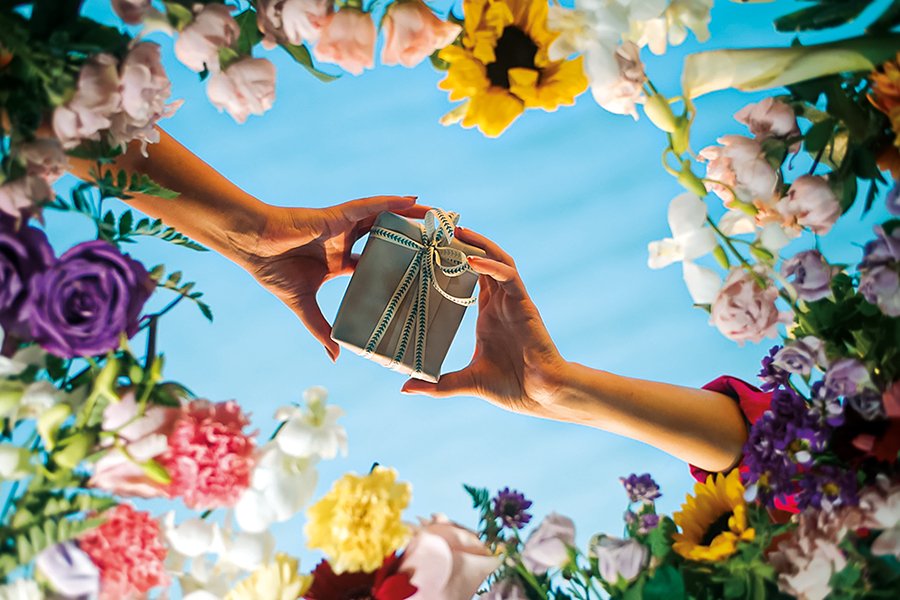
In 2021, Floward expanded into the UK. Al Loughani saw room to bring its gifting approach into an established online retail market. The offer included same-day delivery in London and a personal flourish: senders could attach a video message, opened through a unique QR code.
A card gives the recipient your handwriting. A video gives them your voice, your expression and, possibly, evidence that you recorded it in a hurry. Both serve the same purpose: making a purchased object feel like something that could only have come from you.
His discussion of the UK in October 2026 returned to the connections between Britain and the Gulf, including study, investment and the people who treat Britain as a second home. Geography followed existing relationships. The expansion placed his business in another setting for a familiar human transaction: remembering someone when you are somewhere else.
When the numbers change the questions
By 2022, Floward had become large enough to force choices about its next direction. A Harvard Business School case described a business that had served more than 400,000 customers and recorded compound annual growth above 160% between 2020 and 2022. Should Al Loughani push further internationally, or deepen the gifting business closer to home?
In February 2023, Floward announced a $156 million Series C round led by Aljazira Capital, Rainwater Partners and STV. The announced plans included acquisitions, additional gift categories and investment in artificial intelligence and machine learning. Fragrance brand Mubkhar had already joined the business. Flowers were becoming an entry point into a broader set of purchases.
Floward’s Series C round, announced as pre-IPO financing.
The term “pre-IPO” describes an intention at that moment. Preparing for a listing introduces decisions about where to list, which advisers to hire and what shareholders want. Al Loughani’s next challenge was to reconcile expansion, profitability and investor liquidity. Success had supplied a more complicated agenda.
Breakfast, running, and the long view
His own writing offers a quieter picture of how he thinks a company should run. Recalling Talabat, he described a weekly breakfast open to everyone in the business. As the team grew, written procedures accompanied the informal contact. The purpose was to help new employees understand the company and keep the operation coherent.
He has also argued for clean accounts, legal compliance and a board willing to challenge the founder. These are unglamorous preferences. They are also the details that become rather interesting when a buyer starts asking questions. In his view, a company should be built to endure, whether or not an exit arrives.
For his own problem-solving, he has a daily running habit. Asked in 2022 where he found inspiration on a bad day, he explained that running let him reflect on his decisions and break problems into smaller pieces. There is a pleasing continuity between that description and his work: take the complicated thing apart, examine it, decide what needs changing.
Another influence came from a conversation with Henry Moon, his organizational behaviour professor at London Business School. Al Loughani recalled the discussion while writing advice for people at the beginning of their careers. He urged them to seek feedback, spend time around people who knew more than they did and become approachable colleagues. His interest in mentoring sits comfortably beside that advice. Learning, in this account of a working life, depends on the company you keep as well as the company you build.
The next founder gets a seat
Recognition has gradually given him more opportunities to support other entrepreneurs. In 2021, he became the first Kuwaiti selected as an Endeavor Entrepreneur. In March 2026, he joined Endeavor Saudi Arabia’s board, extending a relationship built around mentorship, networks and helping founders grow.
His perspective on the region also has a consistent starting point. In 2020, he described Kuwait as a useful place to test online consumer businesses because of its connected consumers, infrastructure and compact geography. He saw opportunity in established offline industries. Turning ordinary purchases into reliable online services was work enough.
By October 2026, he was discussing Floward’s robotic flower vending machine and a business operating in nine countries and 40 cities. The machine addressed people who needed a gift immediately, perhaps because an occasion had slipped their mind. Al Loughani’s career has taken him through investment committees, a national fund and international expansion. At the customer’s end, the question remains delightfully small: can the flowers be ready in time?