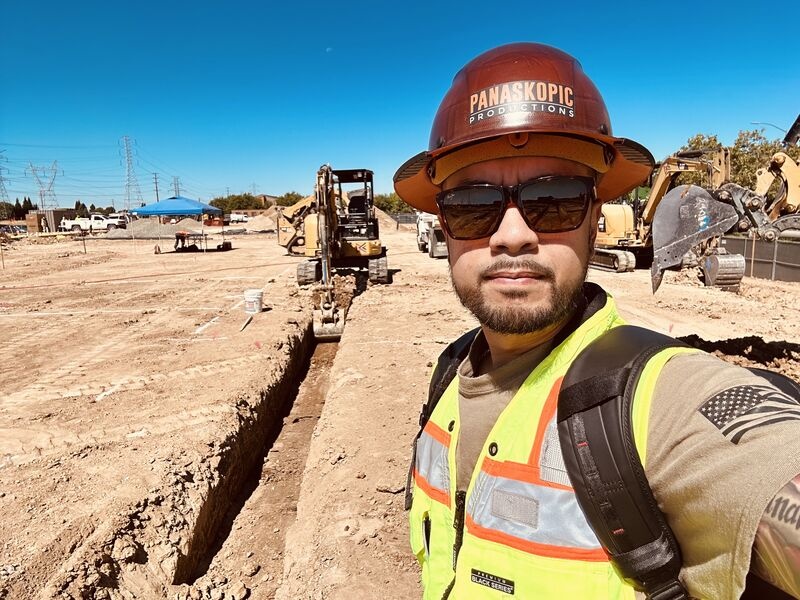
A trench is a poor place to put a desk. In a photograph Roy Panaligan shared in July 2024, he stands beside one anyway, taking a break from office life in a hard hat, dark glasses and a high-visibility vest. Behind him are earthmoving machines and a construction site still a long way from its finished photograph. His teams, he wrote, were shooting from the South Bay to Sacramento that day. For the founder of a marketing company, it is a useful place to be reminded what the company is selling.
Panaligan’s business, Panaskopic Productions, helps construction companies explain themselves. That sounds modest until you consider the material. A contractor can have experienced crews, substantial projects and a perfectly unconvincing website. The people who know the work may be impressed. The people choosing the next team may never get that far. Roy’s career has developed around the distance between those two audiences.
He came to the problem through construction operations, with experience at a general contractor and a fire protection subcontractor. Those are different positions in the same working world: the business coordinating a project and a specialist business contributing to it. Panaskopic’s focus, dating to 2015, grew from his observation that companies could be better at doing their work than presenting it. The building was substantial. The introduction needed attention.
A contractor’s eye for the introduction
The early problem was specific. Outdated websites, uneven project photography and proposal materials could leave capable firms looking less established than they were. Roy built a company to work on those problems together. The audience was construction: general contractors, subcontractors and vendors, with their different jobs and overlapping relationships.
There is an appealing lack of glamour in the starting point. Nobody needs to invent a personality for concrete. Someone does need to show what a particular company contributed, how its people work and why its experience is relevant. A contractor’s reputation can be strong among existing clients while its public presentation remains several projects behind.
That helps explain the breadth of Panaskopic’s work. Photography supplies material for a website. A project description can become part of a statement of qualifications. A photograph of a crew gives the business a human face. Each assignment has a use beyond being something new to post. The finished marketing should make a contractor’s existing competence easier to recognize.
The advice was already there in 2017
Roy’s published writing puts dates on his thinking. In February 2017, his advice to construction companies centered on original photography, websites that work on smaller screens and pages with less clutter. He warned that generic images would leave a generic impression. A company paying for a website, in this view, should give visitors a reason to remember whose website it is.
The small-screen point is particularly practical. He described having to redo sites that looked fine on laptops but failed on tablets and phones. The concern fits an operator’s sensibility: a presentation is useful when it works where the customer encounters it. The beautifully arranged desktop page gets no special dispensation from a person holding a phone.
In March, he described Panaskopic as a team comfortable in both planning meetings and jobsite protective gear. By June, his advice extended from referrals to proposals and choosing a market. He challenged the familiar contractor claim that every job size is welcome, arguing instead for a clearer account of the work a business wants.
“In our experience of building websites for clients, less is more.”
Roy Panaligan, June 2017
His social media advice had a similarly selective streak. A home remodeling business and a large commercial contractor might need different channels. Keeping an account that nobody has time to maintain could do little for either. The recommendation was to follow the audience and show relevant work. It is an agreeable position for anyone who has ever met an abandoned business account still wishing everyone a happy new year.
A camera before the handover
The July 2024 jobsite photograph brings that thinking back to the field. Roy’s face fills one side of the frame. The trench runs into the distance on the other. The equipment has not been tidied into an architectural composition. There is enough unfinished ground to make clear that this is a working day, with work still to do.
Panaskopic’s active-site photography service includes crews at work, field leaders, trade-specific details and aerial images. The material is edited and organized for uses including websites, social media and proposals. Photographing a completed project serves another purpose: recording the result, with interiors, exteriors and details that a contractor can return to when describing its experience.
The distinction matters to the story Roy is helping clients tell. A finished photograph shows what stands there. An active-site photograph can show the contribution that made it possible. The two belong together. One gives the viewer the destination; the other leaves room for the people and coordination along the way.
A service map of the work Panaskopic offers, rather than a measure of sales results.
The next step is often a document with a thoroughly unromantic name: a statement of qualifications. Panaskopic offers project write-ups, team biographies, organizational charts and proposal templates alongside photographs. These are the materials that help a selection team understand relevant experience. The camera’s work continues after the camera is packed away.
The Christmas deadline
One client’s account gives the production work a more demanding shape. Jason W., identified as a regional market manager, approached Roy’s team in the final week of October 2020 about a video. He wanted to show projects and the effort behind them. The requested delivery window was the week of Christmas.
The assignment involved CTF facilities across California and multiple project sites. In his testimonial, Jason described Roy and Hazel developing the outline, offering feedback and keeping him informed. He said they delivered the video within the narrow schedule. This is a client’s assessment, with the enthusiasm of someone pleased that a difficult brief reached the screen.
It also supplies a useful picture of the work between the finished frames: planning visits, coordinating locations and checking that the film follows the agreed idea. In that account, Roy appears alongside Hazel, rather than alone with a camera. Today, Panaskopic lists him as chief executive and Hazel as chief operations officer. Their roles sit within a team whose work includes production, client service and marketing.
The second office made room for the first
In June 2023, Roy announced that the business had the keys to a second office. The production team would use the new space. The primary office would support expanded operations for Panaskopic Printed & Stitched Uniforms. As expansion announcements go, it contained a useful floor plan.
The uniforms business makes the scope of his enterprise unusually tangible. Panaskopic can help a contractor with its digital presentation and with the jackets, hats, polos and vests its people wear. In another June post, Roy described an RCM Fire order whose logo included a gray gradient. He was pleased that the embroidery machine had reproduced it. Marketing, here, involved thread and a very particular shade of gray.
Workwear is an everyday way a company becomes recognizable. It also keeps the business close to its chosen customers. The same firms that need project photographs have teams to outfit. The office arrangement shows how that connection had become operational: space for one side of the business created room for the other.
In Roy’s June 2023 announcement, the production team moved to the second office so the primary space could accommodate the uniforms operation.
His January 2024 post about jobsite banners shows another connection. He thanked partners for letting Panaskopic display them and said the company worked with an average of eight businesses on each site. His ambition was cheerfully direct: “We are gunning to work all of them.” A wink followed. The next prospect might already be working on the other side of the fence.
A place in the next conversation
That ambition follows the structure of construction itself. One project brings different businesses into contact, each with its own experience to explain. Roy’s background spans two positions in that network, and his company serves several more. His interest in working across a site is an extension of the setting he already knows.
Panaskopic now offers a wider range of services, including search optimization, paid advertising and lead generation. The company serves contractors nationwide. Yet the most revealing details in Roy’s public working life remain small enough to picture: a badly scaled website, an embroidered gradient, the keys to an office, a selfie beside a trench.
They keep his business story close to its original problem. Construction companies make things people can walk into, drive past and point at. Their contribution can still need explaining. Roy’s work is to help that explanation reach someone who has another project in mind.
The trench in his photograph will not remain open forever. The project will move on, as projects do. Somewhere between the work underway and the completed view is the material he has built a company to notice. His next useful introduction may begin there, before the ground closes over.