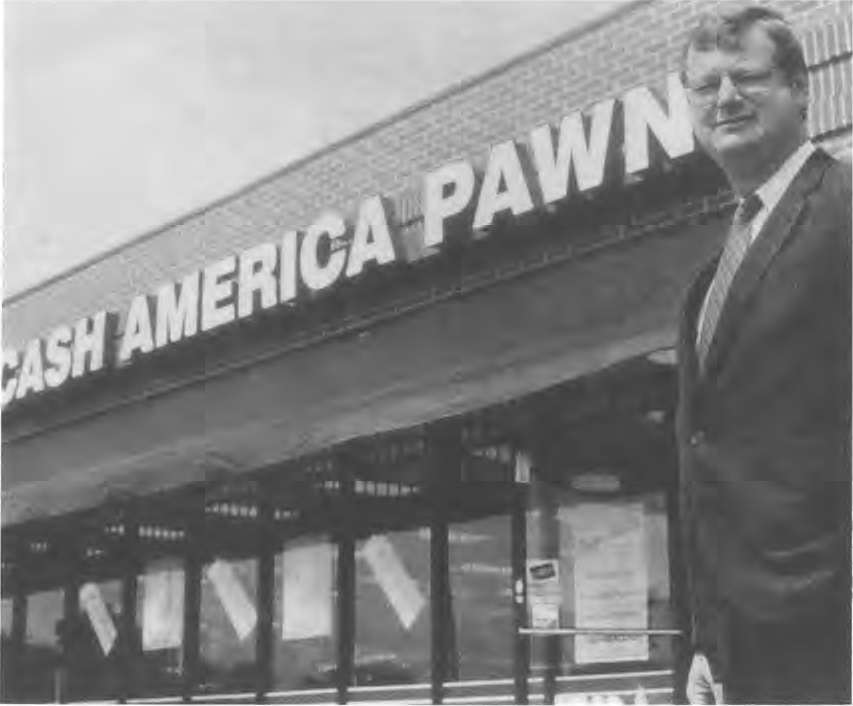
At Jack Daugherty’s Cash America, an office job could come with a spell behind a pawn counter. Secretaries, accountants and even the president spent time in stores, learning how employees appraised goods, assessed a customer’s borrowing needs and wrote loans. Headquarters was expected to understand the business it was administering. The title on the office door offered no exemption from the merchandise.
Consider Vicki Stanley, Daugherty’s secretary. After working in a store, she understood how the goods were handled. When a clerk called with a question, she could help. It was a modest operational victory: one less person transferred, one less explanation repeated, one less small frustration between a branch and the people supposedly supporting it.
That practice offers a useful way into Daugherty’s career. Cash America would become a public company with international operations. Its founder’s operating idea, however, depended on what happened at a counter, in a conversation, with a customer who needed money and an employee who had to put a value on something.
Oil could disappoint. Pawn had a counter.
Jack Randolph Daugherty was born in Dallas on May 17, 1947, and grew up around Irving and Haslet. Basketball took him to Ranger College and Texas Tech on scholarships; he later attended Texas Wesleyan. In 1971 he opened Ace Pawn Shop. His business interests also wandered into oil, an industry capable of making even an energetic Texan reconsider his plans.
When the oil business faltered, he returned his attention to pawn. Cash America took shape in 1983 and was incorporated in Texas in 1984. Those beginnings matter because Daugherty arrived with experience in the trade. He was building on a business he already knew, after trying his luck elsewhere.
A pawnshop offered a direct encounter with value. There was an object to examine, a customer to speak with and a transaction to complete. Turning that local exchange into a chain required more than purchasing additional premises. The judgment exercised at one counter had to become something another employee, in another town, could reliably repeat.
A chain is made of habits
Daugherty’s stores emphasized good lighting, employee training and centralized management. New employees went through three months of classroom and practical instruction. Managers had a year-long program covering such unromantic necessities as recruitment, merchandise control and costs. The business of changing an industry’s image included a considerable amount of homework.
Computerized inventory helped hold the expanding operation together. A pawn chain handles goods with different histories, conditions and resale prospects. Consistency requires a way to gather that information and make it useful beyond the person who first examined the item. The storefront might look friendlier; the organization behind it had to become more methodical.
Cash America’s later operating descriptions show how far that logic extended. An internal pricing and research department reviewed thousands of items to help keep loan values aligned with the market for used merchandise. Employees received product education as well as instruction in the transaction itself. Valuation was work to be supported, rather than a gift headquarters could simply demand.
During Daugherty’s chairmanship, the company also described a retail system in which roughly 70 percent of pawn customers returned to reclaim their property. The remaining goods could become stock for shoppers. A counter therefore served two audiences, sometimes through the same object: its owner seeking a loan and a later buyer seeking a bargain.
In the mid-1990s, Daugherty used the company’s inventory system to identify a problem: too much stock was sitting in stores, and the retail side had drawn attention away from lending. A chain could look busy while its money remained tied up in merchandise. The response was to sharpen the focus on loans and returns on the cash committed to each location. That episode gives the computer system a less decorative role in the story. It helped the founder see where the company’s own habits needed correcting. Standardization could expose a mistake as well as spread an idea.
The pawn ticket reaches Wall Street
In 1987, Cash America went public. In 1990, it listed on the New York Stock Exchange. The distinction is easily lost in a brisk founder biography, but these were separate steps in putting public capital behind an expanding business.
Acquisitions helped carry the company beyond its Texas beginnings. In 1992 it bought Harvey & Thompson, a British chain with 26 locations. Sweden followed in 1994. By the end of 1999, Cash America counted 477 pawnshops: 424 in the United States, 42 in the United Kingdom and 11 in Sweden.
Bar lengths show location counts on the same scale.
The counts could outrun the founder’s immediate recall. Asked in 1993 how many U.S. shops he owned, Daugherty paused to check. There were 225. “I have to ask somebody every week,” he said. The line has the pleasing inconvenience of a business growing faster than its owner’s mental directory.
Scale also changed what the company had to organize. Its 2004 strategy paired acquisitions with new shops, common procedures and concentrations of locations in particular markets. More stores in a region could reinforce the brand and its marketing. The founder’s idea had become an operating system that other managers could continue to use.
“I have to ask somebody every week.”
Jack Daugherty, on keeping up with his store count, 1993
Courtesy has a price
Daugherty sometimes arrived at stores unannounced and questioned customers in the parking lot. He wanted to know how they were being treated. It was an unusually direct route around an organization’s talent for telling its leader that everything was going well.
Yet better treatment and cheaper borrowing were separate questions. He acknowledged that customers using pawnshops and check cashers paid more than bank customers. His explanation concerned the economics of processing small transactions: paperwork takes effort even when the amount advanced is small. Consumer advocates criticized the costs of the wider industry. The argument accompanied its expansion.
The pawn contract itself helps explain both its appeal and its stakes. Cash America’s loans were secured by personal property and were generally due within 30 to 90 days. A customer could repay and recover the item. If the customer forfeited it, the company relied on selling the property to recover its money. The loan was non-recourse: the collateral stood behind it.
Cash America also offered unsecured consumer loans, a separate product with a different basis for approval. Its pawn business depended on the pledged goods; its consumer lending involved an assessment of the borrower. Keeping those activities distinct matters when reading Daugherty’s career. The company’s name came to cover several services, and growth in one did not describe every transaction in another. A pawn counter, a check-cashing outlet and an unsecured loan were different ways of doing business under the same corporate roof.
For an operator, this joins lending to retailing. Money goes out against an object; money returns through repayment or a sale. For the customer, the object may carry a usefulness or attachment beyond its resale value. A well-run counter has to deal with the item in front of it and the person who brought it there. Daugherty’s service ambitions sat inside that more difficult commercial exchange.
The company outgrows the founder’s desk
Daugherty retired as chief executive on February 1, 2000. Daniel Feehan succeeded him, while Daugherty stayed chairman. Feehan described the founder as a mentor and friend. The change separated two jobs that had long belonged to one person: running the company each day and leading its board.
The company that continued under that arrangement had experiments to reconsider. Its diversification into innoVentry and Rent-A-Tire proved unsuccessful. By 2001, management had abandoned that strategy and refocused on its core lending business. Expansion had produced ventures that required unwinding as well as stores that could be counted.
The refocusing also exposed the business’s complicated relationship with the economy. Cash America described employed blue-collar workers as an especially profitable customer group. Reduced hours could create demand for a short loan, while prolonged unemployment could undermine the customer’s ability to use the service. The familiar idea that pawnbrokers simply prosper whenever times are bad misses that distinction.
Daugherty remained chairman until November 1, 2015, then continued as a director. Feehan took the executive chairmanship as T. Brent Stuart became chief executive. The succession was a sequence of responsibilities moving between people, over years, rather than a founder disappearing on the afternoon he stopped being CEO.
In September 2016, Cash America merged with First Cash, and the combined company became FirstCash. The business Daugherty founded entered another corporate chapter. His career had helped make a fragmented trade more recognizable to public investors; the company itself would continue through a larger combination.
Back to the lake
For all that geographic expansion, Daugherty’s personal map kept returning to Texas. He married Shelley in 1971 after meeting her as a teenager at Eagle Mountain Lake. They moved back to the lake in 1978. There were three daughters and, eventually, nine grandchildren who called him Pop.
He hunted, fished and spent time ranching, with outdoor travels reaching well beyond the state. He died on February 3, 2022. The lake remained part of the life even as the store network grew abroad.
One small headquarters policy still makes a fitting final measure of his operating instincts. The person answering a telephone needed some understanding of the person calling from a shop. That was a practical standard, close enough to ordinary work to be overlooked. Daugherty made room for it inside a company ambitious enough to cross an ocean.