A blue rim around a white mug is an unlikely place to begin a story about a technology founder. But Peter Hames has spent part of his working life explaining why that rim matters. At Falcon Enamelware, the familiar outline survived as the range acquired new colours and heavier steel. A camping staple could belong on a kitchen table. The object stayed recognisable; the reasons to buy it expanded.
Hames is better known as the co-founder and former CEO of Big Health, and now works at Microsoft AI. Yet the cookware belongs in the picture. So does karaoke. His working life has crossed businesses with very different products, leaving him with a practical interest in how people discover something, understand its appeal, and decide to use it.
First, pass the microphone
Before Big Health, Hames was head of business development at Lucky Voice, the karaoke company associated with Martha Lane Fox. In later recollections, he credited that experience with teaching him how to build digital products and bring them to market. His Oxford degree was in experimental psychology. His commercial education had a more varied soundtrack.
In 2008, Lucky Voice was taking karaoke beyond its private rooms and into the browser. The proposition was wonderfully ordinary: people could sing at home, with their friends, without having to turn an evening into a public audition. Hames described the possibility in terms of an older habit, people gathering around a piano. The computer supplied the accompaniment.
There was work beneath the party. A reviewer who tested the service offered detailed feedback about playlists, navigation, and the business of keeping a song request moving. Hames helped arrange a loan of equipment and received thanks for taking suggestions on board. It is a small glimpse of business development at ground level: a product, a person using it, and a list of things that could be less awkward.
Karaoke gives that work a useful deadline. Nobody wants the software to become the main event halfway through a chorus.
The mug gets a second act
By 2013, Hames was also talking about Falcon, a British enamelware brand with roots in 1920. He described its appeal through affordability, durability, and familiarity. Its white surface and blue edge already carried associations. The job was to give those associations a place in contemporary homes.
His explanation could be technical. Steel is formed, coated in enamel, and fired. The rim is painted by hand before another firing. Colours depend on reactions in the kiln, and differences in temperature can produce variations. For someone whose career would become associated with software, he was quite comfortable discussing the stubborn behaviour of a physical material.
He also talked about shared meals and the attraction of a pie on a table. Falcon was selling overseas, including in the United States, Japan, and Australia. A familiar British object could travel without surrendering the features that made it familiar in the first place.
The changes could be felt as well as seen. Hames explained that thicker steel gave the mug more substance for use at home. Even new colourways kept a contrasting tonal rim. This was careful adjustment to an existing design, with the recognisable outline doing some of the selling.
Cookware is a useful companion to a technology career. The customer can pick it up. An elegant explanation will only get you so far if the handle feels wrong.
- 2008Lucky Voice
Karaoke moves online - 2010Big Health
Co-founded with Colin Espie - 2011Falcon Enamelware
Becomes a company director - 2022A different seat
CEO to president - 2024Microsoft AI
A new company chapter
A customer before a cheque
When Hames discussed fundraising advice in 2016, he began with the buyer. Founders should understand the need, the opportunity, their advantage, and the skills required to take a product to market. His advice gave early paying customers a place alongside product validation. Investment would be easier to attract if a business had already made progress for itself.
It was an argument for learning through commercial work. Pricing, investment, and a route to market were skills to practise. A background outside the sector you eventually enter could be useful preparation. Seen that way, a karaoke company earns its place on the CV.
Big Health, which he co-founded with Colin Espie in 2010, had its own extended period of working with limited resources. Its first institutional funding arrived in 2014. Hames later said those constraints encouraged ingenuity. He resisted presenting the company’s development as the execution of a plan that had been perfectly legible from the start.
That admission makes the career easier to understand. A founder can be purposeful while changing his mind about how to get somewhere. Experience supplies corrections, sometimes after a product has already reached the customer. A tidy biography tends to edit those corrections out.
“a winding case of trial and error”
Peter Hames, describing the early commercial journey
Twelve years, then another chair
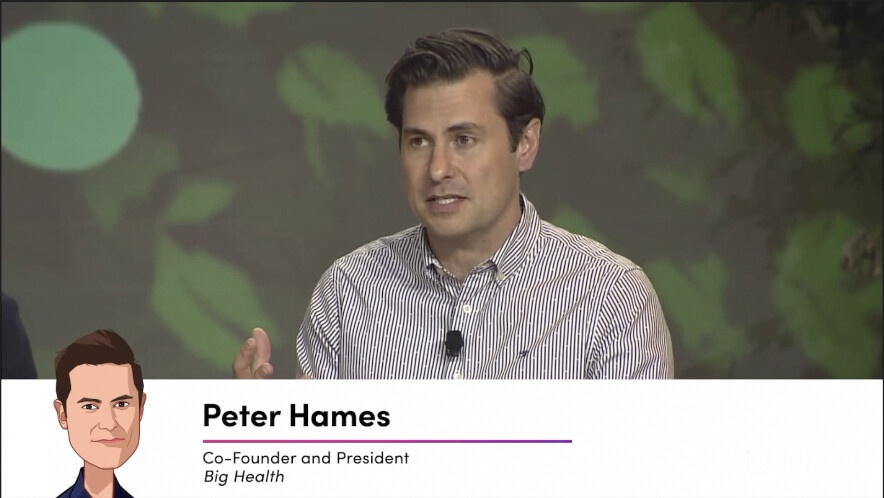
In August 2022, Hames announced that he would become president of Big Health after twelve years as CEO. The new role covered strategy, partnerships, and vision. Executive chairman Arun Gupta would also become acting CEO, following an invitation from Hames, Espie, and the board.
The announcement described a change in the leadership the company needed as it grew. Hames remained involved full-time. The board would continue evaluating candidates and the leadership arrangement. There was room in the account for a founder to keep contributing while someone else took the chief executive’s job.
Company titles can make a working life look deceptively simple. CEO appears as a single box, even when the business underneath it has changed repeatedly. Twelve years in the role is a substantial stretch of building, hiring, negotiating, and revising. A change of chair can acknowledge that the next set of demands may call for a different arrangement.
From co-founding Big Health in 2010 to becoming president in August 2022.
Leaving a company you founded
The next change went beyond a title. In a public update in March 2024, Hames said he had decided to leave Big Health the previous year. After thirteen years, he wanted to give more attention to friends and family, including a new daughter, and make room for a fresh team.
He gave credit to the many people who had worked on the company, singling out Espie. His account of the partnership was affectionate and grateful. He would follow the company’s progress from outside. The founder relationship continued, even as the daily job ended.
That distinction has a certain practical honesty. Founding a company is a permanent fact about a person’s life. Running it is a job with a beginning and an ending. Hames’s explanation allowed space for both the attachment and the decision to move on.
His earlier career had already demonstrated a willingness to cross into unfamiliar work. This departure added a more personal consideration: how much of a life one company should occupy. He named the people he wanted more time for. The explanation did not require a grander claim.
Back to the rainy island
By February 2024, Hames was writing about returning to Britain after a decade in California. People kept asking why. His answer included food, landscape, and being close to friends and family again. His wife, from southern California, was enjoying the rain. British weather had found an appreciative audience.
He was also looking at the country with the benefit of distance. He thought British self-deprecation risked obscuring the quality of its entrepreneurs. Having spoken with roughly thirty founders in his field, he saw energy and ambition, alongside a shortage of experience in growing companies to scale.
He was especially concerned about businesses planning American expansion without enough knowledge or connections. The aspiration was understandable; the preparation mattered. A decade abroad had given him reasons to respect the distance between knowing a market exists and knowing how to operate in it.
The broader ambition was to help more UK innovation reach the world. His return brought experience of both countries back into the same conversation. Home could be a place to put that experience to work, as well as a place to see people he had missed.
He had already found a compact way to talk about persistence. In a 2022 interview, he named a phrase associated with LinkedIn’s Jeff Weiner: “Next play.” The attraction was its instruction to move on after a difficult passage. For a founder describing years of work, it offered a smaller unit of attention than the whole company’s future.
There was a similar practicality in the way he talked about people. His departure message put the team’s work ahead of any solitary founder account. The company had taken thirteen years of his life, but it had also taken the efforts of hundreds of others. Remembering those contributions gave the farewell a wider cast.
The next place to be useful
By December 2024, Hames had joined Microsoft AI. A March 2026 partner announcement identifies him as a vice president. The setting had changed again: from a company he helped found to a division inside a much larger technology business.
There is a temptation to turn every earlier job into a rehearsal for that latest one. Hames’s own account leaves more room for uncertainty. He has been willing to describe a career that wandered, a business that learned as it went, and a point at which leaving was the right decision for him.
His preferred instruction to move on to the next play is an apt way to finish this particular CV. You bring the previous work with you, then attend to what is in front of you. Occasionally, that work involves a microphone. Occasionally, it involves making a rather better mug.