Consider the school club with a cause, a handful of volunteers, and money passing through somebody’s personal account. The ambition is communal. The bookkeeping is awkwardly personal. This is the sort of problem .NGO put on its use-case page: a small organization needs somewhere for its money to live before it needs an elaborate institution.
- Use a fiscal sponsor to begin a charitable project under an existing nonprofit’s oversight.
- Connect donations, receipts, and spending in one dashboard.
- Pay for the shared administration; historical pricing started at 8% plus 30 cents per donation.
The Texas fintech’s early proposition was to make those first steps less cumbersome. Its archived website advertised an embedded donation form, automatic tax receipts, team debit cards, and banking in beta. Alongside the software sat a more consequential service: fiscal sponsorship through a charity arm. The project could start raising charitable money without first obtaining its own tax-exempt recognition.
The paperwork has to live somewhere
There is a small conceptual trap in the phrase “start a nonprofit.” It can mean starting the work: finding students, organizing volunteers, buying supplies. It can also mean constructing the organization that receives donations and takes responsibility for them. These tasks overlap, but they are different. .NGO’s product depended on separating them.
Fiscal sponsorship supplies an administrative home for a charitable project. The National Council of Nonprofits explains that the sponsor provides oversight and must retain discretion over donated funds. That responsibility matters. A sponsor cannot simply lend out its tax identity while everyone else does whatever they please. The shortcut changes who carries the administrative burden.
.NGO packaged that arrangement as “501c3-as-a-Service.” The phrase is cheeky, with the rhythm of a software subscription attached to a tax-code provision. Behind it was a practical proposition: accept donations through the charity, put a form on the project’s own website, and handle the receipt in the background. The donor encounters the cause; the machinery sits behind it.
“Our mission is to make doing good - easier.”
.NGO’s archived About page, November 2022
Four founders. One financial workspace.
The archived team page names four co-founders. Abrahim Javed handled finance and customer experience; Naumaan Hassan and Nabil Khan were engineers; Mubarrat Choudhury worked on product and growth. The team described experience in both technology and nonprofit leadership. That combination helps explain the product’s attention to the unglamorous middle of running a cause.
A donation is only the beginning of a financial journey. Someone needs to know who gave, issue a receipt, find the available balance, and spend appropriately. The archived product page connected those jobs. It advertised virtual and physical cards, chapter management, and separate organizational accounts. Banking was explicitly marked beta. The homepage also advertised an API in beta.
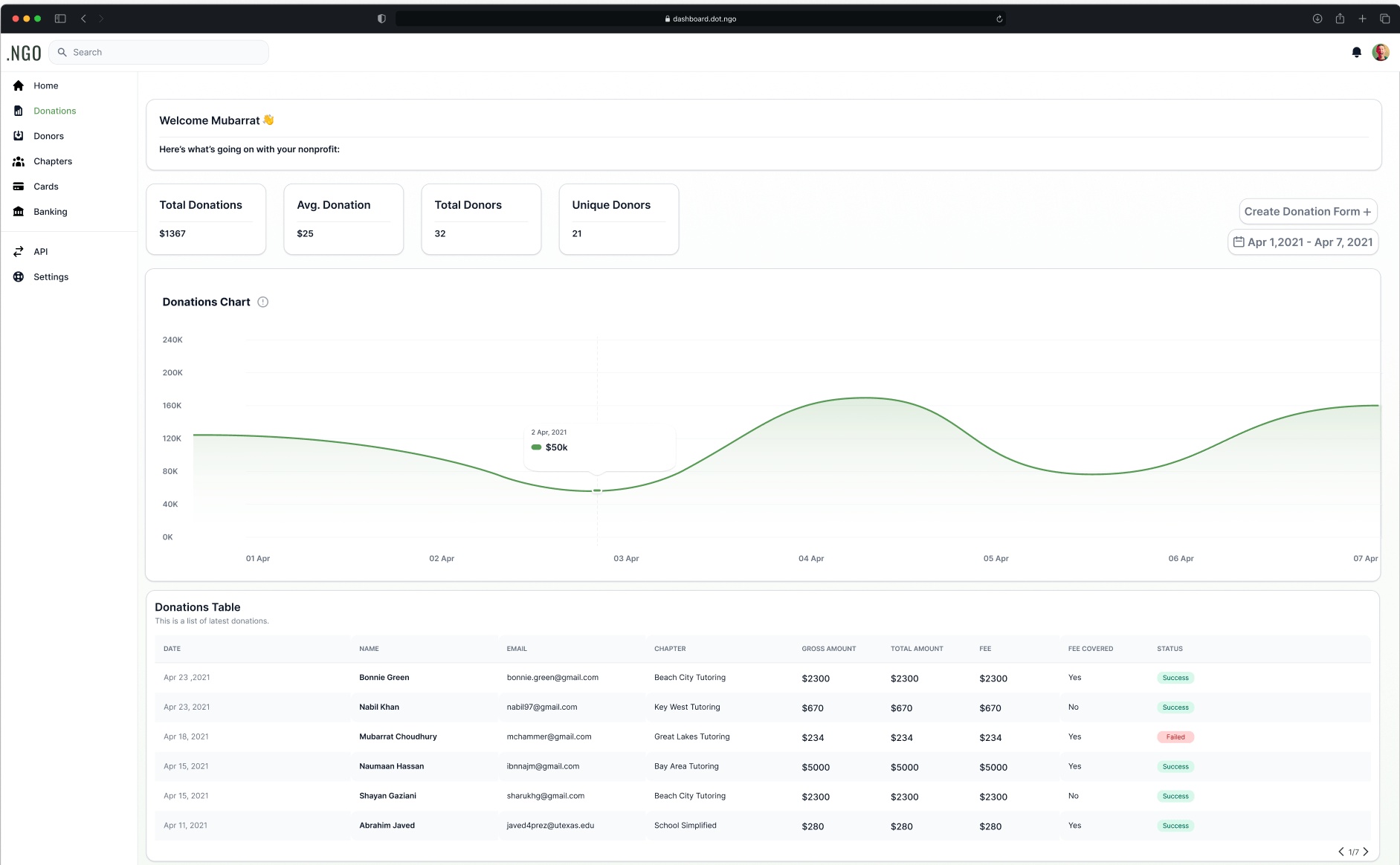
For a college club, the advertised appeal was specific: replace petty cash and reimbursement forms with cards, and keep organizational funds out of a member’s personal account. For a fiscal sponsor managing several projects, the appeal was consolidation. Its use-case page proposed adjustable fees and a shared platform for multiple nonprofits. Different customers, much of the same plumbing.
The price of skipping the build
The archived pricing makes the tradeoff unusually easy to inspect. A January 2022 homepage listed a Start-Up tier at 8% plus $0.30 per donation, aimed at projects receiving less than $1,000 monthly. The dedicated pricing page captured in January 2023 retained that rate. It described the percentage as covering operating, auditing, and accounting work.
On those published terms, a $100 gift leaves $91.70 after the listed fee, assuming it is deducted from the donation. The arithmetic brings the decision down to earth. A small project buys access to shared administration. As fundraising grows, the percentage becomes a larger dollar amount, and the calculation deserves another look.
The same detailed pricing offered an existing-501c3 tier at 2.2% plus $0.30 and custom terms for fiscal sponsors. Its FAQ said projects obtaining their own recognition could move to the cheaper plan. Meanwhile, the January 2023 homepage presented a simpler 8% offer. These are dated product snapshots; their differences make them useful historical evidence rather than a single timeless price list.
Follow one donation
A teacher-training fundraising page makes the arrangement tangible. Basira Education directs U.S. donors to a scholarship fund administered by Burhan Foundation. The page states that contributions are received, receipted, and controlled by Dot NGO Charities, Inc. The educational purpose, fundraising organization, and accountable recipient appear together. Each has a job.
Dot NGO Charities also describes nationwide fiscal-sponsorship work in its volunteer-center listing, including support for free tutoring. Its public program descriptions name Hidden Humanity, Texas MSA, and the Giving Games Foundation. These examples show the kind of grassroots work behind the software pitch. They also keep the reader’s attention on the people being served rather than the dashboard.
Start smaller than the institution
.NGO sits where fundraising software meets nonprofit administration. Alternatives include HCB, Hack Club’s fiscal-sponsorship platform, and hosts using Open Collective. A project can also pursue independent recognition and assemble its own financial tools. The meaningful comparison includes the sponsor’s mission, financial responsibilities, service scope, and fee structure.
The model fits a charitable project willing to work within a sponsor’s oversight. A group that needs independent control immediately faces a different decision. So does an established charity that mainly needs donation processing: it should evaluate the software and payment costs on those terms, rather than assume it needs sponsorship too.
The useful thing to copy is the sequence. Define the work. Identify the administrative tasks. Decide which ones an existing institution can carry. Then compare the cost of sharing them with the cost of building them yourself. .NGO’s interesting contribution was putting that choice beside a donation form. A cause can be small enough to begin and still deserve competent financial machinery.