The Metropolitan Opera had a problem that would sound familiar in a far less glamorous building. It knew who bought tickets. It knew who gave money. But those facts lived in separate systems. A patron could have a seat in one database and a generous history in another. The institution understood the transaction better than the person.
- A $5 million authorization at the Met started the software project.
- Seven arts organizations agreed to share it and create a nonprofit company.
- Tessitura joins ticketing, giving and membership in one customer record.
- The useful lesson: look for the next relationship inside the one you already have.
There is something pleasingly theatrical about the solution. An opera house, dissatisfied with the available machinery, commissioned its own. The resulting software eventually became the foundation of Tessitura, a technology company owned by the cultural organizations it serves. The plot is about databases. The stakes are about who gets remembered.
The $5 million before the handshake
In 1995, the Met’s trustees authorized $5 million to build an integrated customer relationship management system. Chuck Reif managed the project. Called Impresario before its later renaming, the system became operational in the 1998-99 season.
By 2001, six other institutions wanted in. Representatives of Santa Fe Opera, the Kennedy Center, San Francisco Symphony, Seattle Opera, New York City Center and Lyric Opera of Chicago joined the Met in Santa Fe. They agreed to share costs and form a nonprofit company led by Jack Rubin. Tessitura calls this its founding; corporate records give 2002 as the formation year.
CEO Andrew Recinos’s later account supplies the change of mind. Initially, the organizations wanted shared access and support. Conversations about vendor fees, service and whose needs reached the development queue led them toward a cooperative. Ownership became part of the solution.
A person can occupy several departments
Tessitura’s central proposition is a shared constituent record. Purchases, contributions, communications and memberships can sit together, with relationships connecting people to households and institutions. A box-office employee and a fundraiser can work from the same history, subject to the organization’s permissions.
Consider an illustrative patron who attends three performances, brings a child to a workshop and contributes to an appeal. Each activity matters on its own. Together, they suggest a relationship worth tending. The software gives staff a way to see that combination; deciding what to do with it remains a human responsibility.
Conceptual view of the unified CRM, rather than a product interface.
This is the attraction for theatres, orchestras, museums, science centers, zoos and aquariums. Their business includes admission, but also belonging, learning and support. Tessitura says more than 800 organizations in ten countries use its platform. The breadth of those activities explains the breadth of the software.
Plymouth found its next members at home
At Theatre Royal Plymouth, the team used Tessitura to examine purchase, attendance and donation habits. The opportunity was practical: frequent customers could save by becoming members. Staff divided the audience into segments, identified suitable membership tiers and built a campaign comparing past ticket spending with membership costs.
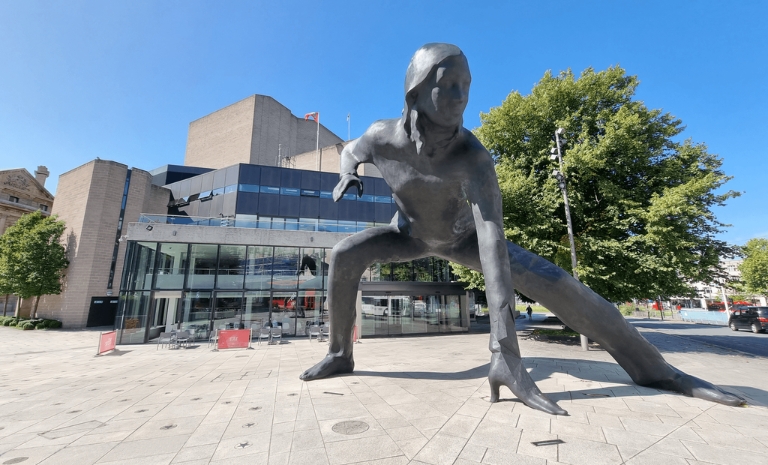
“We dug down into our own data.”Quinn Corvyn, Membership Support Officer, Theatre Royal Plymouth
In a March 2026 case study, the theatre reported an 18-month campaign that took membership from roughly 1,500 to a peak of 5,650, later settling at about 4,800. These are the theatre’s reported results, not a controlled test isolating software from the campaign.
Three reported snapshots, not an annual time series.
The transferable idea is the offer’s honesty. It starts with what a customer already does, then explains the benefit of changing how they pay. A membership campaign can be more persuasive when its arithmetic belongs to the recipient.
The benefit has to survive the checkout
That campaign needs operational machinery behind it. Tessitura supports configurable membership levels, renewals and upgrades. Benefits can apply when a card is scanned or a membership number entered. N-Scan links ticket and membership validation with attendance records in real time. A promise made in a marketing message can therefore follow the visitor to the door.
Ticketing covers reserved seats, subscriptions, general admission and group sales. Those are different kinds of inventory and entitlement, even when the public sees only a Buy button. The value of sharing records is that a member’s privileges can inform the sale rather than require a separate explanation at the desk.
TN Express Web, or TNEW, is the branded e-commerce service. Tickets, memberships, packages and donations can share a cart. Organizations can use Tessitura’s hosted purchase path, build through its API or combine the approaches. API access is included with the license. Tessitura states that it charges no transaction fees; payment processing still belongs in the budget.
The dashboard must lead somewhere
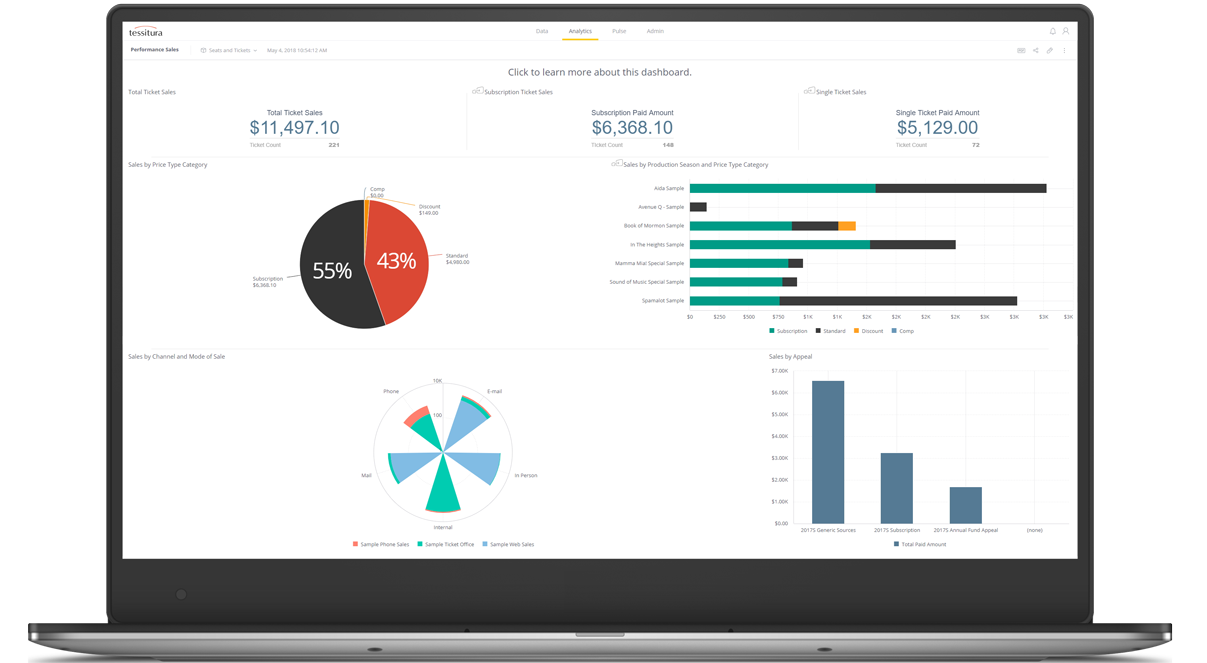
Tessitura Analytics connects reporting to CRM and transactional data. The product offers more than 200 standard reports, browser-accessible dashboards and options for custom reports. Staff can move from a selected group in an analysis to a customer list. That last step is small but consequential: a finding becomes something a team can act upon.
Education tools extend the picture beyond ticket buyers. They track schools, teachers, students and families; capture needs relevant to participation; and support registrations. Resource scheduling assigns rooms, people and items to bookings. An institution running performances and classes has a reason to connect these records, even if each program has its own staff.
The accompanying services acknowledge that enterprise software requires care. Tessitura offers training, troubleshooting, data cleanup, custom development and consulting on projects or retainers. Its cloud-hosting environment uses AWS and includes monitoring, maintenance, backups and disaster recovery. An organization can buy help as well as functionality.
The cooperative still has bills
Tessitura is a member-owned 501(c)(3) nonprofit. Leaders from member institutions participate in its governance. That structure directs attention toward the sector using the software and gives the company a different set of incentives from an investor-owned supplier.
The financial scale is substantial. Its 2024 Form 990 reported $67.9 million in revenue and $69.1 million in expenses, leaving an annual deficit of about $1.24 million. Program services supplied $62.3 million of revenue; contributions were about $884,000. These are organization-wide figures, not a subscription-revenue metric. Nonprofit status changes what the enterprise exists to do. It does not remove the expense of doing it.
Nor does integration make Tessitura a solitary supplier. Its ecosystem includes Queue-it for waiting rooms, Donate2 for quick giving, Substrakt for websites and True Tickets for digital ticket delivery. A shared database can be the center of a network of specialist tools.

Buy the shared view. Organize the shared work.
Tessitura competes in the arts ticketing and CRM market, where Spektrix also combines ticketing, marketing and fundraising. Unified functionality alone is therefore an incomplete explanation of its position. Tessitura’s cooperative ownership, institutional reach and services belong in the comparison.
For a buyer, the practical question is how much of that breadth the organization will use. A team needing a straightforward admission sale should weigh the staffing and configuration required by an enterprise system. A team coordinating memberships, gifts, classes and subscriptions has more relationships to connect.
The Plymouth approach also has conditions. As an editorial inference, its logic depends on reliable customer identities, meaningful purchase history and a membership that offers real value. Disconnected records weaken the analysis; an unconvincing benefit weakens the offer. Software supplies neither a good promise nor agreement between departments.
The lesson reaches beyond arts technology. Before looking outside for another audience, examine the people already present. Give staff permission to see the whole relationship, and make someone responsible for acting on it. Tessitura’s origin was an institution deciding that remembering a patron properly was worth building for. The useful question is what your organization does with the memory.
Follow the work
Explore Tessitura, its CRM capabilities, articles and customer stories, and vendor ecosystem.
Watch the Tessitura YouTube channel. The listed v16 demonstrations for performing arts and admissions require a member login.