A guitar has more than one kind of value. There is what it cost new, what its owner would accept to part with it, and what another person would pay today. Cash America Pawn operates in the space between those numbers. For someone short of cash, that space can buy time. For the company, getting those numbers right is the business.
- Bring an object. Borrow against its value, or sell it outright.
- Browse the other side. Shop pre-owned jewelry, electronics, instruments and tools.
- Know the trade-off. Loans carry charges; an unredeemed item can be lost.
A lender with a second life for everything
Cash America serves borrowers who need small amounts of money, sellers clearing possessions, and shoppers hunting for a useful bargain. These customers meet under one roof. Its parent, FirstCash, describes its focus as cash and credit-constrained consumers. The merchandise makes the proposition tangible: a necklace, a television, an amplifier, a drill.
A pawn loan begins with personal property. The store advances money and holds the item as security. Redeem the loan and the possession comes home. Forfeit it and the store acquires something it must sell. Interest and service fees generate lending revenue; merchandise sales generate a separate margin. The retail floor gives the lender a route to recover money from collateral.
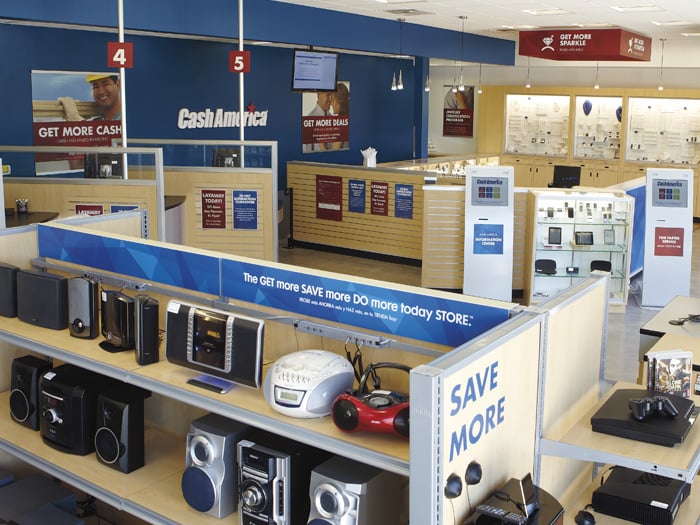
The expertise is unusually physical. Does the device work? Is the jewelry genuine? Will somebody buy this particular object in this condition? A lending decision carries a merchandising judgment inside it. The pawn counter must understand an item’s next owner before handing cash to its present one.
Cash America competes with independent shops and chains such as EZCORP’s EZPAWN and Value Pawn & Jewelry, which also combine loans and resale. Its chain infrastructure brings systematic valuation and shared administrative resources to a local transaction. Customers still encounter an individual store, an individual object and a specific offer. The useful comparison is the cash advanced, the redemption charges and the merchandise actually available.
The chain began with the room
Jack Daugherty’s ambition was to change the experience of visiting a pawnshop. Cash America’s 1999 annual report dates that vision to 1984: build a large chain focused on customer service and improve the industry’s image. Public reporting from 1993 described his emphasis on attractive premises and respectful treatment. The customer’s dignity was part of the operating idea.
The company later described brightly lit stores, knowledgeable assessments and a collateral-value database as elements of that approach. A familiar service became something a chain could reproduce. Cash America went public in 1987 and joined the New York Stock Exchange in 1990. Capital helped expand the network; consistent operations gave the expanding network something to repeat.
When the shelves got too full
Then came a revealing problem. In the mid-1990s, inventory accumulated. Discounts through a frequent-shopper program were not clearing unredeemed merchandise quickly enough. Cash America’s tracking system exposed the buildup. Daugherty concluded that retail had received too much attention relative to lending.
Management’s 1996 response was to slow expansion, reinforce lending at store level and emphasize cash returns. The lesson is practical: more merchandise does not necessarily mean more productive capital. For any resale business, the useful question is how quickly stock turns back into money. An inventory system earns its keep when its findings change buying and lending decisions.
The price of another month
FirstCash describes a usual pawn term of 30 days, with variation by state. Repayment means principal plus applicable interest and fees. An extension, where available, requires payment of charges. That buys additional time without necessarily reducing the amount borrowed. The transaction’s actual cost depends on its terms and how long the customer keeps it open.
“The value of your item is based on market value not of the price of the item when it is new.”
FirstCash · Pawn FAQ
That distinction explains why a pawn offer can disappoint an owner remembering the original receipt. FirstCash says condition and the ability to resell determine value. Accessories can help an assessment; damaged goods are worth less. The store wants to see the object in person. A remembered purchase price cannot demonstrate whether a laptop still works.
Take the item home.
Subject to eligibility.
It can enter resale.
Layaway reverses the direction. A shopper pays toward merchandise the store holds. FirstCash advertises interest-free layaway with 10% down on most items. Its separate layaway page notes that cancellation and service fees can vary by state and are non-refundable. A small deposit starts a purchase; it does not describe every condition attached to finishing or cancelling it.
The name stayed. The company changed.
Cash America separated its online lender, Enova, in November 2014. Management described storefront and internet lending as distinct business models. In September 2016, Cash America combined with First Cash Financial Services to form FirstCash. Cash America shareholders received 0.84 First Cash shares for each share they held.
The announced $2.4 billion figure represented the combined companies’ pro forma equity value, rather than a cash purchase price. Management projected $50 million in annual synergies, largely from technology and administration. Those were expectations. The completed merger brought more than 2,000 locations together while retaining established store brands.
Pawn stores across FirstCash’s international network. This is the group’s footprint, not the Cash America brand’s store count.
On October 22, 2026, FirstCash reported quarterly revenue of approximately $1.1 billion and trailing-year revenue of $4.3 billion. Group scale helps explain the resources behind the brand. The store-level proposition remains recognizable: assess an object, advance cash, manage the eventual outcome.
The rules travel with the loan
The history also contains costly misconduct. A 2013 CFPB order required predecessor Cash America International to provide up to $14 million in refunds and pay a $5 million penalty. In July 2025, a separate FirstCash and subsidiaries settlement required redress and a $4 million penalty over alleged Military Lending Act violations. The earlier order was separately terminated after obligations were fulfilled.
The transferable idea is disciplined valuation, backed by systems and consistent service. Its limits are just as concrete. An object without resale demand cannot support much lending. A borrower without acceptable collateral has little to offer. And someone who cannot afford redemption risks losing a possession whose personal importance exceeds its market price. Cash America’s useful trick is finding cash in ordinary things. That usefulness depends on the terms - and on what the owner can bear to part with.