Ralph Andretta expected questions about the presentation. Al Kelly had a question about the footnote. In the appendix. It was the sort of encounter that could make an ambitious executive reconsider both his slides and his audience. Andretta remembered it for a different reason: someone senior had taken the trouble to look that closely.
Kelly, an American Express executive who later ran Visa, became one of his models for leadership. Another was Jud Linville, who called Andretta’s wife after his first analyst meeting to tell her he had done well. One mentor inspected the work; the other noticed the family behind it. Andretta still tells both stories. Together, they offer a useful introduction to the president and chief executive of Bread Financial, whose business runs on calculations but whose account of leadership keeps returning to people.
A tuition bill, a garbage truck, a griddle
His first workplaces were some distance from the executive suite. To pay for college, Andretta worked on the back of a garbage truck and as a short-order cook at Nathan’s Hot Dogs on Coney Island. He describes those jobs as an education in effort and in the dignity of work. A corporate title arrived considerably later than the lesson.
He earned a bachelor’s degree in accounting and finance from Siena College. That combination would prove durable: accounting asks what happened to the money; finance asks what to do with it next. His subsequent career moved through American Express, Bank of America and Citi, giving him experience with the workings of large institutions before he took responsibility for reshaping one.
The progression matters because Bread’s reinvention is sometimes told principally as a technology story. Andretta arrived with a much older set of questions about customers, repeat business and how a lender earns its way through changing conditions. The software would change. The need to understand the customer would stay.
The rewards business, before Bread
Andretta spent 18 years at American Express, in operational and financial roles in the United States and abroad. A surviving presentation from February 2007 catches him explaining Membership Rewards to the financial community. His subject was how a loyalty program could encourage spending, create value for merchants and cardholders, and generate resources to invest back into the program.
That is a revealing early chapter. Rewards can look like a collection of pleasant extras attached to a card. In his presentation, they were part of an economic system: an incentive to keep using a product, a reason for a merchant to participate, and a business that needed continued investment. Years before Bread, Andretta was already explaining how the next purchase could grow out of the last one.
From 2010 to 2011, he worked in global affinity and international cards at Bank of America. At Citi, his responsibilities included loyalty, co-brand and product development, followed by leadership of U.S. Cards. By the time Alliance Data recruited him, he had worked across several versions of the relationship between banks, brands and shoppers. He brought the perspective of an operator who had seen the machinery from several sides.
First, listen. Then decide what belongs.
His appointment took effect on February 3, 2020. The announcement of his arrival described an initial 100 days devoted to listening and assessing the entire enterprise. It was an appropriately practical opening for someone hired to lead a business already undergoing change: learn what is there before announcing what should replace it.
Alliance Data had a history extending beyond consumer credit. The task ahead involved deciding which activities belonged together and where the company should concentrate its money and attention. A new leader could inherit the legal entity, its obligations and its staff immediately. Understanding the institution would take longer than changing the name on an office door.
By October 2020, the company had announced an agreement to acquire Bread, a digital payments business, for an estimated $450 million. Bread brought installment and buy now, pay later capabilities, along with technology for retailers and banking partners. At announcement, the deal was expected to add approximately 185 employees and more than 400 merchant clients.
Those details give the transaction a human and practical scale. The acquisition meant adding people who knew how to build a different sort of checkout experience, as well as a network of businesses already using it. For Andretta, it expanded the menu a retail partner could offer a customer. A store card would no longer have to be the only answer.
A smaller name, a more concentrated business
The other side of the transformation involved subtraction. In November 2021, Alliance Data completed the spinoff of LoyaltyOne into Loyalty Ventures, retaining a 19% interest. The company’s account of the transaction recorded $750 million of debt repayment. The aim was to concentrate on payments, lending and savings rather than continue operating distinct businesses under the same umbrella.
That separation also has a difficult sequel. Loyalty Ventures filed for bankruptcy in 2023. Investors brought securities-fraud claims against Alliance Data and executives including Andretta. On January 21, 2026, the Sixth Circuit affirmed dismissal of that complaint, agreeing that it had not sufficiently alleged misleading statements or fraudulent intent. The outcome belongs alongside the strategy: a business transformation leaves consequences beyond the company that survives it.
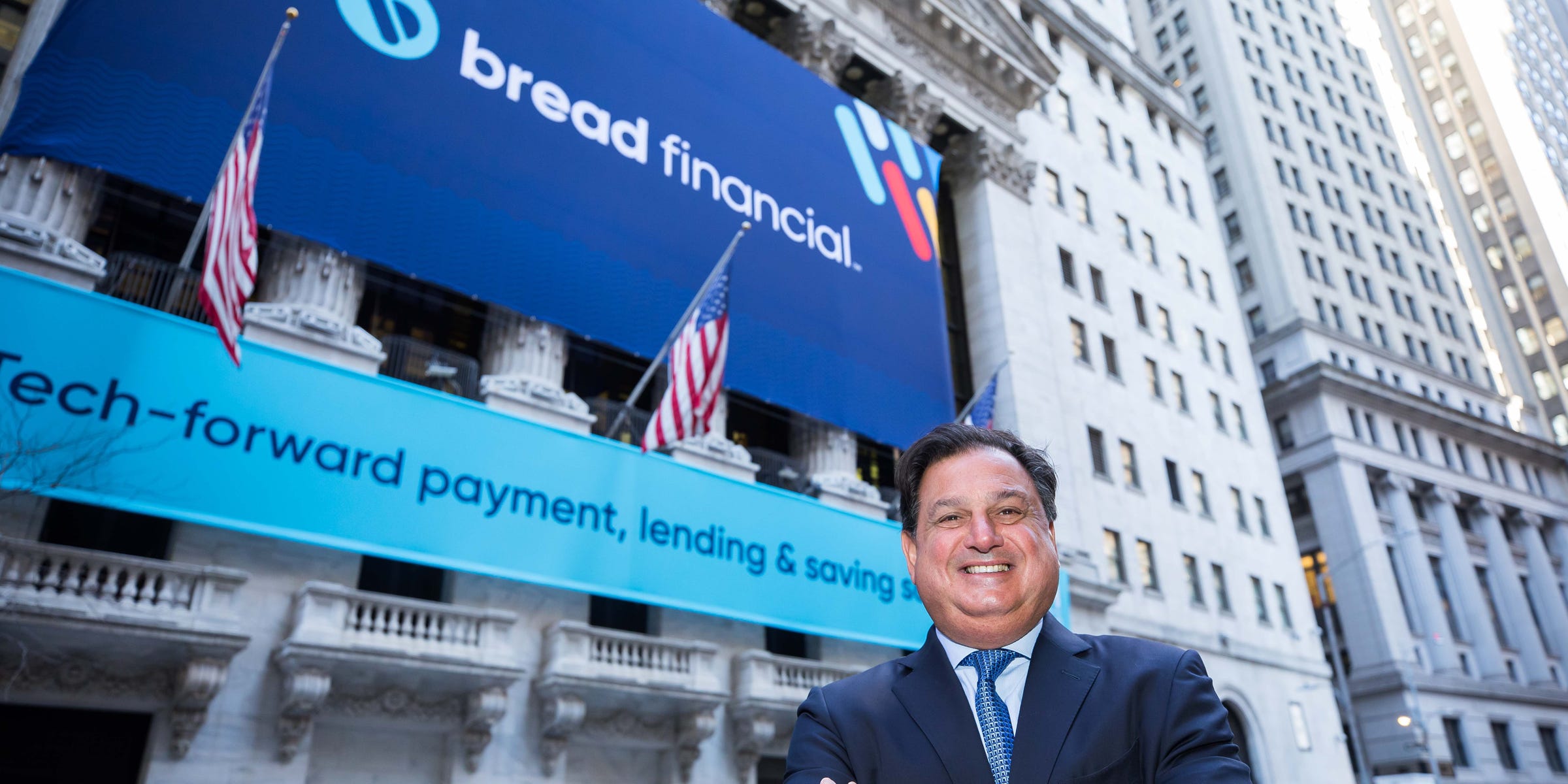
On March 23, 2022, Alliance Data announced its Bread Financial brand. Andretta described the change as the expression of a more focused business, with payments, lending and savings at its center. The name was brief enough to fit on a card. The work behind it included a fintech acquisition, product expansion and changes to technology.
“Bread Financial combines the heart and hustle of a fintech with the discipline and stability of a well-established bank.”
Ralph Andretta, March 2022
The pairing in that statement explains much of his assignment. Faster product development and convenient digital experiences have to coexist with the obligations of lending money. A payment can take seconds while the relationship it creates lasts years. Bread’s chosen identity put both sides of that equation under one name.
What happens after the first purchase?
In 2022, Andretta’s pitch to merchants emphasized a choice of products: private-label cards, co-branded cards and pay-over-time options. He wanted the company to help retailers build repeat relationships with customers. It was familiar territory for someone who had spent years in loyalty, translated into the language of an online checkout.
There is a fairly ordinary human question underneath that business model. Why come back? A card or installment option can help make one purchase possible, but an enduring relationship requires a reason to use it again. Andretta’s career has repeatedly placed him at that intersection of convenience, incentive and habit. The connection between his American Express chapter and Bread is especially clear there.
By 2026, the company was celebrating its thirtieth year and its twenty-fifth trading on the New York Stock Exchange. Andretta joined the executive team on Wall Street for the anniversary. Retiring board chair Roger Ballou rang the closing bell. In describing the visit, Andretta connected the ceremony to six years of simplifying the business, modernizing technology and strengthening risk management. The bell supplied a moment; the work had required a calendar.
The figures keep their own score
The third-quarter results released on October 22, 2026, offer a current view of that work. Average loans were $18.6 billion, up 6% from a year earlier. Consumer deposits reached $9.9 billion, a 21% increase. Revenue grew 5%, while pretax income rose 6%. These are company results under Andretta’s leadership, produced by an organization rather than a solo performance.
Year-over-year growth; bars share a 0-21% scale.
The quarter also resists a tidy victory lap. Net income of $156 million was down 17%; the prior-year quarter had included a favorable $38 million discrete tax item. The net loss rate was 6.40%. Growth, credit performance and comparisons all need to be read together. Andretta’s preferred language of discipline has a concrete test in figures such as these.
Room for a different kind of team
His interests outside the business include golf and tennis, and time with his wife and two daughters. In January 2023, he joined the Women’s Sports Foundation’s board of trustees, entering alongside leaders from ESPN, Nike and water polo. The foundation’s work centers on opportunities for girls and women in sport. His other commitments include the Bob Woodruff Foundation’s board, supporting veterans and military families, and participation in the Columbus Partnership.
These roles place him in groups where the task is broader than a lending portfolio. They also provide a counterpoint to the familiar executive biography in which everything seems to lead inexorably toward the corner office. Andretta’s public life includes teammates, family, merchants and associates, each with a different claim on his attention.
He has a compact instruction for dealing with difficulty: “Work the problem.” It is plain enough to survive a meeting without becoming a slogan on the wall. The footnote, the analyst presentation, the acquisition and the next set of quarterly figures all ask for some version of that effort. Read carefully. Notice who helped. Then return to the work.