A credit-card statement is an unglamorous place to begin a career story. It arrives, it gets scanned, and it disappears into a drawer or a digital archive. Yet one of the clearest windows into Gregory Feniak's way of working is a statement redesign from his years at Credit Union Payment Services. The project changed confusing transaction descriptions, tightened the presentation, and made the monthly document easier for members to understand. The results were unusually legible: 98 percent fewer statement-related complaints, 75 percent fewer questions, half as many pages, and a 28 percent reduction in production costs.
Those numbers describe more than a formatting win. They show what happens when a complicated system is examined from the edge, where an ordinary person meets it. Feniak was then Assistant Vice President of Relationship Management and Sales. The title placed him between institutions, operations, and the member experience. His later roles would grow broader, but the same translation problem kept returning: how do you make the machinery of payments understandable, useful, and local?
The business behind the tap
Payments are full of mismatched scales. The tap takes a second. The network behind it spans issuers, processors, card brands, fraud systems, rewards programs, identity checks, digital interfaces, regulators, and the financial institution whose logo appears on the card. For a local credit union, the challenge is sharper. Members expect the ease and polish of a national bank while still wanting the relationship, identity, and community grounding that made them choose a cooperative institution.
Feniak has spent more than 20 years inside that tension. His experience crosses marketing, product management, communications, relationship management, business development, and strategy. He has worked in the shared infrastructure of Credit Union Payment Services, served as Vice President of Strategy and Engagement at Prairie Payments Joint Venture, and held senior roles at Collabria Financial Services. It is a career less about a single invention than about making a network cohere.
He joined Collabria as a vice president in 2015, the year the company entered the market with a credit-card model designed for Canadian credit unions. He later moved to Prairie Payments, where he led business development and strategic partnerships. In January 2023, Collabria announced that he would return to its Executive Committee as Chief Marketing Officer, based in Calgary. The familiar face came back with a portfolio that joined brand, product, communications, and strategy.
Relationship management and sales leadership at Credit Union Payment Services.
Joined the newly launched Collabria as a vice president.
Led strategy, engagement, business development, and partnerships at Prairie Payments Joint Venture.
Returned to Collabria's Executive Committee as Chief Marketing Officer.
Elected to the Calgary Meals on Wheels board of directors.
“Every transaction is an opportunity to build engagement.”Greg Feniak, on a payments-first approach
A card is a habit with a logo
Feniak's most useful public idea is also his most compact. Every transaction, he has argued, is an opportunity to build engagement. This reframes a credit card from a product a member applies for once into an interface they may use every day. The card becomes a recurring reminder of the institution behind it. Rewards, alerts, service moments, and simple digital interactions can either reinforce that relationship or quietly hand it to someone else.
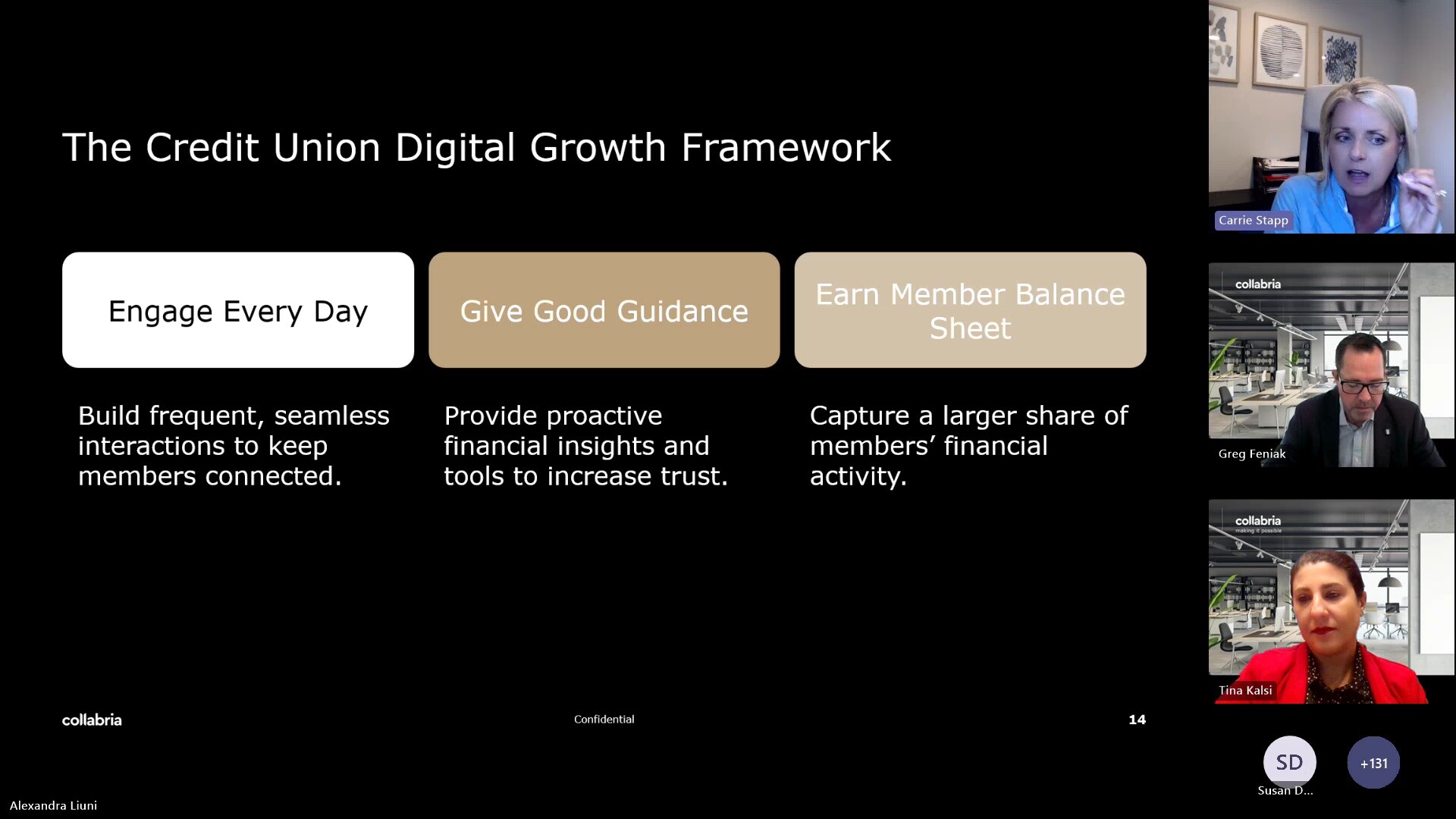
In a 2025 system presentation, Feniak and other speakers organized the opportunity into three jobs: engage every day, give good guidance, and earn the member balance sheet. The language is plain because the strategy needs to travel. Daily payments create frequency. Guidance earns trust. A broader relationship follows when the first two are done well. Each step depends on the previous one, and none can be rescued by a clever campaign if the underlying experience is clumsy.
Engage every day
Put useful, rewarding interactions inside an existing payment habit.
Give good guidance
Use timely information and service to turn frequency into trust.
Earn more trust
Let a better daily experience support a deeper member relationship.
The framework also explains why his work sits across departments. Product determines whether the card is worth carrying. Marketing gives the value a clear shape. Communications helps a credit union explain it. Partnerships add capabilities that would be slow or expensive to build alone. Strategy decides which of those moving pieces deserve attention.
Partnership as an operating system
Collabria's recent partnerships make the cross-functional logic visible. Work with Co-op Solutions supported hosted and managed credit products. A collaboration with Trulioo addressed identity verification for new cardholders. Agility CMS was selected to improve the speed and consistency of digital content. Navan added travel and expense capabilities for World Elite Mastercard for Business cardholders. Different vendors, different layers, one common shape: combine specialist infrastructure so a credit union can offer a coherent experience under its own relationship with the member.
Feniak's comments around these deals consistently return to partners and their members. When Collabria announced Navan, he described the collaboration as a way to give business cardholders better tools and resources. The interesting word is “tools.” Travel benefits may look like a perk from a distance. For a small business owner reconciling expenses, visibility and control are operational features. The value appears when the promise meets a Tuesday afternoon.
The same preference for useful specificity showed up much earlier in the redesigned statement. Confusing descriptions became clearer. Pages disappeared. Calls declined. Costs fell. Technology changed dramatically between that case and today's headless content systems or automated identity checks, but the management question barely moved: where is complexity leaking into the user's day?
Clarity is not decoration in financial services. It changes calls, costs, confidence, and whether a member wants to keep using the product.
The cooperative thread
Feniak is a native Albertan, and his career has stayed close to the Canadian credit-union system. That continuity gives him a specific kind of institutional memory. Cooperative finance is built on shared action: independent organizations combine resources without surrendering their local identities. The model can be slow because agreement matters. It can also create durable reach when the participants align.
His advisory work reflects that bridge-building role. Velera's 2024 annual report lists him on both its Marketing Advisory Council and Product Advisory Council. Serving on both is a neat summary of his professional position. Marketing hears what should matter. Product decides what can work. The member experiences the seam between them, whether an organization notices it or not.
The person visible through colleague recommendations sounds suited to that seam. He has been described publicly as proactive, personable, collaborative, willing to share knowledge, and quick to take ownership. His LinkedIn record also includes a small early clue: while at Dalhousie University from 2000 to 2002, he served as Vice President External of the MBA Student Council. The external role is the connective one, facing outward, representing a group, and turning relationships into motion.
There is also room for cake. When Collabria launched its Cash Back Visa Infinite and Cash Back World Elite cards, Feniak shared the team's celebration: card-themed cakes marking the end of the work. Product launches in finance involve approvals, systems, training, operations, disclosures, and long checklists. A cake is not strategy. It is a humane full stop after the strategy survives contact with reality.
A new table in Calgary
In 2026, Feniak was elected to the board of Calgary Meals on Wheels. The organization introduced him as an executive with deep experience in strategic planning, technology, and marketing, and emphasized his commitment to keeping people and communities at the centre of decisions. Feniak's own note was shorter. He called it an organization that strengthens communities through collaboration and teamwork, then said he looked forward to working with the team.
A payments company and a meal service have very different missions. Structurally, however, both depend on coordinated systems delivering something dependable at the edge. A card network must make a payment work at the moment of need. Meals on Wheels organizes staff, volunteers, kitchens, routes, and community support so a meal reaches a door. In each case, the end experience hides the complexity required to produce it.
That may be the cleanest way to read Feniak's career. He works on the hidden arrangement behind an ordinary moment. The statement should make sense. The card should belong in the wallet. The local institution should be able to compete. The partner should add capability without adding confusion. The route should reach the person it was designed to serve.
Financial services often celebrates novelty, but much of its real value comes from dependable translation. Someone has to connect the network to the institution, the institution to the product, and the product to the person. Feniak has spent two decades working those connections. His latest board role brings the same instinct home to Calgary, where cooperation is measured less in clicks or cards than in whether the system arrives.