Anthony Noto went to work at Twitter with the sort of trousers that invite trouble in Silicon Valley. A colleague eventually asked when he would stop wearing the “dad pants.” He had already been a Goldman Sachs partner and the National Football League’s finance chief. Apparently, there was still a dress code to learn.
It is a small episode in a career full of large institutions, but a useful one. Noto has repeatedly arrived somewhere with an impressive résumé and a fresh set of things to figure out. The Army taught him to lead. Wall Street taught him to examine a business. Football taught him that even a beloved institution needs financing. Twitter required him to work inside the technology companies he had once studied.
At SoFi, where he became chief executive in 2018, those experiences finally shared an office. The former student-loan specialist offered him a chance to build a broader financial business. It also gave him a question that has occupied much of his working life: how do you turn an ambitious plan into something people will actually use?
A degree with shoulder pads
Noto grew up in Poughkeepsie, New York. His mother worked multiple jobs, and the family received public assistance during part of his childhood. He has described that experience as a reason for wanting financial services to help people gain more control over their lives. The mission has a particular face for him: his mother’s.
West Point offered a different kind of security, although hardly an easy life. Noto wanted to play college football and learn leadership. He graduated in 1991 with a mechanical engineering education, then served in the Army, earned his Ranger Tab and reached the rank of captain. His preparation for business included considerably more marching than most MBA applications require.
On the football field he became a linebacker, earning All-East and Academic All-American honors. His Army teams beat Navy three times in four years. For an Army graduate, this last detail can carry the emotional weight of an additional academic qualification.
West Point graduate. Mechanical engineer. Army football linebacker. A leadership education with several kinds of homework.
One of his recollections from the academy is wonderfully unglamorous: leaving swimming class, hurrying into uniform and crossing the grounds for a chemistry exam as his wet hair froze. Leadership, in this telling, begins with getting to class. It also involves accepting help and offering it. Noto remembers West Point as a place where getting through alone was never a realistic plan.
He speaks about coaches with unusual specificity. Jim Young, Army’s head coach during his four years, helped shape his thinking about preparation and success. Other coaches gave him opportunities before he had proved himself. His mother coached his Little League team. Before the professional mentors came along, he already had a fairly extensive advisory board.
The holiday reading that changed his job
After military service, Noto joined Kraft Foods in brand management. His route to finance began with consumer products and decisions about running a business. He attended business school at night in Chicago before moving east and earning his Wharton MBA in 1999.
The decisive reading arrived over a holiday break. Given books on finance and securities analysis during his first year at Wharton, he started reading and found he could not put them down. He had never taken a finance class. By the next semester, he wanted to switch his focus to finance. Career changes do not always announce themselves with a recruiter’s call. Sometimes the assigned reading is the problem.
Lehman Brothers and then Goldman Sachs followed. He joined Goldman in 1999 and became a partner in 2004. Internet businesses became his territory, and Institutional Investor ranked him first among internet analysts in each year from 2003 through 2007. The engineer had found another set of systems to take apart.
There is an obvious difference between judging a company and being responsible for one. An analyst can revise a model. An executive must persuade people to carry out the revised plan. Noto’s later choices repeatedly moved him toward that second kind of responsibility, even when he already had a job at which he was doing well.
Football, with a treasury department
In February 2008, Noto became the NFL’s chief financial officer, reporting to Commissioner Roger Goodell. The remit included finance and strategy, corporate development, labor finance, accounting, tax and treasury. Anyone imagining the position consisted chiefly of attending excellent games would have been disappointed by the calendar.
The financial crisis made that calendar more demanding. The league’s economic arrangements, stadium obligations and access to financing required attention. Noto had arrived at a familiar sport and an unfamiliar operating problem. Fandom could explain his interest in the job; it could not do the job for him.
His work also placed him among people with different interests who had to keep an institution functioning together. Owners, players, lenders and broadcasters each saw a different piece of the same enterprise. The practical challenge was to make the pieces fit. That experience helps explain why the word strategy, in Noto’s career, tends to be followed by decisions about money.
He returned to Goldman in 2010, this time in investment banking. His team helped lead Twitter’s 2013 initial public offering. In July 2014 he joined Twitter as CFO, moving from the adviser’s seat into the business itself. He became COO in November 2016.
Football followed him there, too. In 2017, Twitter and the NFL announced a multiyear agreement for live studio programming, behind-the-scenes broadcasts and highlights. Noto spoke for Twitter about bringing more football content onto the platform. The professional worlds on his résumé were beginning to look less like separate chapters.
A bank that fits in the same pocket
SoFi announced Noto’s appointment in January 2018. It had finished 2017 with more than 430,000 members. He inherited a recognizable lending business and the task of deciding how much else it should become.
His early priorities included strengthening lending operations and investing in additional products. He also made culture an immediate concern, establishing a mission, priorities and 11 core values during his first weeks. A company asking customers to trust it with more of their financial lives needed a shared understanding of its own behavior.
“Culturally it is a turnaround, 100%.”
Anthony Noto, April 2018
The expansion would reach beyond the products visible on a phone. In April 2020, SoFi announced a $1.2 billion cash-and-stock agreement to acquire Galileo, whose technology supported payments and account functions for other businesses. The purchase brought infrastructure into Noto’s consumer-finance plan.
In 2022, SoFi announced an approximately $1.1 billion all-stock agreement for Technisys, a core banking software business. The distinction matters: an app is what the customer sees, while the systems beneath it keep track of accounts and make transactions possible. Noto was buying more of the machinery as well as expanding the shop window.
The regulatory milestone came in January 2022, when the Office of the Comptroller of the Currency conditionally approved the bank transaction involving Golden Pacific. That decision brought SoFi into the federal bank regulatory framework. Growth now came with the capital, risk-management and customer-treatment obligations of a national bank.
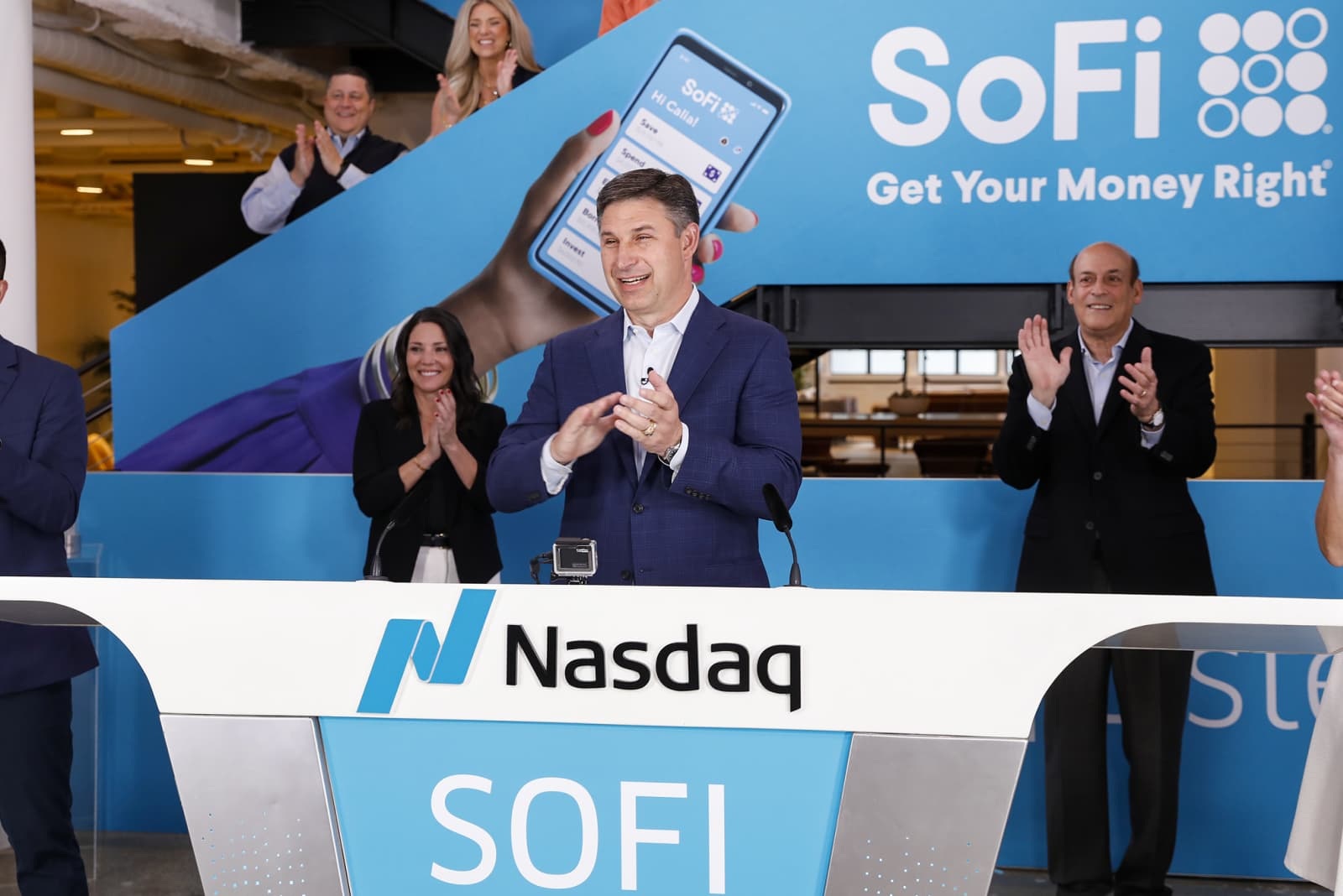
Public markets had arrived a little earlier. SoFi completed its combination with Social Capital Hedosophia V in May 2021 and began Nasdaq trading that June. The transaction provided about $2.4 billion in cash proceeds. A plan that once needed a board’s agreement now had a much larger audience inspecting its progress.
The name on the stadium, the work inside the app
One of Noto’s most visible decisions involved returning to football on a different scale. In September 2019, SoFi entered a 20-year naming-rights partnership for the new home of the Los Angeles Rams and Chargers. A financial app had acquired an address people would say aloud on television.
For a former NFL CFO, the connection was easy to appreciate. Sports offered recurring attention, recognizable teams and a place for a relatively young financial brand in everyday conversation. Yet recognition creates its own test. After someone remembers the name, the service has to justify the introduction.
By the end of 2024, SoFi had 10.1 million members and had completed its first full year of GAAP profitability. In the second quarter of 2026, membership reached 15.8 million. Quarterly GAAP net revenue was approximately $1.22 billion, with net income of $156.6 million. The figures describe a business far larger than the one Noto joined.
Company-reported members. Bars share a zero baseline; these are two snapshots, not a continuous growth curve.
Scale has not made every part of the business grow together. Technology Platform revenue fell 23% from a year earlier in that same quarter, reflecting the departure of a large client. That is a useful complication in a career often told as a succession of promotions. Building several businesses under one roof also means answering for several kinds of disappointment.
On October 22, 2026, SoFi announced SoFi Earn, a tokenized bank-deposit product, extending Noto’s effort to connect banking with digital money. It was another entry on a product list that has moved well beyond the student loans with which the company began.
Outside the quarterly scorekeeping, Noto and his wife, Kristin, have five children, and lacrosse has occupied a large part of the family’s sporting life. The former linebacker has spent time as the parent on the sideline. He knows something about the value of a coach who offers a young player a chance.
That is the most consistent feature of his winding career: an institution supplies an opportunity, and then asks him to become useful in a new way. At SoFi, he has chosen to make the opportunity larger. The work is to make it useful for the person opening the app.
Read, watch & follow
Continue with Noto’s conversations and the company’s work.
SoFi Official website ↗Anthony Noto on LinkedIn Professional profile ↗Anthony Noto on X Posts & conversation ↗A conversation about the career Wharton Magazine · 2024 ↗West Point to Wall Street On the Tape · audio & transcript ↗Ambitious Leadership Liz Thomas interview · 2025 ↗Noto on crypto ambitions Bloomberg Technology · YouTube ↗Earnings and the next products CNBC · YouTube ↗SoFi quarterly results Company financial reports ↗The October 2026 product announcement SoFi Earn ↗