Rosaria Cain can put a price on one of her business lessons: $200,000. That was the cost she attached to opening an office in San Diego when asked about her regrets in 2015. Plenty of founders offer advice about expansion. Cain could produce a receipt. She also had a recommendation for her younger self: get some experience inside an advertising agency before opening one.
By then, she had already been running her own for 16 years. The warning came rather late to be of practical assistance to its intended recipient. It remains a useful introduction to Cain, whose accounts of business ownership have room for the expensive mistake, the unfinished education and the joke at her own expense.
Her Phoenix agency, Knoodle, began in 1999 with Caleb Miller and Fulton Homes as its first client. Cain had been selling media at Fox. She and Miller both had small children. In their later recollections, the demands of meetings and school pickups sit alongside the less glamorous problem of finding money for everyday necessities. Agency ownership arrived with all its departments attached, including the ones neither founder had previously run.
Cain’s stated cost of the San Diego office detour, recalled in 2015.
Before she had an agency, she had questions
There was an earlier apprenticeship in paying attention. At Fort Lewis College, which she attended from 1979 to 1983, Cain edited the college Independent. She also worked at the Durango Herald, describing herself as the newspaper’s first intern. Editing a student paper and selling advertising are different jobs, but both require some interest in what will make another person stop and read.
That connection has followed her into agency work. She has taught media and marketing at the Art Institute of Phoenix and mentored interns through practical work in the Knoodle office. Her advice to newcomers has been to try internships across different parts of the business. It is advice with a pleasing lack of romance: go inside, see how the work happens, and learn what the titles conceal.
Her explanation for starting a business is similarly grounded. In 2018, she described wanting control over her choices and a workplace where people could work together to serve clients. The appeal was the ability to decide how work would be done. Once you own the company, though, the distance between making a promise and paying to keep it becomes considerably shorter.
“Never start an ad agency without having worked in one first!”
Rosaria Cain, looking back in 2015
A relationship renewed every other week
Fulton Homes gave the young agency its starting point. By 2015, Cain described a routine for maintaining the relationship: every other week, her team brought Doug Fulton at least three fresh ideas spanning creative work, media, public relations and digital. Familiarity had acquired a schedule. A long-standing account still required a next proposal.
The partnership also gave Knoodle opportunities to play. In 2016, the agency created a local television spot for the presidential debates, set at a fictional Fulton Homes news desk. A male anchor announced that he was going home, leaving his colleague behind. The reason was his satisfaction with his Fulton home. The political temperature supplied the setup; the house supplied the punchline.
Cain explained at the time that the team had spent twelve consecutive years creating specific Super Bowl advertisements. The debates offered a different occasion for a familiar client to do something new. It is a small example of the work behind retention: finding another setting, another joke, another reason for a customer to notice a name they already know.
Good intentions need a running order
Cause marketing became a particular focus of Cain’s work. Her approach begins with questions for customers rather than an appealing slogan. In one early homebuilder campaign, interviews with Hispanic consumers identified high school graduation as a concern. Knoodle developed an education campaign with college scholarships for younger students, tied to their eventual completion of school.
The practical machinery matters to her. A cause needs an appropriate media partner, resources to support it and a story people can understand. Her examples include Fulton Homes Teacher of the Week, developed with KNIX in 2000, and a dog-bootie giveaway that attracted television coverage during Arizona’s summer. The giveaway offers something a camera can show. The teacher recognition offers someone a community can celebrate.
In her 2026 conversation with Mark Sneider on Under the Agency Hood, Cain discussed how this work fits mid-sized companies, along with the difficulty of getting attention as media outlets lose promotional staff. Her journalism background informs the approach. A useful question is always waiting beneath the campaign: what would make this interesting to someone who has no obligation to care about the advertiser?
- 01Ask customers
Find a shared concern - 02Design the program
Connect cause and brand - 03Bring in media
Give the story a public life
The photographs, the red shoes, the committee
Cain has also put herself through the branding exercises she recommends to others. For a 2021 NAWBO photo shoot, board members wore black, white button-down shirts and red shoes. Knoodle donated the shoot, with photographer Paul Markow and creative director Ivan Galaz working on the images. The common outfit allowed individual interpretations. Unity, in this case, still permitted a choice of shoes.
The process had its familiar complications. Some people could not attend; some disliked the concept. There were fans, music and professional hair and makeup. Cain described board members enjoying their temporary careers as models. Her ensuing advice was firm: give a rebrand a clear direction and a responsible decision-maker. A committee can have excellent attendance and still produce a muddle.
Clothes have a place in her working life beyond a single photo shoot. In 2013, Knoodle brought in stylist Cathy Harrelson, arranged a team shopping afternoon and gave each employee a $100 allowance. The company also offered image-management services. For Cain, presentation could be discussed, practiced and improved, down to the clothes someone chose for a meeting.
That attention to appearances carries into her writing about websites. In a 2023 example, she described the original photography and artisan stories used for luxury textile company Etnico. The point was specificity: visitors could see the people and work behind the objects. Her concern was the impression a business leaves when nobody from the business is there to explain it.
What she wanted other owners to have
In July 2021, Cain became president of NAWBO’s Phoenix chapter. She had joined as the demands of ownership grew more complicated. The appeal was a group of women who could discuss their accomplishments alongside their struggles. Both subjects deserve a seat at the table, particularly when everyone at the table is responsible for payroll.
Her plans included reviving mentoring and making events more flexible, with evening gatherings alongside the customary daytime programming. Sandra Guadarrama-Baumunk, Knoodle’s partner and vice president, served as a programming co-chair. The connection between the two women extended beyond their agency titles into the work of bringing other owners together.
Cain’s stated aim was to offer the support she had received from peers. There is a practical generosity to that ambition. Another owner cannot remove the difficult decision waiting on your desk, but she may have made a version of it already. Sometimes the useful thing is an introduction. Sometimes it is permission to say that the business is harder than the photograph suggests.
The founder takes the interviewer’s chair
By 2026, Cain had another setting for those conversations: Knoodle Founders Hour. The program brings her together with people building businesses in and around Arizona. In February 2022, she had appeared as a guest on Phoenix Business Radio, alongside Debe Black and Amber Cordoba. Now she was the person asking how somebody else had begun.
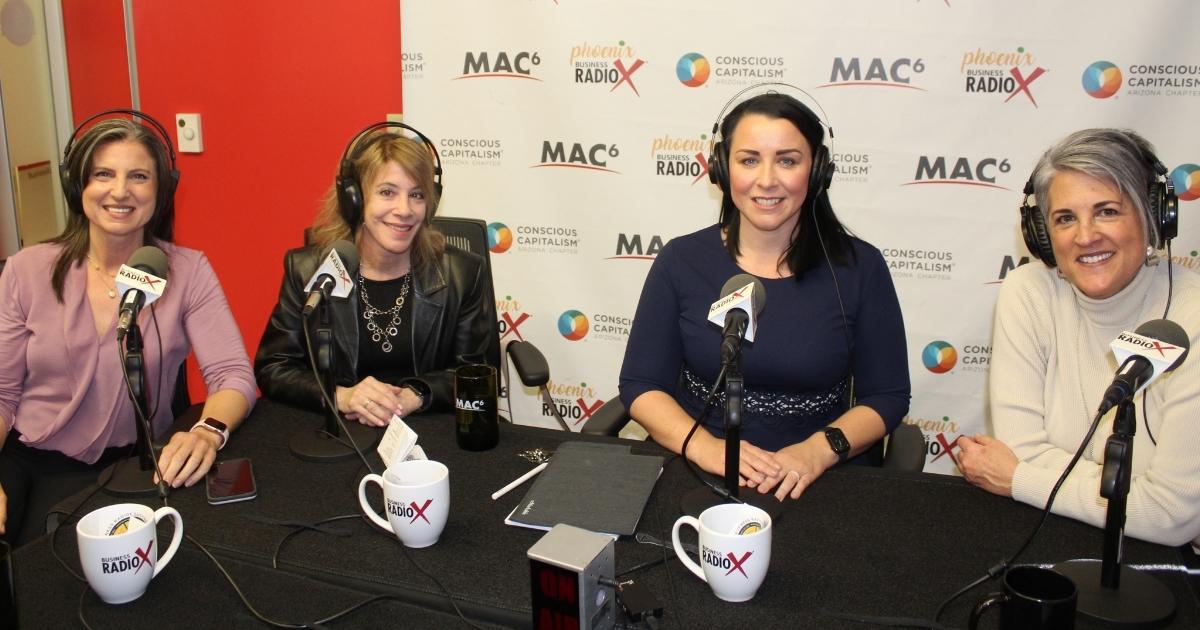
The range of guests gives the series its character. Brewery founder Megan Greenwood talked with her about moving from engineering into brewing. Rodeo Scottsdale’s Dave Alford discussed a very different sort of enterprise and inheritance. These businesses have different products and different working days. Cain’s interest returns to the choices made by the person responsible for them.
With Synthetic Grass Store co-founder Bonnie Mull, she asked whether entrepreneurship had been there from childhood or had developed later. Cain placed herself among the accidental arrivals. That question has more room in it than the usual invitation to recite a company history. It allows someone to have become an owner without having spent childhood rehearsing the role.
Her conversation with Rachelle Strole in September 2026 also left room for ordinary, unfinished pursuits. Cain said she had been learning Italian for seven years and was still working toward fluency. The admission suits an interviewer who can discuss the mechanics of a business and then acknowledge that her own education is continuing elsewhere.
An education with no graduation ceremony
At Knoodle’s 25th anniversary, Cain looked back on a company that had sometimes paid for staff celebrations in Italy and sometimes needed her own money to continue operating. Her list of lessons included hiring slowly, keeping promises and preparing the next CEO well ahead of an exit. The business had provided plenty of material for reflection.
In May 2025, Knoodle published an announcement of a planned leadership transition. The announcement described Cain moving toward strategy and development, media and new business, while an incoming leader would take on the CEO and owner role. It laid out a future in which the founder would continue contributing to the agency in a different capacity.
For Cain, the enduring work seems to lie in that willingness to keep reconsidering how a business should run. Ask a customer a better question. Bring an old client another idea. Tell another owner which decision cost money. After years spent building a company, she still has an appetite for finding out how somebody else did it.