The first Root Energy project that made people pay attention was not a giant offshore wind farm. It was a 95.85-kilowatt patch of solar panels on the roof of Seoul Energy Corporation's office in Yangcheon. In July 2017, the company opened the project to ordinary investors. The target was 180 million won. It filled in 55 minutes.
Sixty-five people put in an average of roughly 2.7 million won. The minimum was 100,000 won, the maximum 5 million. The one-year product advertised a 7.5 percent annual return, with an extra 0.5 percentage point for Yangcheon residents. The numbers were small by infrastructure standards. The design was not. It compressed a power project, a local benefit program and an online investment product into one transaction that a person could understand before lunch.
That transaction contains the thesis of Root Energy, a Seoul climate-fintech company founded by Taehwan Yoon in 2013: renewable infrastructure moves faster when people living beside it can become economic participants rather than spectators. The company does not manufacture panels or turbines. It builds financial and operational rails around them.
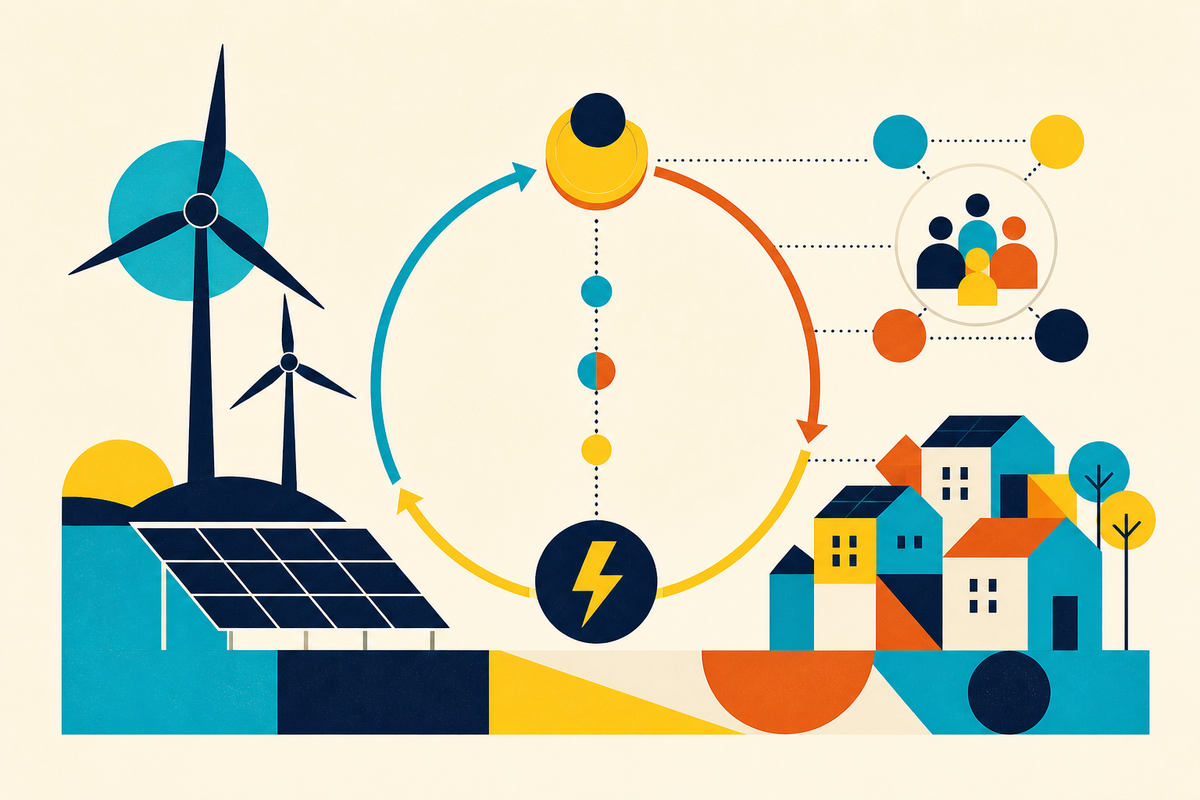
The machine was ready. The bargain was not.
Yoon studied wind-energy engineering at the Technical University of Denmark, then worked in energy and carbon consulting and as an energy-technology auditor. Denmark supplied the useful observation. Wind projects there had long incorporated community benefits and local participation. Korea's decisions, he concluded, were more likely to turn on personal and corporate economics. A moral appeal for clean power would not be enough. The bargain had to change.
The conventional development process was already showing its weakness. A 2017 Korean energy study, later summarized in a public profile of Root Energy, found that roughly one in three solar and wind applications in 2016 had been rejected or delayed amid resident opposition. The failure came before electricity generation - during permission, siting and trust.
“The question is not whether it can or cannot be done, but how we overcome the limits.”Taehwan Yoon, in a 2017 interview
Root Energy's change of mind was practical: stop treating acceptance as a communications problem and start treating it as infrastructure. In a community fund, eligible residents near a project receive priority access to an approved investment structure. They might participate through a loan, fund, bond-like claim or project equity, depending on the deal. The developer gains capital and a tangible local-benefit plan. Residents gain a disclosed economic interest. No slogan has to carry the whole load.
What the company actually sells
Root Energy now operates across three connected jobs. RootFund is the online finance layer. It gives individual and corporate investors access to project-linked products and gives permitted renewable developers construction or operating finance. Its public lending page says eligible projects may borrow 50 to 90 percent of total cost. Short construction loans are listed with three-to-ten-month terms and annual rates of 10 to 15 percent; long operating loans extend as far as 25 years at listed rates of 7 to 12 percent. These are borrower terms, not guaranteed investor returns, and the platform explicitly warns that principal and yield can be lost.
Community Fund is the acceptance layer. Root Energy designs a participation master plan, recruits and educates eligible residents, handles the investment process and helps administer profit sharing. The project list has included Taebaek Gadeoksan wind, GS Yeongyang No. 2 wind, the 200 MW Saemangeum onshore solar development and Ørsted's proposed Incheon offshore wind work. The corporate names vary. The repeated assignment is to make the local economics legible.
RE100 Solution is the demand layer. Korean companies facing carbon commitments and supply-chain pressure need to choose among green premiums, renewable-energy certificates, third-party or direct power-purchase agreements, project investment and self-generation. Root Energy maps electricity demand, policy and available supply, then helps execute and report a procurement plan. It announced RE100 work for JYP Entertainment in 2022 and lists an unnamed global streaming company among its clients. The combination is strategically neat: one side helps create financeable renewable supply; the other helps companies buy clean electricity.
A small team beside very large assets
A 2023 public company profile counted about 300 climate-fund products, roughly 52 billion won in cumulative loans, and customers tied to some 30 projects totaling 12 gigawatts. Those are dated, non-audited snapshots, not current totals. They still illustrate the operating leverage. Root Energy's supplied company record lists eight employees, while LinkedIn puts it in the 11-to-50 band. A structuring company can touch an asset many times its own balance sheet because it coordinates money and participation instead of buying every turbine.
The financing history mirrors that progression. Root Energy raised a 500 million won seed round in 2018 and a reported 2.1 billion won round in early 2020. A public 2023 profile records another 4.5 billion won Series A investment from Lighthouse Combine Investment, MYSC, Korea Development Bank and Hyundai Marine & Fire Insurance. Valuation and current audited revenue are not public. A Korean employment-data service lists 2025 sales near 3.72 billion won, a third-party estimate best read with caution.
The company's differentiation is not merely online access to green investments. Banks can finance projects. Brokers can sell funds. Consultants can buy certificates. Root Energy packages local priority, project due diligence, regulated online finance, secondary trading and corporate procurement inside one climate-specific practice. In 2019, the service entered Korea's financial regulatory sandbox. Root Energy registered as an online investment-linked finance business in 2021. Those steps matter because trust in a community product depends on where money is held, how risk is disclosed and who supervises the platform.
What failed, what it cost, what changed
Top-down development. Projects could have sound engineering and still stall when residents saw inconvenience without a fair share of value.
The 2017 proof raised ₩180 million. A 2024 offshore-wind program recruited ₩20 billion. Root Energy does not publish a universal service price.
Denmark showed Yoon that community benefit was not decoration. It was part of the renewable-energy operating system.
A public profile records that a 2014 online renewable-market patent application was rejected. Execution and authorization proved more useful than the patent.
The first showcase project's advertised 7.5 percent return was attractive, but its cost structure cannot be copied blindly. It benefited from a public rooftop, an offtake framework, policy treatment and a short maturity. Root Energy's current loan pages show a much wider range of rates and terms. More importantly, each investment carries construction, operating, counterparty, weather, policy and liquidity risk. The existence of an “open market” for claims can help a seller find a buyer; it does not create guaranteed liquidity.
The playbook worth stealing
The reusable idea is a sequence, not a crowdfunding page. First identify the people who bear a project's concentrated cost. Give that group a defined priority or economic advantage. Use a project with visible permits, credible revenue and inspectable milestones. Keep investment money separated and pay suppliers or contractors against progress. Explain risk in the same type size as return. Then report what the asset produced and what participants received.
That sequence can travel beyond power generation. A battery site, district-heating network, electric-vehicle charging hub or building retrofit can create local inconvenience while distributing benefits broadly. A participation structure brings some of the benefit back to the people closest to the asset. Root Energy has already expanded its financing language beyond wind and solar to ESS and other K-taxonomy-aligned lower-carbon projects.
When the model will not work
- The project lacks permits, a bankable buyer or predictable operating cash flow.
- “Participation” arrives after every important decision and functions as a sales pitch.
- The local group is legally ineligible, poorly defined or does not receive a meaningful advantage.
- Environmental, cultural or land-use objections cannot be answered by financial benefit.
- Risk controls, custody, disclosures or a route through financial regulation are missing.
This qualification is important. Financial participation is not permission to build anywhere. A community can rationally reject a project even when returns are offered. Root Energy's model is strongest where a technically and environmentally credible project faces a distribution problem - benefits are diffuse, while disruption is local - and where residents have a real choice.
From a rooftop to the sea
By February 2024, Root Energy announced that it had recruited 20 billion won from residents of Suwon-ri in Hallim, Jeju, for participation in the Hallim offshore wind project. In June, it opened recruitment for Yeongdeok County's first wind resident-participation fund. The physical scale had changed radically from the Yangcheon rooftop. The logic had not.
Root Energy occupies an unusual place in the climate market. It is part fintech platform, part project-finance arranger, part community-relations operator and part enterprise energy adviser. Its best product may be the connection among those roles. Every completed community program produces knowledge about project risk and resident behavior. Every RE100 engagement produces knowledge about buyer demand. The company can use one side to inform the other.
There is a modest lesson in that architecture. Climate founders often begin with the machine because the machine is visible. Root Energy began with the stalled conversation around the machine. It gave the conversation terms, a risk disclosure, a minimum ticket and, sometimes, a local rate preference. The output was not universal agreement. It was a bargain people could inspect.