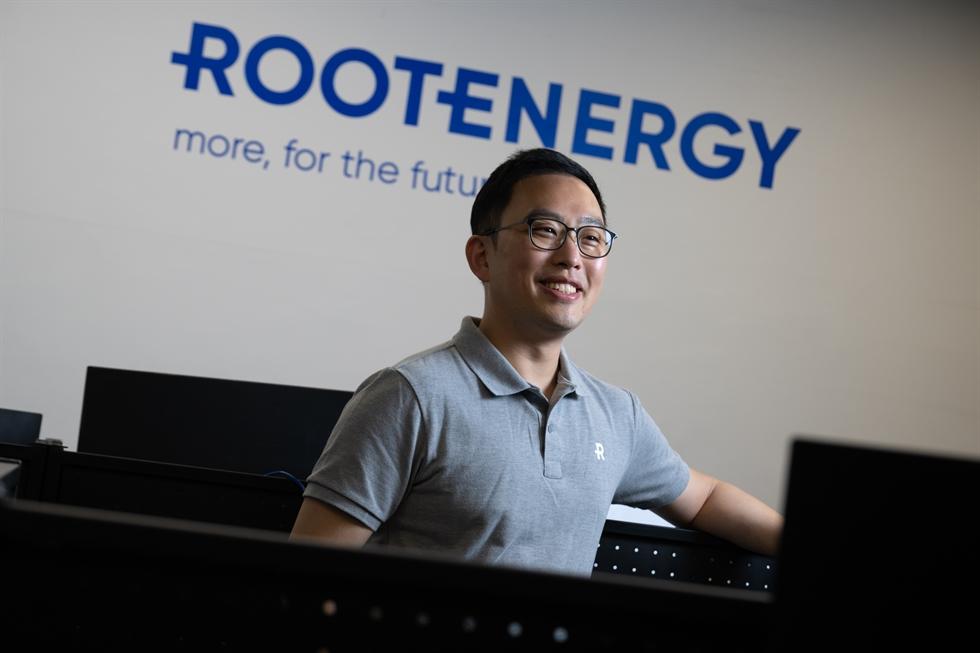
The first clue to Taehwan Yoon's career is hidden in the name of his company. Root Energy does not refer to buried cables, botanical fuel, or an unusually earnest gardening club. The root is the citizen. Yoon's premise is that an energy system lasts when ordinary people can understand it, participate in it, and receive something tangible from it. A turbine may turn in the wind, but consent has to turn first.
That conviction now sounds comfortably at home in the language of climate finance. It was stranger in South Korea in 2013, when Yoon founded the Seoul company. Renewable power was still widely framed as a matter for government targets, utilities, and industrial engineering. His idea put a household investor and a village meeting into the same diagram as the solar panel.
The diagram came from a life spent crossing boundaries: engineering and finance, policy and software, Denmark and Korea, public benefit and private return. Yoon's unusual contribution was not to invent a better blade. It was to ask who should stand beneath it.
A question large enough for a career
Near the end of university, Yoon began asking himself which field deserved the rest of his working life. Energy won. During his final semester, he made a habit of attending international conferences, listening to professionals argue about the future and imagining himself inside the argument. The timing was unhelpful. The global financial crisis had chilled the Korean job market, and an energy-consulting firm rejected his application.
He kept sending résumés. Internships at the Korea Institute of Science and Technology and the Hope Institute put him close to solar power, climate change, and social innovation. He later spent several years working in energy and carbon consulting and as an energy-technology auditor at DNV. It was serious work with serious people, yet government projects could disappear after a change in administration. Expertise did not guarantee durability.
“To what field can I devote myself for the rest of my life?”Yoon on the question that drew him into energy
The frustration sent him to Denmark, where he studied wind-energy engineering at the Technical University of Denmark and supported research connected with the United Nations Environment Programme. Denmark offered a different view of how infrastructure could grow. Energy policy still mattered, but so did local ownership and bottom-up participation. The neighbors did not have to appear only at the end of a project, seated in folding chairs beneath a presentation they had not helped write.
Yoon could have stayed abroad. He returned because he believed the idea was more useful in Korea. In 2013, he started Root Energy and entered what he later described as an exploratory sea voyage. The hard part was earning trust for a business few people could yet picture.
The rooftop that filled in 55 minutes
A compact project in Seoul eventually made the model legible. In July 2017, Root Energy opened investment in the Yangcheon Shared Solar Power Plant, a 95.85-kilowatt array planned for the roof of Seoul Energy Corporation's office. The company sought 180 million won from ordinary investors. It reached the target in 55 minutes.
Sixty-five people participated, putting in an average of roughly 2.7 million won. The offer advertised a 7.5 percent annual return for a one-year term, with an additional 0.5 percentage point for Yangcheon residents. The project was modest by power-industry standards. Its architecture was anything but modest. A public roof, sunlight, a digital investment product, local preference, and the sale of electricity had been folded into a transaction a citizen could grasp.
This is the part of Yoon's story that other founders can steal. An abstract transition becomes concrete when its value loop fits on one page. People invest. A project gets built. Clean electricity is sold. Returns flow back. Nearby residents receive a better term because proximity is treated as a contribution, not an inconvenience to be managed.
The participation loop
Money alone does not settle every argument about land, landscape, or environmental impact. Yoon's stated standard is wider: a project should avoid harming the local environment, disclose information transparently, and distribute participation opportunities fairly. The financing has moral conditions attached. Otherwise, a community fund risks becoming a glossy envelope around an unchanged decision.
Finance as neighborhood design
Root Energy sits in an unfashionable but important layer of the climate stack. It does not manufacture solar modules or pour turbine foundations. It builds the financial and operational rails around projects. Its work has grown to include community funds, broader climate funds, resident-participation services, project support, and tools for companies pursuing RE100 renewable-electricity commitments.
The combination makes sense when viewed from Yoon's original question. A renewable project needs capital. It also needs a buyer for its output, a compliant process, records that can survive scrutiny, and people willing to live beside it. Finance and data connect those needs. Community participation gives the connection a local address.
This is a decidedly downstream view of energy. The upstream end has factories, raw materials, and machinery with heroic proportions. Downstream has service design, customer accounts, legal terms, and somebody checking whether a resident understood the brochure. Yoon has argued that Korea's next energy innovation should come through data and finance as well as manufacturing. It is an engineer's respect for the whole circuit. A panel without financing is inventory. A project without a buyer is a proposal. A national target without a route for people to join it is a press release with excellent posture.
The resident is not merely a source of capital in this picture. Local participation can improve the project's ability to proceed, while project revenue can remain in the region instead of passing through it. The reciprocity is the point. Root Energy's community team does the patient work that the diagram cannot show: consultation, explanation, and the translation of complex project economics into terms people can challenge. Every transition promises a future. Yoon's model tries to issue a receipt.
Root Energy's path also reveals the unglamorous sequence behind a durable market. The company gained venture certification and preliminary social-enterprise status in 2018. In 2019, South Korea's financial authorities designated its resident-investment peer-to-peer service as an innovative financial service under the regulatory sandbox. By 2021, the company had received a Minister of Trade, Industry and Energy award. Each marker represented less a victory lap than another piece of permission to operate.
“Our business is profitable and a win-win platform providing everyone with revenue sources.”Yoon, explaining why public benefit and profit belong in the same model
Yoon has resisted the idea that social benefit requires a vow of commercial poverty. His argument is practical: if a model depends on charity, it will struggle to carry an entire energy system. Returns invite repetition. Repetition creates a market. The trick is to keep the return attached to the purpose instead of letting the purpose become decorative.
That balance explains why his company can look like several businesses at once. To an investor, it is an access point to climate assets. To a developer, it offers a path through financing and community participation. To a company making a renewable-electricity commitment, it provides help measuring and securing cleaner power. To a neighbor, at its best, it is an invitation received before the concrete arrives. The same platform has to speak all four dialects without becoming vague in any of them.
The stubbornness in the system
Early interviews capture a founder aware of the voyage's length. In 2014, barely a year after launching, Yoon said he would keep running the company until Korea could use clean energy to achieve energy self-sufficiency, however long it took. More than a decade later, his public writing still circles the same tension: national ambition arrives in enormous numbers, while local people are often invited late.
In a July 2026 essay, he examined plans involving hundreds of trillions of won for semiconductors and artificial-intelligence data centers through the familiar lens of who enters the room and when. Two years earlier, he had written about uncertainty in Korea's renewable-energy deployment rules during the RE100 era. The subject changes scale, but the instinct is consistent. Big systems fail in the gap between announcement and participation.
That consistency says something about Yoon's personality. He appears less interested in novelty for its own sake than in finding better machinery for a settled conviction. Root Energy's products have evolved. The citizen at the center has not. Persistence, in his version, is not doing precisely the same thing for thirteen years. It is keeping faith with the same principle while rebuilding everything around it.
There is an appealing modesty to the result. A community-energy project does not abolish political disagreement. It gives disagreement better materials: disclosed numbers, a route to ownership, a local benefit, and a reason to keep talking. The approach treats trust as something designed through terms and process, not sprinkled over a finished plan by a communications team.
Yoon began with the question of who owns the electricity. The answer he has spent his career constructing is plural. The utility still matters. The developer still matters. Government still matters. But the person who can see the turbine from the kitchen window belongs in the economics of the sentence.
Steel, sunlight, wind, software, capital, and consent: an energy transition needs all of them. The hardware is the visible part. Taehwan Yoon has made a life in the arrows between the boxes, where a citizen becomes an investor and a neighbor gains a stake. Roots are not glamorous. They are simply where durable things begin.