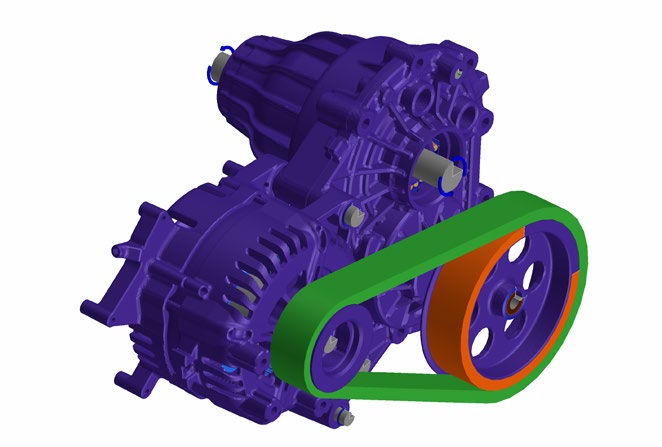
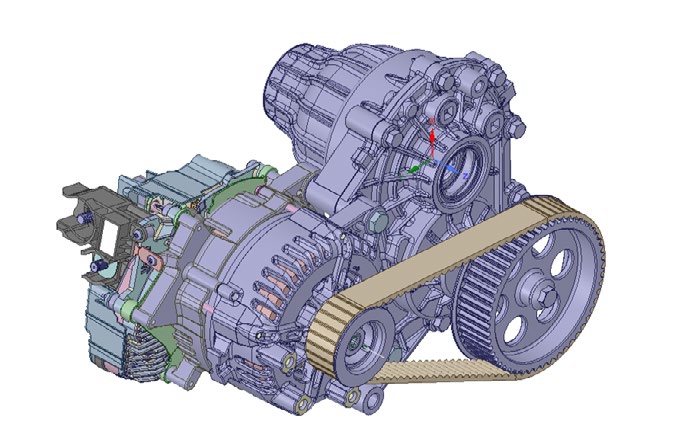
The belt was supposed to help. In a small electric-drive project at Valeo, connecting a motor and gearbox by belt offered useful flexibility. Engineers also expected it to reduce interaction between the two subsystems. Instead, belt stiffness produced unwelcome behaviour. A component chosen partly to keep things apart had introduced a new way for them to misbehave together.
Working with Romax, the team identified a resonance problem and changed the belt material. Valeo’s published account says simulation and engineering support helped eliminate a physical prototype iteration, cutting seven to nine months from development. Physical approval tests remained. The useful achievement was getting to them with fewer unanswered questions.
That is a good introduction to Romax Technology, a Nottingham company whose software examines the machinery that moves power from one place to another. Its territory includes gearboxes, bearings, shafts and electric machines. The product is a way to ask how those parts behave together, before an expensive assembly supplies its own answer.
A bearing is never working alone
Romax’s central argument starts with a deceptively simple observation: the parts of a transmission affect one another. Bearing stiffness influences shaft deflection. That changes gear alignment and where teeth make contact. Those forces feed back through the shaft and bearings. Put everything inside a flexible housing and the calculation becomes a conversation with several participants.
Its software combines analytical, empirical and finite-element methods. Different components receive different mathematical treatments, tied together in a system model. This lets engineers investigate interactions without representing every part at the same computational expense. Detail is valuable when it changes the answer; otherwise, it can make the answer slower to obtain.
For a buyer, the practical questions are wonderfully unglamorous. Will the bearing last? Where is power being lost? Which gear geometry is causing vibration? Can a lighter housing still do the job? Romax supplies a working environment for comparing these competing demands, with specialist consultancy available when the modelling gets difficult.
Housing flexibility influences every part. Conceptual diagram, not a simulation result.
The man who wanted better calculations
Founder Peter Poon came to the problem through bearings. His career included industrial work at RHP, a doctorate at Bristol and research at Cambridge. In a 2021 interview published by MSC Software, he described a severe bicycle accident that left him with substantial sight loss. Unable to drive afterwards, he saw consulting as a practical way to support his family.
He established Romax in 1989. The name draws on “rotating machinery experts”. An early US National Institute of Standards and Technology project, Poon recalled, helped finance two to three years of software coding. It is an origin story built around specialist work paying for more specialist work.
His public advice is refreshingly specific. Break a problem into fundamental parameters, calculate, then judge. In a 2020 BearingNews interview, he spoke about enjoying coaching people and seeing their ideas make an impact. He also discussed mistakes and the need to recover from them. That gives a clearer picture of the founder’s engineering philosophy than a list of corporate values would.
“You must make decisions based off calculations and facts.”
Peter Poon · BearingNews interview, 2020
Six tools, one awkward assembly
The current family divides the work into recognisable engineering questions. Concept handles early layouts and sizing. Enduro studies structure and durability. Spectrum deals with noise and vibration, while Energy examines transmission losses. Spin serves bearing specialists. Evolve brings mechanical simulation capabilities together for electric-machine work.
Older customer accounts refer to RomaxDesigner and the Romax Nexus platform. Those names belong to the product’s evolution; they should not obscure the present six-tool family. Cadence now markets Romax within its MSC Software portfolio, with support, training and professional services alongside it.
Concept’s role is particularly useful to understand. Its drag-and-drop layouts let a team compare arrangements before committing to detailed design. The point is to preserve choices while they are relatively easy to change. A quickly rejected idea can be a productive result, even when it leaves nothing impressive to show in a presentation.
Spin goes deeper into Romax’s original specialism. Its published catalogue includes more than 60,000 bearings from suppliers including SKF, Schaeffler and Timken. Engineers can also define custom bearings. In 2021, Romax integrated SKF’s online calculations, giving users access to the supplier’s own methods inside their studies. That makes collaboration with the component maker part of the calculation.
A tram customer turns down the volume
At Czech gearbox maker Wikov, a tram project presented a different difficulty. The customer required airborne noise no higher than 100 dB(A) across the operating range. Wikov had assessed durability, but its existing simulation approach did not provide the full-system noise analysis the project needed.
With the detailed design nearly complete, the company brought in Hexagon’s engineers. They used Romax Spectrum and embedded Actran acoustics to connect gear excitation, vibration and radiated noise. The work led to changes in gear microgeometry and the housing, with Klingelnberg’s KIMoS software contributing to the bevel-gear work.
The case illustrates both the value and the discipline of simulation. Testing followed the optimisation, and the model had to reflect the conditions of the test setup. A gearbox mounted on a rig can behave differently from one installed in its intended application. The mounting conditions belong in the engineering discussion, however attractive the coloured plots.
The purchase includes an engineering habit
Romax sells into organisations making transmissions and rotating machinery: automotive manufacturers and suppliers, bearing companies, aerospace businesses, and teams working in wind, marine and rail. Hyundai WIA is another documented user. Its account describes using Concept to shorten the development loop and make designs more robust earlier, before internal test teams receive the parts.
The business combines commercial software with consulting, training and support. Romax has also been offered through MSCOne, the wider software-access programme. The purchasing decision therefore includes which analyses a team needs, how often it needs them and whether it has the expertise to conduct them. A licence is one input into that decision.
A sensible evaluation would price the intended software access and engineering support together, then compare that commitment with the prototype work and development time the team expects to avoid. That is an evaluation method, rather than a promised return. The customer cases show why modelling skills and trust in results belong in the budget discussion.
There are credible alternatives. SMT’s MASTA covers transmission design and analysis from concept through manufacturing. KISSsoft combines machine-element calculations with gearbox system modelling. General finite-element packages also support parts of the task. Romax’s distinction is its particular combination of drivetrain modelling, bearing expertise, connected tools and engineering services. The useful comparison is a representative project using the buyer’s own data.
New owner. New solver. Same mechanical problem.
Long before the acquisitions, Romax received a Queen’s Award for Enterprise in International Trade in 2009. In February 2012, it announced an investment partnership with Moonray Investors, part of Fidelity International. Poon retained majority ownership at that point. The stated purpose was to accelerate simulation and drivetrain design development, with transportation and wind energy among the intended markets.
Romax’s corporate history has moved beyond the Hexagon label still visible in older material. Hexagon announced its acquisition agreement in February 2020, reporting 2019 sales of €27 million and approximately 240 employees. Those figures describe the business at that moment. Its home was Hexagon’s Manufacturing Intelligence division.
On February 23, 2026, Cadence completed its purchase of Hexagon’s Design and Engineering business. Companies House records Cadence as Romax’s controlling company from the same date. The approximately €2.7 billion transaction covered the wider business, including other simulation products. It is not a valuation of Romax on its own.
The technology is changing too. An August 2026 release article introduces Romax 2026.1, including a preview of a second-generation static-analysis engine intended for larger models and modern computing hardware. It also describes an automated Ansys Maxwell interface for electric-machine noise work and faster processing when using MSC Nastran for external dynamic condensation.
A housing model, less waiting
Cadence’s example for external dynamic condensation with MSC Nastran: approximately 74% less end-to-end processing time. This is a specific example, not an overall Romax speed claim.
Copy the sequence, earn the confidence
The transferable lesson is a sequence of decisions. Compare layouts early. Model the important interactions. Ask suppliers whether the proposed components can be made. Check the results against relevant physical evidence. Then decide which repetitions of expensive prototype work can responsibly be removed.
The approach depends on appropriate loads, material properties, component information and boundary conditions. It also needs people who can recognise when a model is answering the wrong question. Romax’s own technical explanation warns that inaccurate bearing stiffness can undermine the system result. Buying more detailed software cannot rescue an incorrectly specified problem.
For readers outside engineering, the appeal is easier to grasp than the mathematics. Romax gives a design team another opportunity to discover the awkward thing while it is still changeable. Sometimes that thing is a gearbox housing. Sometimes it is a belt. The expensive part is finding out after everyone has agreed to build it.
Go inside the model
Explore the current Romax suite, follow Romax on LinkedIn, or visit its legacy Twitter/X and Facebook profiles.
Read about Romax 2026.1 · Browse the technical blog · Watch Jamie Pears demonstrate Concept on YouTube (2015)