Four and a half hours is an awkward amount of time to spend discovering what an insurance policy can do. In Delhi in 2015, Rohan Malhotra was helping a friend deal with a car accident. Filing the claim involved calls, delays and the arrangements needed to get a vehicle off the road. By his account, the afternoon supplied the idea for Roadzen.
There is an appealing lack of glamour in that beginning. No driver wakes up hoping for a closer relationship with a claims department. Insurance is supposed to be the arrangement made in advance, so that the difficult day requires fewer decisions. Malhotra encountered a process that demanded considerable effort precisely when it was meant to offer assistance.
He had an engineer’s education and experience building enterprise software. The question he took away was practical: why was technology doing so little to help? Founded that year, Roadzen became his attempt to answer it. The business would eventually take him to Nasdaq, but its original unit of measurement was time spent waiting.
The engineer before the insurer
Malhotra’s route into insurance began with an interest in machines that could act for themselves. “I was drawn to robotics at an early age,” he has said. He studied engineering at NSIT, part of the University of Delhi, and earned a master’s in electrical and computer engineering at Carnegie Mellon, studying robotics, AI and control systems.
He completed the master’s in 2010. From June 2011 to July 2014, he led Avacara Global Solutions, an enterprise software and data analytics business serving Fortune 500 clients. Before he was asking insurers to change how they worked, he had been involved in making software for large organizations.
That background helps explain the shape of Roadzen. A robot has to interpret information and decide what happens next. An insurance operation has its own sequence of observations and decisions: identify a vehicle, understand its condition, assess a risk, inspect damage. Malhotra brought a technical vocabulary to a business whose customers usually describe the problem in simpler terms: somebody needs to sort this out.
The connection has limits, of course. A claims process involves contracts, people and responsibility as well as images and data. That makes the engineering problem more demanding. A working demonstration must eventually fit into somebody else’s working day.
It is a career path that makes the choice of insurance less surprising. Enterprise software lives among approvals, established procedures and teams with different priorities. The technical founder needs to understand the organization around the task. In motor insurance, that organization extends beyond the insurer to the roadside provider, the assessor and the garage. Each has a job to finish before the customer can finish theirs.
Teaching the parts to talk
Roadzen’s work stretches across the stages of motor insurance. Its tools include vehicle inspection, insurance distribution, claims handling and telematics, the collection of information about vehicles and their use. Computer vision gives photographs and video a role in assessing a car’s condition. Driving data adds a record of what happens between purchase and claim.
Think of those as connected questions. What is being insured? How is it being driven? What happened to it? What work is needed now? Each answer has potential value elsewhere in the process. Damage information can help a claim; the circumstances of a claim can inform a view of risk. The idea becomes interesting where the handoffs begin.
- 01ObserveVehicle images
and driving data - 02AssessCondition, behavior
and insurance risk - 03RespondClaims decisions
and repair workflows
In a March 2026 podcast conversation, Malhotra described a driver submitting a video that circles the vehicle, allowing a system to assess damage and draw on local parts-and-labor information. The attraction is easy to grasp. A phone is already in the driver’s hand. It can become the means of supplying information that would otherwise require another appointment.
The ambition reaches backward from the claim, too. Roadzen’s drivebuddyAI business works with driver monitoring and collision warnings. In June 2026, the company announced a $5.3 million agreement covering 3,600 electric buses and trucks in India. That is a different setting from a personal insurance claim, with vehicles whose time off the road has an immediate operating consequence.
These activities put Malhotra in conversations with insurers, fleets and carmakers. They also keep his original question from becoming merely a faster form to fill in. A shorter wait is useful. So is making sure the information collected during it can travel to the next person who needs to act.
The two-person sales department
Malhotra has admitted to a mistake that will sound familiar to technically minded founders. For Roadzen’s first five years, the sales team consisted of two people. He had expected the quality of the technology to do more of the commercial work. Looking back, he described an early failure to give distribution the attention it needed.
“we underestimated the importance of sales and distribution”
Rohan Malhotra · reflecting on Roadzen’s early years
It is a refreshingly specific confession. Two salespeople is a headcount, and a headcount exposes the choice beneath the strategy. A system may perform well and still need someone to explain it, follow up, answer objections and help a buyer see where it belongs. Good code has many virtues. Maintaining a customer conversation is generally somebody else’s job.
He also described taking Roadzen into international markets while the team numbered roughly 30 to 40 people, acknowledging the strain. Read together, the two decisions show an ambitious technical business learning the demands of distribution. Geography could expand more quickly than the organization supporting it. Building the company required attention to both.
The bell, and the quarterly clock
On September 22, 2023, Malhotra rang Nasdaq’s closing bell at MarketSite in Times Square. Roadzen had completed its combination with Vahanna Tech Edge Acquisition I Corp.; its shares began trading under RDZN. The public company chapter had an unusually clear opening image: a founder pressing a button, colleagues celebrating around him.
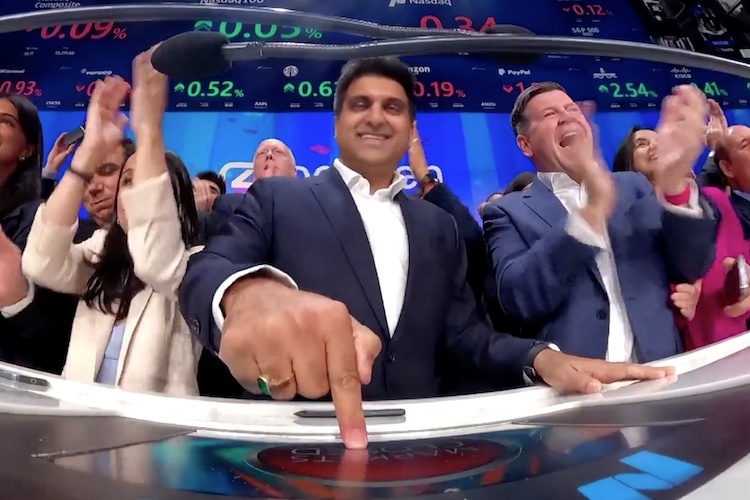
A bell supplies a satisfying punctuation mark. Quarterly reporting promptly supplies the next sentence. The work becomes visible in revenue, costs and the explanations management gives for the difference between them. For Malhotra, the same company now had to make its operating argument to investors as well as its product argument to clients.
There were complications along the way. Discussing the UK business in 2025, he explained that a market-wide regulatory pause on guaranteed asset protection insurance had interrupted a substantial revenue stream. A software company working inside insurance still has to contend with the rules governing the products it helps distribute. The operating environment gets a vote.
By August 2026, Roadzen reported $16.2 million in revenue for the quarter ended June 30, compared with $10.9 million a year earlier, a 49% increase. Its adjusted EBITDA loss narrowed to $0.37 million. The distinction matters: a smaller loss on that adjusted measure still leaves work before break-even, and it is separate from net income.
His public calendar continued to reflect that responsibility. An October 6 announcement scheduled him for an AI panel at the Maxim Growth Summit and a ThinkEquity presentation in New York later that month. The topics had broadened from one difficult claim to a company operating across countries. The need to explain the business remained.
For the founder, that creates two clocks. Product development measures progress in capabilities: another type of image understood, another workflow connected. A public company measures it in reporting periods. The challenge is to make the first clock produce results the second can recognize. An announcement can describe the ambition; the next set of operating figures gives that ambition a date and a scale.
The price of being understood
Malhotra’s written argument for telematics starts with a familiar irritation: insurance categories can say a great deal about a group and rather less about how a particular person drives. He favors using actual behavior to refine risk assessment and create incentives for safer driving. The proposition asks a customer to exchange information for a more individual assessment.
That exchange makes trust part of the product. In his writing, he has called for transparency about data handling, accessibility and common assessment standards. These are consequential details for a business built around observation. A customer needs to understand what is being collected and why it belongs in a decision about their policy.
His commentary on AI also addresses governance and the quality of the underlying data. Old or inaccurate information can produce poor decisions at impressive speed. Existing insurance systems create integration problems. The appeal of automation therefore comes with a less photogenic workload: maintaining records, checking models and making sure a decision can be explained.
Those concerns bring the story back to Delhi. The original frustration involved being left to navigate a process. Adding intelligence to that process carries an obligation to make it easier to understand. A claim resolved quickly but opaquely would leave a different problem for the same customer.
There is a plain standard available beneath all that complexity. Can the person using the service tell what happens next? The founder’s original experience offers a way to ask it without needing a technical explanation. Four and a half hours was enough time to recognize the distance between holding a policy and getting help from it.
Malhotra has spent the years since 2015 working on the space between a promise and its delivery. His story contains the engineering degree, the early commercial mistake and the stock exchange ceremony. It also contains the friend waiting for practical help. For all the company’s expansion, that remains a useful person to keep in view.
Keep the conversation going
His work, his writing, and the conversations behind this profile.