The first thing to know about Kevin Eunsu Lee’s startup story is that it starts before the startup people associate with him. Around 2000, he was already working on technology to help drivers keep their vehicles out of trouble. His earlier business supplied SsangYong and Daewoo Bus. Then the global financial crisis arrived, and that business closed. The customers, the engineering, the promise of the market: none had made the company immune to a much larger event.
Lee returned to the field. In 2010, he established CARVI in Korea. That decision supplies a useful opening to his story. Before there was a crowdfunding campaign or a photograph of a partnership signing in Las Vegas, there was a founder making another attempt at a problem he already knew. The road had not become easier to read because his first business had ended.
The business before the pitch
A restart complicates the usual account of invention. The pleasing version begins with an idea, proceeds to a prototype, and finishes with people applauding in sensible shoes. Lee’s version has a closed business in the opening chapters. It also has experience supplying vehicle manufacturers, which is a rather different education from sketching an app and wondering who might download it.
He had been dealing with a specific difficulty: giving a machine useful information about the scene around a moving vehicle. A road keeps changing. So do the light, the distance to the next car, and the driver’s decisions. Any useful assistance must keep up with that untidiness. The problem travels with the car.
The Korean restart and the later American consumer launch belong to the same career, though they mark different stages. CARVI’s windshield device came to public attention through a 2015 Indiegogo campaign. By then, Lee’s involvement in automotive electronics stretched well beyond the age of the pitch. The small object arriving on a crowdfunding page carried a longer working history.
A new attempt
CARVI in Korea
The public pitch
A windshield coach
A wider view
Roads and driving
A passenger with an opinion
The early CARVI camera was a round device, 100 millimeters across and 35 millimeters high, mounted inside the windshield. It connected to a smartphone over Wi-Fi. It watched the road ahead, warned about following too closely or straying from a lane, and assembled feedback on the drive. Its size suggested a hockey puck with career ambitions.
The proposition was practical. Drivers could add a layer of assistance to the car they already owned. The household decision did not have to begin with replacing the vehicle. That mattered to the design: a device intended for an existing windshield had to make a case for itself in an existing life, with its existing budget.
Lee’s language at the time gave the product a surprisingly social job. He wanted the app to recognize good habits as well as point out mistakes. A driving score was supposed to make habits visible and encourage changes over time. The imaginary passenger had an opinion, certainly, but the brief included encouragement.
That small distinction helps explain the project. An alert addresses the next few seconds. A report asks what the driver might do differently tomorrow. CARVI was trying to work in both time frames, with the same view through the windshield.
“The idea is to applaud good behavior and supply feedback for areas that need improvement.”
Kevin Eunsu Lee · on driver feedback
A handshake, then the hard part
In January 2016, Lee stood beside KT executive Yoon Kyung-lim in Las Vegas with a signed agreement between them. The photograph has the familiar formal ingredients: dark suits, an open document, a handshake held long enough for the camera. Above them, a banner spelled out the collaboration on connected car technology.
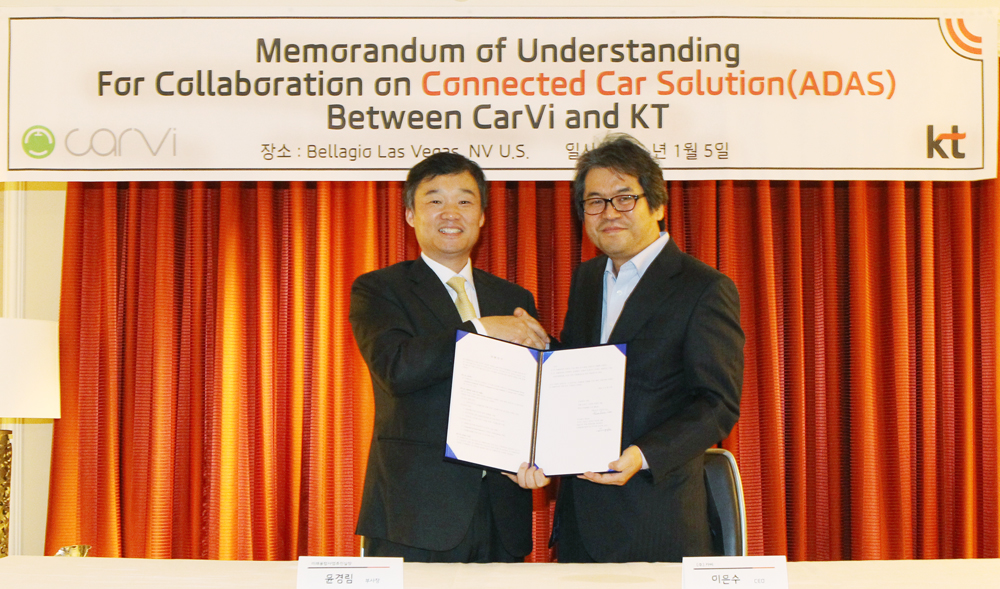
The CES project brought together CARVI’s driver assistance technology, KT’s driver analysis work, and Samsung Electronics’ ARTIK platform. The agreement covered joint commercialization and development. Later that year, CARVI announced a $5 million Series A involving Samsung Venture Investment, Korea Telecom Investment, and POSCO.
Those developments changed the resources around Lee’s project. They also made the next task more concrete: turn cooperation and capital into a product people could obtain and use. A signed document looks wonderfully complete in a photograph. The work it authorizes is generally just getting started.
For a founder with a previous venture behind him, these were milestones in a continuing effort. They connected a relatively small technology company to organizations with their own infrastructure and customers. The camera still needed to earn its place in a vehicle. Now more businesses had a reason to help it get there.
The difference between a stop and a story
As CARVI developed, Lee’s attention extended to the decisions that driving information might support. An insurer wants to understand risk. A fleet operator wants to understand what is happening across vehicles. Both need more than a pleasing product demonstration.
Consider a simple example. Two drivers brake sharply. A count of sudden stops records two events. A view of the road can help explain the circumstances around them. One number starts the inquiry; the scene gives it something to work with. This is an illustration of the problem, rather than a claim about any particular journey.
Lane · signal · vehicle ahead
What happened during the drive?
Context for feedback and decisions
CARVI’s approach uses image recognition to capture details such as following distance, lane behavior, and signals. By 2022, its insurance proposition described assessment across 38 items. Lee wanted actual driving habits to play a greater part in how premiums were calculated. Better information, in his argument, could give safer behavior a financial reward.
The attraction is easy to understand. A driver can change a habit. A bill that responds to that change makes the feedback tangible. But translating a driving record into an insurance product introduces another set of decisions. The meaning of the data has to survive the journey from camera to customer.
An insurer has habits, too
By June 2022, Lee was speaking publicly about the difficulty of introducing new products into Korea’s established motor insurance market. He argued that a technical capability could exist without finding a straightforward commercial route. He also called for conditions that would give smaller businesses more room to offer insurance products.
His frustration had a recognizable commercial shape. Existing products already sold. Established organizations had reasons to keep using familiar arrangements. A founder could explain a different method, but someone else still had to decide to adopt it. There was no software update that would make that decision on the institution’s behalf.
Lee described public sector fleet work as another route for CARVI’s technology. An organization running vehicles could use driving information in daily management, while the broader insurance ambition continued. That offered a practical setting for the work: actual routes, actual vehicles, and people responsible for both.
This chapter makes the career more interesting than a procession of devices. Lee had moved into a problem where engineering and institutional behavior met. He wanted drivers to adjust their habits. To make his insurance idea work, organizations would have to adjust theirs as well.
A founder makes room
The same tension between ambition and practical constraints appeared inside the company. In 2021, Lee described the difficulty of hiring people with the expertise CARVI needed. He wanted colleagues able to work internationally and willing to test how far their own abilities could take them.
He also described a responsibility to reward their effort. CARVI offered employee stock options, and Lee acknowledged that he could not achieve success alone. A founder’s contribution had brought the company to a certain point; people joining afterward would have their own contributions to make.
That is a modest but revealing part of his public account. It locates the next stage of the business in other people’s work. The engineer who had returned to the same field after a closure was describing a company that needed room for additional expertise. Persistence could get him back into business. Building the team required more than persistence.
The road gets a report card
In April 2025, CARVI reported GS Grade 1 certification for its intelligent mobility service platform. Alongside driving assessment, the platform included pothole detection and road safety grading. Vehicles traveling their usual routes could help identify damaged pavement and send images and locations to a dashboard.
It is an appealingly concrete development. A camera that observes a driver’s surroundings can also collect information useful to the people maintaining those surroundings. The road becomes part of the work. A report can lead toward a repair, with the platform tracking the process.
For Lee, the connection to his earlier work is visible. He has continued finding decisions that might improve when someone can see more of what happened on the road. The original consumer product addressed the driver. Later applications brought in fleet managers, insurers, and road operators, each with a different reason to pay attention.
His career has included a closure, a restart, a consumer pitch, partnerships, and arguments about adoption. The thread through them is unusually ordinary: a vehicle moving through a scene, and the effort to understand it well enough to be useful. Years after his first attempt, Lee is still working on the view ahead.