Before Robert A. Berman tried to make sense of traffic, he had to persuade people to let a crowd assemble. At nineteen, he obtained a mass-gathering permit in Sullivan County, New York, and went into outdoor concerts. Working with promoter Sid Bernstein, he opened Music Mountain on the grounds of the former Avon Lodge Hotel in Woodridge. The bills included Santana and the Allman Brothers. It was an early education in a business where enthusiasm arrives by the carload.
Decades later, the crowds have become data. Berman is the founder, president, chief executive and chairman of Rekor Systems, whose software helps interpret what happens on roads. His route there passed through hotels, gaming and specialty finance. A career that looks scattered on a business card becomes easier to follow when you notice how often it involves coordinating money, places and people who need permission to do something.
Then came a return engagement. Berman stepped out of Rekor’s CEO job in May 2024, remaining chairman. In March 2025, after David Desharnais resigned, he took it back on an interim basis. A March 2026 agreement appointed him president and CEO. The founder was back dealing with the daily arithmetic of the company he had helped create.
A promoter learns to read the room
Concert promotion makes a useful opening chapter because it has so little patience for abstraction. A venue needs an audience, an audience needs a reason to come, and the surrounding community has opinions about both. Music Mountain put Berman into that practical world early. His later businesses would involve different customers, but similarly crowded negotiations.
His formal education also involved a change of direction. After graduating from Monticello High School, he attended Arizona State University for one semester, then returned home. He earned an associate degree in business at Sullivan County Community College in 1979. The sequence puts an actual place and a modest qualification beside the later corporate titles. His business education continued in organizations where he had to make decisions and live with their consequences.
During the 1990s, he co-founded Hospitality Worldwide Services, serving as chairman and chief executive. Hotels became another arena for assembling a business around physical assets and the services that keep them working. The hospitality chapter matters because it places him in operating businesses long before Rekor’s cameras and computer vision entered the picture.
By 2002, he was running Empire Resorts, the Nasdaq-listed gaming business he co-founded. He remained CEO until 2005. Gaming added another layer: a business can have capital and customers yet still depend on approvals, public authorities and relationships that do not move to an entrepreneur’s preferred timetable. The spreadsheet has to accommodate the meeting that has not happened yet.
From 2006 through March 2015, he chaired and led Cinium Financial Services, a specialty finance company. Alongside these jobs, he has been general partner of Avon Road Partners since January 2000. Real estate and broadcast media feature in that partnership’s investments. The consistent professional credential is experience with capital and company structures, acquired across several businesses rather than inside a single technical discipline.
The acquisition that changed the question
Berman began serving as CEO and a director of Rekor’s predecessor in March 2016. The business that became Rekor did not emerge fully formed as a roadway software company. Its transformation involved buying capabilities, shedding other operations and deciding what the remaining company should be for.
A consequential purchase arrived in March 2019: the assets of OpenALPR Technology. Its vehicle-recognition software gave the company a way to extract information from camera footage. Rekor moved from perpetual software licensing toward subscriptions and broadened the applications. The commercial question became how many useful decisions could follow from a camera already looking at a road.
That question appealed to more than police departments. Parking operators, highway authorities and commercial customers also had reasons to understand vehicles and movement. In 2020, Rekor sold its government-contracting consulting and aviation-staffing businesses as it sharpened its focus. There is a particular discipline in selling something that works because it no longer belongs in the company you are trying to build.
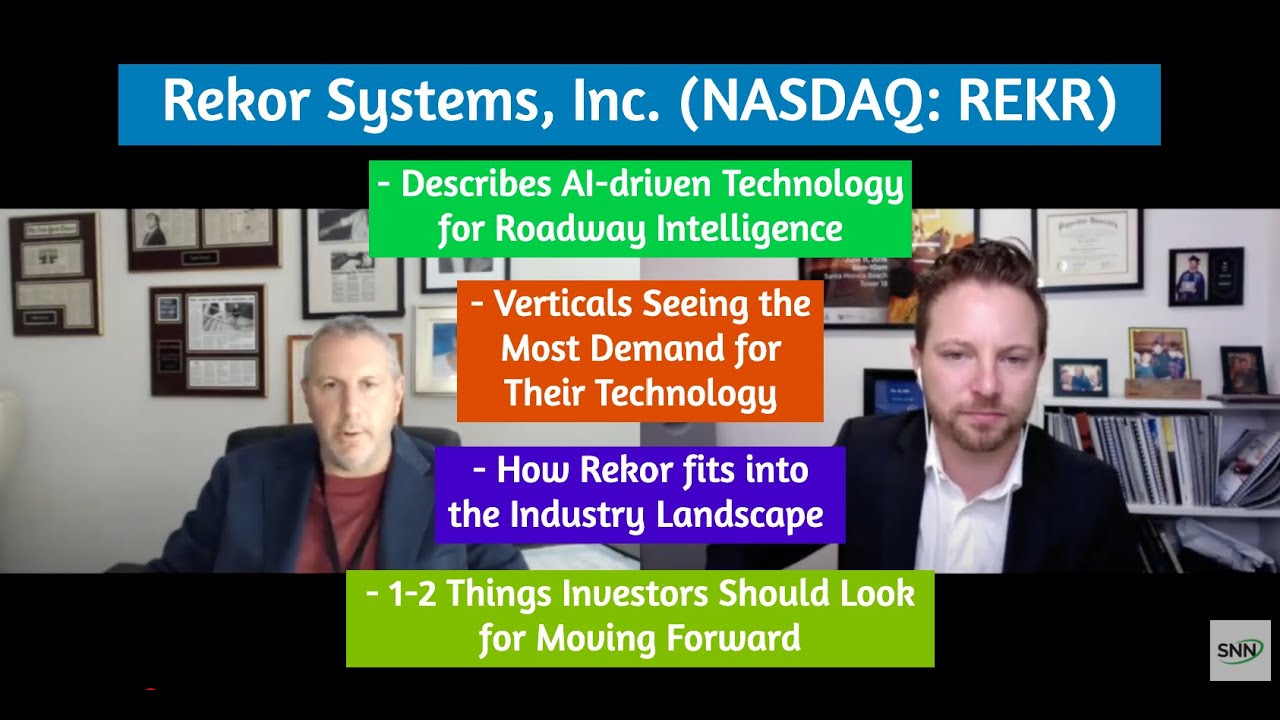 Watch the interview ↗
In recorded interviews and investor appearances, Berman has made the business case for turning observations into action. A picture is one ingredient. The paying customer needs a useful answer: something to investigate, a traffic condition to understand, or an incident to respond to. The distance between those two things is where Rekor tries to earn its keep.
Returning to a company with bills to pay
The second spell as CEO brought a less photogenic assignment than describing intelligent roads. Rekor needed to reduce its costs and improve its finances. During the first half of 2026, the company cut headcount by 20% and reorganized engineering operations. Those are consequential decisions for the people involved, whatever the resulting chart looks like.
The August results showed progress alongside unfinished work. Second-quarter revenue was $12.7 million, and the adjusted EBITDA loss was $1.2 million. The latter is a company-defined, non-GAAP measure, with exclusions; it does not establish net profitability. Berman’s stated goal remained reaching profitability. A smaller loss made that ambition more plausible without making it an accomplished fact.
September brought another practical decision: terminating two long-term leases, one in the United States and one in Israel. Rekor said it would use approximately $2.8 million in cash to reduce about $10 million in lease obligations, with annualized savings expected to exceed $2 million. For an executive with a history in property, the latest move involved getting out of space.
There is an unromantic continuity here. Berman’s early career involved bringing people into venues. His present job includes deciding how much venue a software company actually needs. Ambition still requires a place in the budget, even when the product lives on a network.
The camera has a trust problem
A roadway camera creates another obligation beyond selling software. Observing vehicles can help public agencies. Accumulating searchable records of ordinary travel also raises questions about who can look, for what reason and for how long. Berman has increasingly put those questions into his public account of the business.
In August 2026, he appeared on New York’s Finest: Retired & Unfiltered to discuss license plate readers, AI and privacy. The following week, Rekor proposed a national framework for responsible automated license plate recognition. The proposal sought rules that would apply across vendors. Adoption would require other companies and public institutions to participate.
“The current battle is benefiting no one.”
Robert A. Berman, August 2026
The proposed framework groups its demands around three concerns: protecting plate information unrelated to an authorized alert, retaining records according to their purpose, and verifying the integrity of supporting video. These are policy and product ambitions. Their value depends on whether systems implement them and whether the protections can be demonstrated.
One small detail in his public writing makes the executive voice less anonymous. A 2022 essay titled DOTCOM 2.0 ? opens with a memory of coffee and The Wall Street Journal in January 2000. The setting is ordinary, the date loaded with market history. It is a reminder that his present AI business belongs to a career extending across earlier cycles of technological enthusiasm. Berman has been reading the financial pages for a while.
His LinkedIn writing adds a useful personal edge. He asks who owns data, who can search it and whether an outcome can actually be attributed to a particular technology. In a field that sells better information, those are fair questions to direct back at the seller. They also give his position more substance than a general promise to take privacy seriously.
When seeing needs a receipt
The same concern about trust extends to recorded media. In June 2026, Rekor launched Go-Secure.Video, designed to authenticate video cryptographically from capture. By August, Berman was discussing an extension to recorded audio. The proposed market reaches beyond traffic: organizations using recordings need ways to establish whether their material has changed.
The distinction is practical. A system examining a suspicious clip after the fact faces a different task from one that records evidence of authenticity as the footage is made. Berman’s pitch centers on that earlier point in the process. The business ambition is to make verification useful wherever disputed recordings cause trouble, while commercial partnerships still have to be negotiated.
Meanwhile, the road business continues to produce concrete opportunities. On September 30, Rekor announced Oregon’s intent to award a connected-vehicle alert program, anticipated at $1.4 million over five years. It remained subject to contract negotiations and later renewals. The planned service would carry roadway warnings to supported vehicle displays and navigation tools, without asking drivers to install another app.
October supplied a reminder that corporate leadership also involves conflict. Rekor announced it had filed a Delaware complaint against a former director over alleged failures connected to a December 2025 financing. Berman publicly backed the board’s action. The allegations had not been adjudicated. His role now combines selling the product, managing costs and defending the company’s position in a dispute.
Read across those chapters and Berman emerges as an entrepreneur accustomed to businesses that have to work in public. A concert venue needs local acceptance. A gaming project needs approvals. A roadway-data company needs customers, public trust and enough cash to keep going. The tools have changed substantially. The need to persuade several constituencies at once has endured.
The early promoter wanted people to turn up. The returning CEO needs agencies, partners and shareholders to keep showing up, quarter after quarter. A road is a demanding place to make a promise: eventually, somebody has to get somewhere.
Keep following the road
- CompanyRekor ↗
- Professional profileRobert A. Berman on LinkedIn ↗
- Watch / YouTubeThe SNN Network interview ↗
- Listen / August 2026License plate readers, AI and privacy ↗
- Read / August 2026Rekor’s proposed responsible-ALPR framework ↗
- Results / August 2026The second-quarter operating figures ↗
- News / October 2026Rekor’s statement on its Delaware complaint ↗