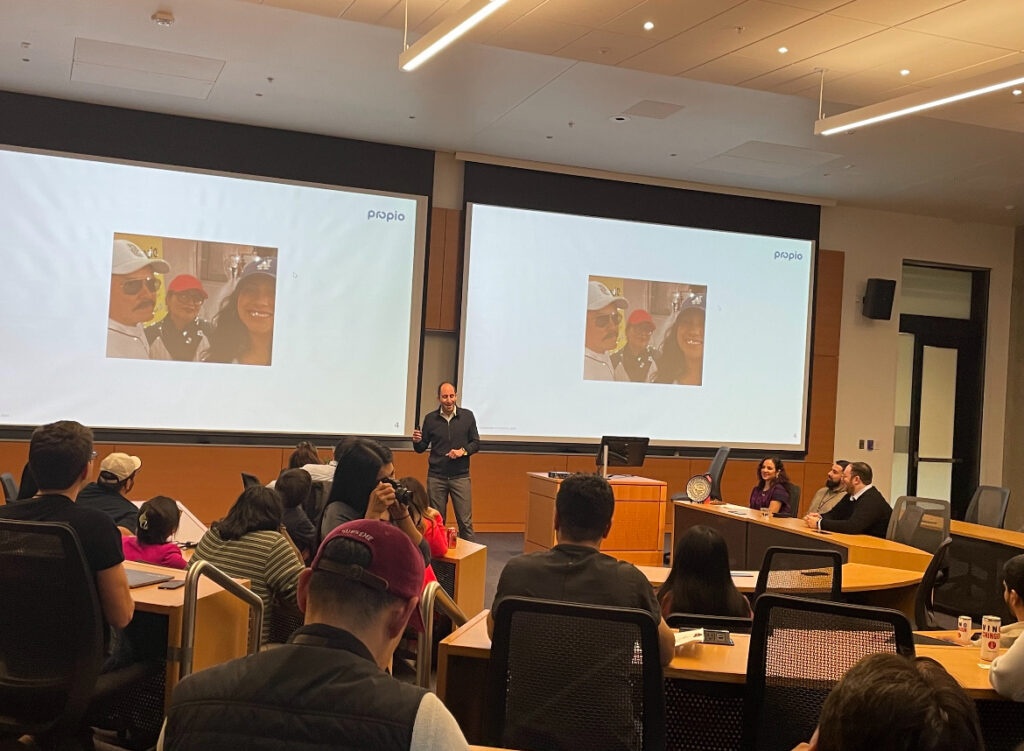
Rodrigo Carriedo had three minutes. On May 8, 2024, at the University of Washington’s Founders Hall, he began his pitch with a photograph of Araceli, a Mexican immigrant who had worked her way toward owning two businesses. An accounting startup was asking for the room’s attention. Its founder gave that attention to somebody else.
The choice is a useful introduction to Carriedo. Before founding Propio in Seattle, he worked in public finance and served on the World Bank’s board. His subject was access to money and the institutions surrounding it. At Propio, the question has a smaller address: the accounting practice serving a business owner who needs help making sense of the numbers.
There is a certain comic imbalance in that journey. Finance can convene an international meeting about inclusion, then leave a proprietor wrestling with a receipt. Carriedo has worked at both ends of that distance. His current undertaking is to make the everyday end less cumbersome.
Eight countries, then one business at a time
Carriedo’s education followed a sustained interest in economics and government. He studied economics at the Instituto Tecnológico Autónomo de México, completing undergraduate and master’s studies, then earned a master’s in public policy at Georgetown. His Georgetown years ran from 2012 to 2014. The combination placed economic reasoning beside the practical question of how institutions act.
His work took him through Mexico’s Ministry of Finance, where he led financial inclusion initiatives, and into development finance. In 2017, he participated in a G-24 technical meeting as Mexico’s alternate executive director at the World Bank. His presentation addressed international tax cooperation, including the challenge of ensuring that multinational profits are taxed where economic value is created.
By November 2018, he was an executive director. His constituency covered eight countries, and his responsibilities included chairing the Audit Committee. These are jobs concerned with representation, oversight and the reliability of financial information. The scale differs sharply from a small accounting firm’s monthly workload. The importance of dependable numbers travels rather well.
That continuity helps explain why his career change makes sense without requiring a tidy conversion story. A public official and a software founder operate under different incentives. Both can spend their days confronting the gap between a financial system’s formal design and the people expected to use it. Carriedo’s career gives that gap a concrete setting.
The coffee machine did some recruiting
By the time Propio joined Techstars Seattle’s 2023 class, Carriedo was building for Latino gig workers, with a pitch that encompassed payments, taxes and financial access. Fernando Aguilar Reyes brought experience as a Microsoft software engineer. Orlando Gomez brought experience in startup and small-business development at Drift. The early team combined financial policy, engineering and business development.
Carriedo has described another consequential relationship in rather less corporate language. When people encouraged him to find a technical cofounder, he compared the decision to choosing a spouse. You could meet without planning to propose, he suggested, and eventually discover that formalizing the partnership made sense. It is a demanding standard for recruitment, though it does improve the conversation beyond a skills matrix.
He met Alan Gonzalez at the University of Washington’s CoMotion as Propio started Techstars. Encounters at the coffee machine lengthened into conversations about technology, fundraising and hiring. Friendship came before the formal arrangement. Gonzalez joined as cofounder and chief technology officer in summer 2024, as Carriedo later recounted.
When Gonzalez was named to the Puget Sound Business Journal’s 2025 40 Under 40 list, Carriedo publicly celebrated the partnership. The anecdote puts a human pace on company building. Some decisions require a deadline. Others benefit from enough ordinary conversations to discover how another person thinks when nobody is delivering a pitch.
The room understood Araceli
Back at Founders Hall, Carriedo’s opening photograph made the work legible. Araceli’s experience, alongside that of his own mother and women he knew growing up in Mexico, helped inspire Propio. He described people who could build businesses while still needing practical accounting support. Their ability and their need for help existed together.
Propio’s offering at the time used WhatsApp to help business owners and accountants communicate. Carriedo moved between English and Spanish in the pitch. Nine founders were competing; the audience chose the winner. Propio received the $5,000 prize. The product had found a setting where its intended users’ experience could be explained in ordinary language.
The scene offers a clue to his instincts as a communicator. He can discuss international finance, but he chose a proprietor’s photograph for a short presentation. That makes a demanding problem easier to follow without pretending it is simple. A person with two businesses is already doing something difficult. The accounting ought to help her continue.
“We were very wrong”
Rodrigo Carriedo, reflecting on an earlier product approach, May 2026
A founder changes his answer
Propio’s focus has become more specific. Today it builds accounting software for firms, including those serving Latino-owned small businesses. Its website presents bookkeeping and tax planning around a shared ledger, with support for English, Spanish and Portuguese. The accountant is the route to the business owner, an existing relationship through which new software must earn its place.
In May 2026, Carriedo described a mistake behind that direction. Accounting partners had repeatedly asked for QuickBooks with AI. Propio tried to answer that request. He then concluded that adding intelligence to the familiar structure left a deeper mismatch unresolved. His blunt assessment of the earlier effort was unusually economical: “We were very wrong”.
His revised approach starts the ledger on a tax basis, with accrual reporting as an output. In his account, this better fits the work of the accounting professionals Propio is targeting. It is a product thesis about a particular customer and workflow. The interesting biographical detail is his willingness to describe the discarded answer in public.
He had outlined the direction in September 2025: connect accounts to tax lines and update estimates as transactions arrive, so accountants can advise throughout the year. The aspiration is to move useful conversations earlier. A report delivered after the relevant decision has passed may be impeccably formatted and still arrive rather late to the party.
- 01TransactionsThe daily business record
- 02Tax-basis ledgerA shared accounting foundation
- 03Ongoing adviceThe accountant helps owners act
A schematic of Propio’s stated approach, not a performance measurement.
When a customer takes the other seat
There are numbers in Propio’s story, of course. In December 2024, Carriedo announced that the platform had categorized one million transactions. He framed the milestone around reducing manual work so accountants could spend more time helping clients. The count describes activity on the platform; its value to a practice depends on what that activity makes possible.
By November 2025, he had another kind of evidence to discuss. Claudia and Hector, customers running an Orlando accounting firm serving English-, Spanish- and Portuguese-speaking owners, had invested in Propio with a group they assembled. Carriedo described the investment as particularly meaningful because it came from people who encountered the problem in their own work.
That is an unusually close relationship between a product and its backers. An accounting customer can judge the presentation, then return to the office and judge the software. Investing adds a further commitment to that experience. Carriedo’s excitement centered on the combination: the people using what his team built were also willing to help finance its future.
Their firm’s ambition, as he described it, was to serve more clients and offer more advice without accumulating ever more manual data entry. That ambition brings his work back to professional time. Software earns its fee when it changes what a working day permits. An investor presentation gets considerably more interesting when the investor has already lived the demonstration.
The smile after the polite nod
Carriedo also participates in the networks around Latino entrepreneurship. Through Colectivo, he has described finding access to New York investors from Seattle and maintaining those relationships through WhatsApp groups and coffee meetings. Propio appeared in the 2025 Angeles 100 recognition of Latino-led startups. Relationships recur throughout his account of how the company develops.
Outside work, he is a father of three, a runner and a private pilot. Those details give the biography some welcome space beyond boardrooms and software. They also resist the temptation to make every personal interest into a management lesson. A pilot’s license is allowed to be a pilot’s license.
In June 2026, announcing Propio’s new website, Carriedo wrote about earlier products that had attracted polite nods while leaving most of the excitement on his side of the conversation. What mattered to him now was a different response: customers asking for more, referring others and finding uses the team had not planned.
It is a revealing measure for someone trained to work with institutions and numbers. He began his Seattle pitch by showing a business owner’s face. Years into building the company, he was still watching faces, this time for the moment courtesy gave way to interest. For Carriedo, the next useful answer begins with paying attention.