A toy that blinks has a surprisingly demanding customer. The eyelid must move, the mechanism must fit inside the head, and the whole performance is rather spoiled if the doll sounds like a coffee grinder. At NanoMuscle, Rod MacGregor saw an opening in those small inconveniences. A quieter, smaller way to create motion could give a designer room to do something different.
It was an unusual destination for a Scottish software entrepreneur. It also makes a useful starting point for understanding him. Across his career, MacGregor has returned to the space between a technical possibility and a customer's ordinary working day. The invention has to do its job. Then it has to fit, financially and physically, into somebody else's business.
Today, as GlassPoint's president and CEO, he works on solar steam for industrial sites. The scale has expanded considerably since the blinking toys. The underlying commercial question remains pleasantly stubborn: what would make a customer put this to work?
A small movement, a different mechanism
NanoMuscle, founded in California in 1998, developed actuators using shape-memory alloys. These materials change shape with temperature. An electrical input can produce a contraction, creating useful motion without the familiar arrangement of a spinning electromagnetic motor. A component that moves quietly offers possibilities wherever a little mechanical fuss has become an accepted nuisance.
MacGregor talked about toys and automotive components as markets. A moving mouth, an adjustable mirror and a seat mechanism sound like modest ambitions until someone has to design, manufacture and price them. They are also a reminder that much of engineering happens inside objects whose owners never ask how they work.
The company name invited attention. In 2002, MacGregor was pitching a device that cost less than a dollar to make, with Hasbro among its investors. The attraction was concrete: a small mechanism could help make a more expressive toy. Nanotechnology acquired an unusually approachable sales demonstration. You could look it in the eye.
For MacGregor, one design connection came from remembering segmented aircraft hangar doors. Several small movements could add up to a larger displacement. He had learned to fly at 17; an observation from that world became useful in another. An engineer's memory can be a disorderly workshop, with the right part waiting in an unexpected drawer.
Hong Kong was part of the product
In October 2003, NanoMuscle announced a $16 million Series C round. Its investors spanned Europe, China and North America, with automotive interests alongside venture capital. MacGregor's explanation emphasized the need for a global presence. A component intended for several industries needed relationships beyond the neighborhood where it was invented.
By 2004, he was making that argument from Hong Kong. Toy designers there connected with manufacturers in southern China and with the companies selling toys internationally. NanoMuscle also opened a design center in Shenzhen, where engineers could work with customers on applications. Proximity made the conversation more useful.
“You have to be where your customers are.”
Rod MacGregor, 2004
The geographical move was accompanied by a willingness to reconsider production. In August 2004, NanoMuscle described shifting manufacturing from automated operations in South Korea to labor-intensive production in Guangdong. The expected benefit was lower cost. A company selling an unfamiliar mechanism could still make a thoroughly practical choice about how to manufacture it.
There is a pleasing complication here for anyone who assumes that an advanced product must arrive from the most automated factory. MacGregor's business needed an affordable component in a customer's hands. The machinery behind the machinery had to earn its keep too.
Hong Kong offered more than an attractive office location. The regional headquarters coordinated sales and marketing, while the Pearl River Delta supplied a manufacturing base. For a small supplier, that network could connect an interesting sample with the people able to commission a production run.
The software years left him a habit
Before the actuators came software. MacGregor studied at the University of Glasgow and built a career that included Insignia Solutions, networking software and OnLive! Technologies. Insignia's business helped software cross hardware boundaries. It received Queen's awards for technical and export achievement and later listed on Nasdaq.
That earlier work gives his later ventures a recognizable family resemblance. Compatibility is a customer problem before it is a technical description. Someone has equipment, established habits and money already committed. A new product becomes easier to consider when it can work with those things.
At university, MacGregor had been drawn toward computing after initially intending to study electronic engineering. He liked the creative freedom of software. His subsequent career carried that appetite into materials and energy, where physical constraints are rather less willing to negotiate.
He also began trading early. As a boy, he arranged for a neighbor's son to do litter-picking work for half the sum his father was paying him. The margin was small, but the principle had arrived. It is an appropriately unceremonious origin for a career that would eventually involve industrial infrastructure.
A greenhouse with a different harvest
GlassPoint began in 2009, with MacGregor as its founding CEO. Industrial customers needed heat, often in the form of steam produced by burning fuel. GlassPoint's proposition used concentrated sunlight to supply that heat. Solar energy could enter a factory through a pipe.
Its enclosed-trough design places curved mirrors inside a glasshouse. Protecting the array from wind allows the mirrors to be lighter. Cleaning the enclosure also addresses the dust that would otherwise settle directly on exposed reflective surfaces. A greenhouse, usually associated with protecting plants, becomes part of an industrial cost calculation.

The customer does not need a novel kind of steam. GlassPoint's integration approach supplies the temperature, pressure and quality the process already requires. Existing boilers can remain alongside the solar supply. That detail has the quiet importance of a plug fitting its socket.
In 2013, the company's installation at Petroleum Development Oman's Amal West field was producing steam for enhanced oil recovery. The 7 MW system had been built during 2012. Its application was specific: reduce the gas burned to generate steam for an established oilfield process.
The oil connection gives this part of MacGregor's career an awkwardness worth preserving. Solar heat was being used to help produce oil. His initial customers were large users of steam, and the opportunity was to change the source of some of that heat. The practical route into an industry does not always resemble its favorite publicity photograph.
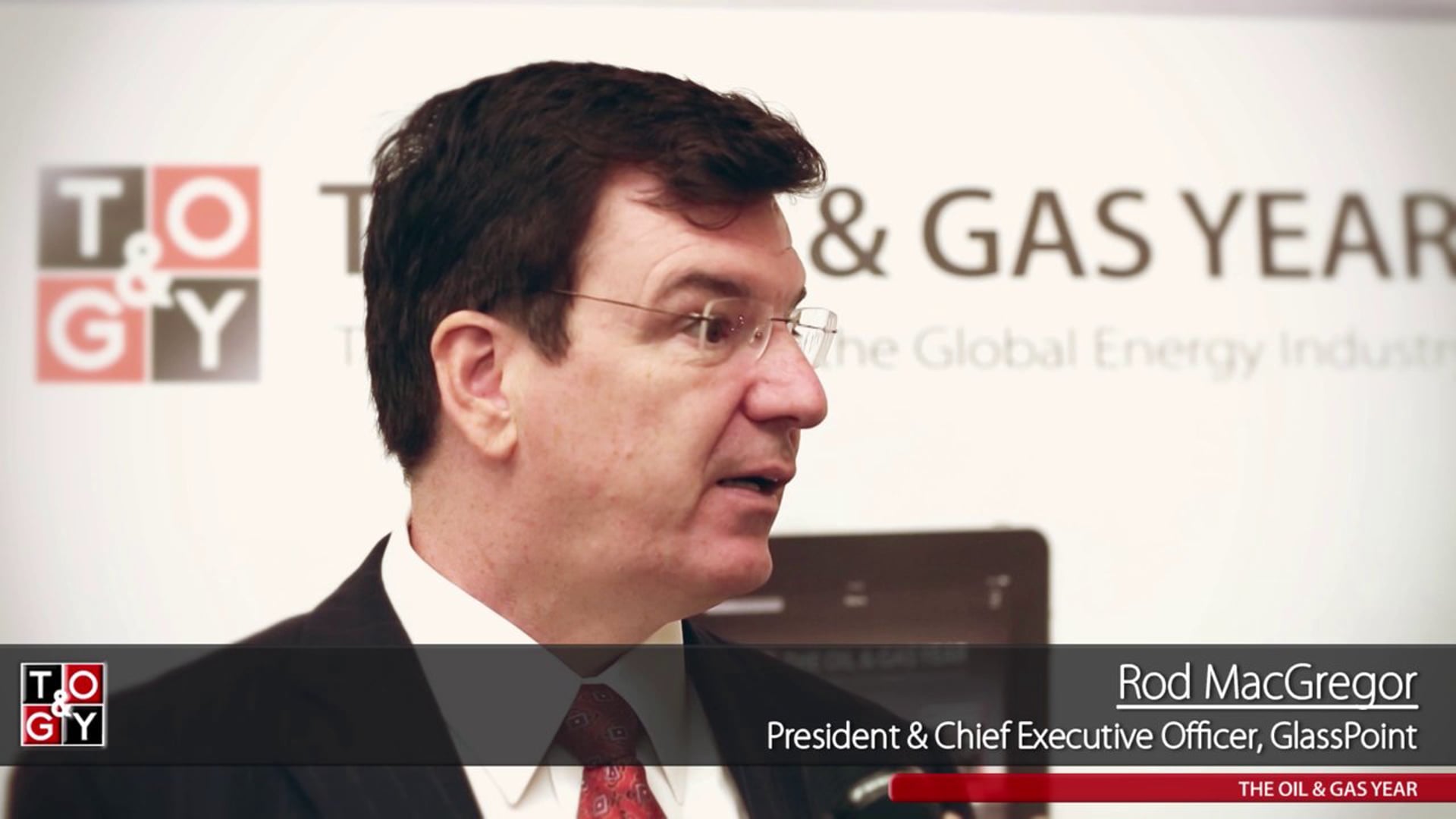 ↗ Watch the interview
The restart changed what the customer bought
GlassPoint's corporate history did not proceed as smoothly as its diagrams. The earlier company was liquidated in 2020. MacGregor, who had left the CEO position in 2017, returned to lead a restart.
The earlier model had sold equipment, leaving revenue tied to construction phases. The new approach centers on building, owning and operating facilities, with customers paying for delivered steam. That changes both the customer's commitment and the supplier's responsibilities.
A factory considering an energy plant must compare that investment with other demands for capital. A factory buying steam can assess a continuing service. GlassPoint takes on the work of financing and operating the installation, while seeking longer-term revenue from supply contracts. The engineering still matters; so does the agreement surrounding it.
The customer owns and operates the plant.
GlassPoint builds, owns and operates the facility.
The purchase also has to survive an internal conversation. An operations team wants dependable heat. A finance team wants an understandable commitment. A new supplier must give both a reason to proceed. That can be as demanding as explaining the mirrors, and rather harder to illustrate on a slide.
This arrangement carries its own demands. A supplier promising heat has to deliver it, and a facility needs funding before it produces anything. Moving responsibilities between buyer and seller does not make them disappear. It changes who must become good at managing them.
The next customer still wants the numbers
In June 2025, GlassPoint announced a partnership with Searles Valley Minerals for a planned 750 MWth solar thermal project in Trona, California. The proposal would supply an industrial minerals operation and begin replacing steam generated using coal and natural gas. GlassPoint also planned to deploy thermal storage.
In January 2026, it announced $20 million in new funding, led by N.I.S. New Investment Solutions with MIG Capital participating. Development priorities included California and a planned 1.5 GWth project with Saudi mining company Ma'aden. These are development commitments. They should be read separately from the company's operating installation in Oman.
Oman deployment, supplying steam since 2017
California project announced in 2025; under development
By August 2026, MacGregor was explaining solar heat to alumina producers through a familiar set of business concerns: cost, fuel-price exposure, energy security and the ability to expand production where gas supplies are constrained. He described the economic balance as location-dependent. Industrial buyers have reasons to ask for more than a bright forecast.
That emphasis carries into his October discussion of GlassPoint's priorities. The proposition combines lower emissions with a commercially useful heat supply. Years of operating data matter because customers are running industrial processes with little appetite for interruptions. A persuasive presentation eventually has to become a dependable utility.
MacGregor's career makes an interesting loop through scale. A small actuator had to fit inside someone else's product. A large solar installation has to fit into someone else's operation. In each case, the customer has good reasons to be cautious, and the founder has work to do after the demonstration ends.
The blinking doll and the industrial steam line are unlikely companions. Both ask MacGregor to answer the same practical question he has been following across industries and borders: how does this become useful enough for somebody to buy?