Rod Little asked a roomful of people a question that ought to have been easy. It was 2019. He had become chief executive of Edgewell Personal Care, and a company town hall had filled an auditorium. Could anyone tell him the company's vision, mission, and values? Nobody could produce an answer. Corporate prose had achieved the peculiar distinction of existing everywhere on paper and nowhere in the room.
For Little, the silence was useful. It exposed a distance between the statements a business makes about itself and the things its employees carry around in their heads. He would later describe that moment as a reason to rethink Edgewell's purpose. The replacement, introduced with a cultural reset in 2020, was short enough to remember: “Make Useful Things Joyful.” A maker of razors had given itself a surprisingly cheerful assignment.
The officer who passed on pilot training
Little's route to that auditorium began at the United States Air Force Academy, where he graduated in 1992. He already held a private pilot's license, but flying was not the attraction. Academic demands, competition, and service appealed to him. He declined pilot training and went into the Air Force's research and development organization. Even at an institution associated with flight, he was willing to choose a different job.
Four years as a cadet were followed by five as an active-duty officer. His account of what stayed with him centers on dependence: people with different backgrounds working toward a shared objective, with individual responsibilities attached to it. “The military is the ultimate team sport,” he wrote. In his telling, a leader earns credibility by doing the work and standing with the people expected to deliver it.
His description of the CEO's job is correspondingly practical: develop the people and help them deliver. The vocabulary is closer to a practice field than a corner office. It also leaves relatively little room for the executive as solitary genius. Somebody still has to explain the assignment.
“My role is to motivate, develop and coach the team to deliver.”
Rod Little, on leadership
An apprenticeship in other people’s brands
The civilian career gave Little a different education. He spent 16 years at Procter & Gamble, taking roles in salon professional finance and corporate acquisitions and divestitures. He became executive vice president and chief financial officer at Elizabeth Arden, then CFO at HSN. Beauty counters, professional salons, and television shopping each offered a different route from a product to a buyer.
His formal qualifications combine a management degree from the Air Force Academy with an MBA in finance from the University of Pittsburgh. Finance became his route through consumer businesses. It required attention to what brands promised and what their sales, costs, and investment requirements actually supported. A handsome package could make a first impression; the accounts would eventually offer an opinion.
Little joined Edgewell as CFO in 2018 and became president and CEO in March 2019. He had already overseen finance and information technology and helped implement Project Fuel, the company's growth and efficiency initiative. The promotion expanded his responsibility from assessing the business to choosing its direction. The town hall question belonged to that larger task.
The $1.37 billion plan that stopped
Early in Little's tenure, Edgewell pursued an acquisition that could have changed the company at a stroke: Harry's, the shaving challenger that had grown from online sales into physical retail. The proposed price was $1.37 billion. Edgewell would have brought an established manufacturing business together with a younger competitor whose relationship with consumers had helped unsettle the razor aisle.
The Federal Trade Commission objected. In February 2020, it moved to block the transaction, alleging that the combination would remove an important competitive force. Its case focused on the price reductions and product choices that competition from Harry's had encouraged. Edgewell terminated the agreement on February 10. The regulator's position was an allegation in a challenged merger, and the deal ended without a completed acquisition.
Little said Edgewell disagreed with the agency, but judged the time, expense, and uncertainty of litigation against the alternative of proceeding independently. That is an unglamorous part of leadership: deciding when a plan has become too costly to keep defending. A transaction designed to accelerate change had left him with a more laborious assignment. Edgewell would have to build more of its future itself.
Buying brands, building the missing skills
The next purchases were smaller and more specific. In August 2020, Edgewell announced an agreement to buy Cremo for $235 million in cash. The men's grooming business sold across beard, hair, shave preparation, and skin care categories. Little presented it as an addition to a portfolio that already included Jack Black and Bulldog, with opportunities to reach different consumers and expand into more grooming occasions.
Cremo's appeal extended beyond its product range. Little also singled out the team's ability to build brands around consumers. Acquiring a business could bring people and commercial habits along with its sales. That distinction mattered for a company trying to refresh the way it competed. Buying another label would be easier than making the parent company better at understanding why somebody chose it.
In November 2021, Edgewell bought Billie for $310 million in cash. Founded in 2017, Billie had built a direct-to-consumer business around women's shaving and body care. The deal had received pre-merger clearance and closed when it was announced. It brought digital capabilities and a brand preparing to enter American physical retail in early 2022.
Harry's and Billie therefore occupy different places in Little's record: one was a proposed combination abandoned after regulatory opposition; the other became part of Edgewell. Billie also gave the company another way to connect manufacturing and retail experience with a younger brand's customer relationships. For Little, the shopping list had become more selective.
Fewer layers between the decision and the shelf
Purchases were only part of the repair. Speaking to investors in May 2023, Little described hiring digital talent to develop capabilities Edgewell had once hoped to acquire. He explained that the company had built out much of its digital team in 2020. By the time of that investor discussion, he put digital at more than 90 percent of media activation spending.
He also described removing management layers and giving local teams a more direct route to senior leadership. The underlying choice was about where decisions should sit. A global company needs common priorities, but the person closest to a market may understand something a distant committee misses. Little's approach put more weight on that local knowledge.
The organizational changes had a concrete example in September 2022. With international president Nick Powell planning to leave, Edgewell split responsibilities between Little and then-CFO Dan Sullivan. Little took responsibility for Japan and Greater China; Sullivan added Europe and Latin America, alongside other markets and international brand strategy. The changes took effect on October 1.
That arrangement brought the CEO directly into particular markets rather than leaving international operations behind another layer. It also expanded Sullivan's job beyond finance. Little's preference for teams did not mean an absence of individual accountability. The organization chart still had to show who would make a decision, and who would answer for what happened afterward.
The boardroom beyond Edgewell
In August 2023, Victoria's Secret & Co. appointed Little to its board. Chair Donna James pointed to his financial, consumer goods, and public-company experience. Little said he wanted to contribute to the retailer's work on profitable growth. The appointment extended a career already spent moving among businesses where brands, distribution, and the customer's choice meet.
His connection to the Academy continued too. The Victoria's Secret announcement identified him as a director of the Air Force Academy Foundation. In June 2025, he appeared with Vince Greco on the Academy Association & Foundation's Sabre Society podcast to discuss leadership, corporate culture, and giving back. The institution was still part of his working life, decades after graduation.
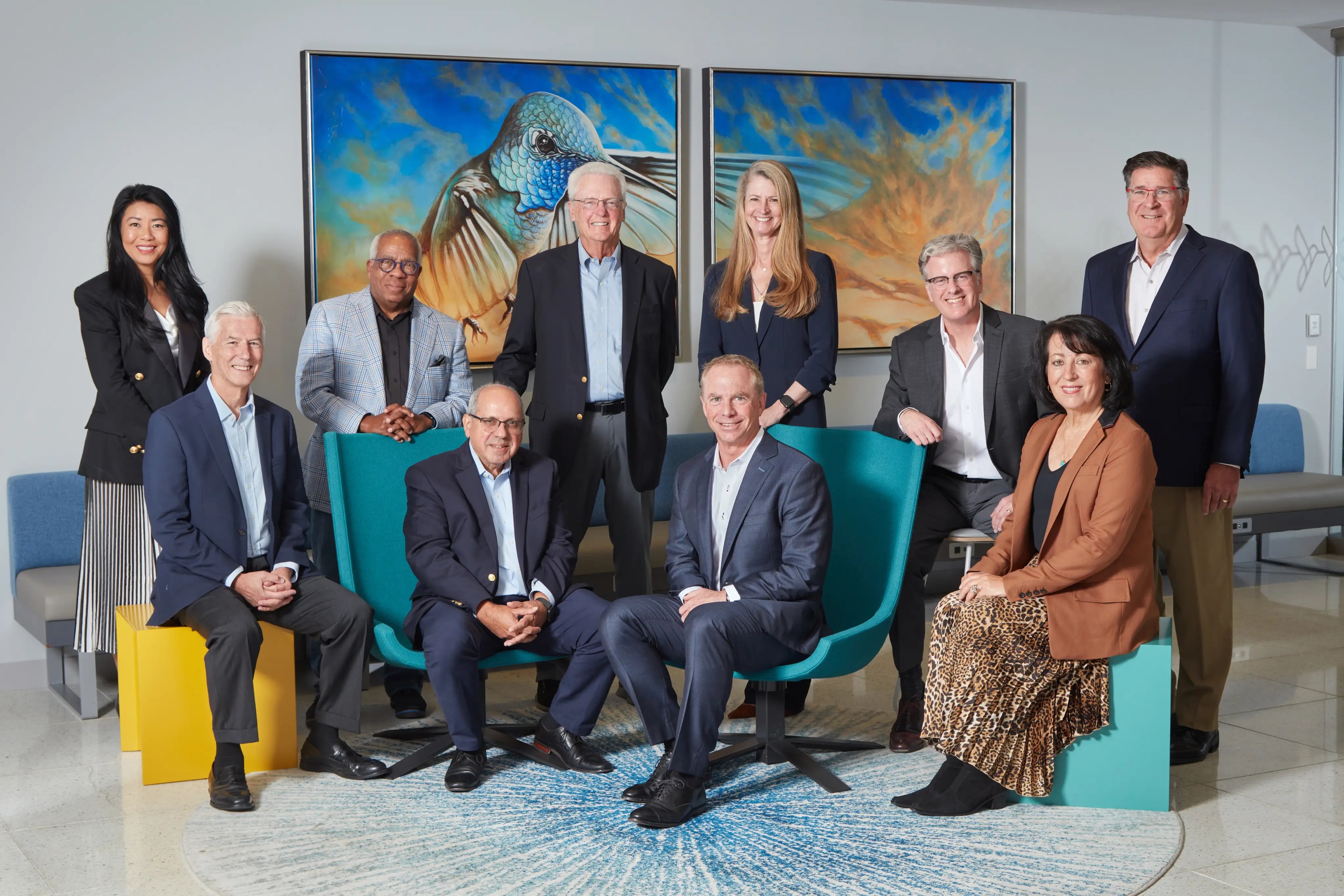
A board photograph from Edgewell offers a quieter version of the same theme. Little sits among colleagues, with large hummingbird paintings behind the group. There is plenty of color for a corporate portrait. The point, however, is fairly ordinary: even a chief executive who talks frequently about the team has a particular seat in it.
A smaller portfolio, an unfinished test
By 2026, reshaping Edgewell meant selling as well as buying. On February 2, the company completed the $340 million sale of its feminine care business to Essity. Little described the transaction as a way to simplify the portfolio and concentrate resources on shaving, sun and skin care, and grooming. Edgewell planned to use the net proceeds primarily to strengthen its balance sheet and repay revolving credit borrowings.
The change puts a useful qualification around the word growth. A company can become more focused by giving up revenue along with a business. Little's stated objective was a more durable operation with money available for its remaining brands and product development. Whether that trade produces the intended results takes longer to establish than the closing date of a sale.
The third quarter of fiscal 2026 supplied a mixed reading. Continuing-operations net sales reached $570.1 million, up 1.7 percent; organic sales, excluding currency movements, rose 1.1 percent. North America returned to organic growth. Diluted earnings per share fell to $0.26 from $0.46 a year earlier, while adjusted earnings per share held at $0.72. Those measures describe different parts of the quarter and deserve to stay separate.
Little characterized the results as progress and remained focused on improvement in the second half of the fiscal year. In September, he and CFO Fran Weissman took the business to the Barclays Global Consumer Conference. The next full-year earnings call was scheduled for November 12. As of October 24, the annual verdict was still ahead.
That leaves Little with a more interesting story than a finished turnaround. An officer became a finance executive, then a CEO who had to replace a large abandoned deal with a sequence of smaller decisions. The question from the auditorium still hangs over the work: can people explain what they are trying to do together? After that comes the harder question, answered one product choice and one quarter at a time: does it work?
vs. $0.46 a year earlier