At Brown Advisory, an RFP used to take an average of 28 hours. The investment firm assembled responses manually in Word, hunted for the right material and asked subject matter experts for updates as the need arose. The work had a peculiar quality: much of it had been done before. Yet each proposal required another expedition through the company’s memory.
This is the territory RocketDocs occupies. A buyer sends a request for proposal, a due diligence questionnaire or a security assessment. The seller must explain itself, accurately and on deadline. Repetition is unavoidable. Repeating the research is expensive. An answer that sounds familiar may also be dangerously out of date.
- Keep the answers: a governed library stores approved content, owners and review dates.
- Keep the workflow: Word and Excel add-ins bring that content into the documents teams already use.
- Keep the human: private AI drafts responses, while reviewers remain responsible for approval.
The answer has a maintenance bill
Brown Advisory’s change was admirably prosaic. It introduced a structured RocketDocs library, a dedicated database administrator and reviews by the appropriate experts. Salesforce integration supported reporting; requests could move through assigned workflows rather than email. Monthly, quarterly and annual reviews replaced the habit of updating content only when somebody needed it.
The vendor-published case study reports a 75% reduction in proposal time. That is a customer outcome, with a particular process behind it. The administrator matters. A library without somebody responsible for its contents can become a beautifully indexed collection of yesterday’s truths.
RocketDocs began in 1994 as PMAPS Proposal Software, built by people with experience in proposal work. It adopted the RocketDocs name in 2018. Its current customer references include banks, insurers, investment firms and technology businesses. These organizations need persuasive answers, but they also need to know who approved them.
Let the approved answer speak first
Astro, RocketDocs’ private AI, follows a revealing sequence. Exact-match autofill retrieves approved answers first. Similarity search finds nearby material next. Generative AI drafts what remains using the company’s knowledge base. Every generated response is flagged for human review. There is something pleasingly economical about asking a machine to check the cupboard before inventing dinner.
- 01Exact matchReuse approved text
- 02Similarity searchFind related knowledge
- 03Generate a draftThen route to human review
RocketDocs says its models run within its own environment and customer data does not travel to third-party AI providers. That architecture is central to its pitch for regulated organizations. Private processing still leaves a separate question: whether the underlying answer is correct. Permissions, version history, review dates and approval gates address different parts of that problem.
For Q2, which provides digital banking technology, the volume makes this concrete. Its case study describes 130,000 to 160,000 questions annually across roughly 865 projects. Certain answers that previously took about half an hour could be drafted in as little as a minute. That qualifier matters: a quick draft is one stage of a completed response.
“Things that could have taken a half an hour can now take possibly a minute.”
Phil Marion / Senior Manager, Sales Advancement, Q2
The spreadsheet gets to stay
LaunchPad puts library search, autofill and response tools inside Microsoft Word and Excel. Teams can choose questionnaire tabs and response locations. RapidDocs tackles a related task: assembling proposals and presentations from approved content through configurable templates, then producing Word, PowerPoint or PDF output.
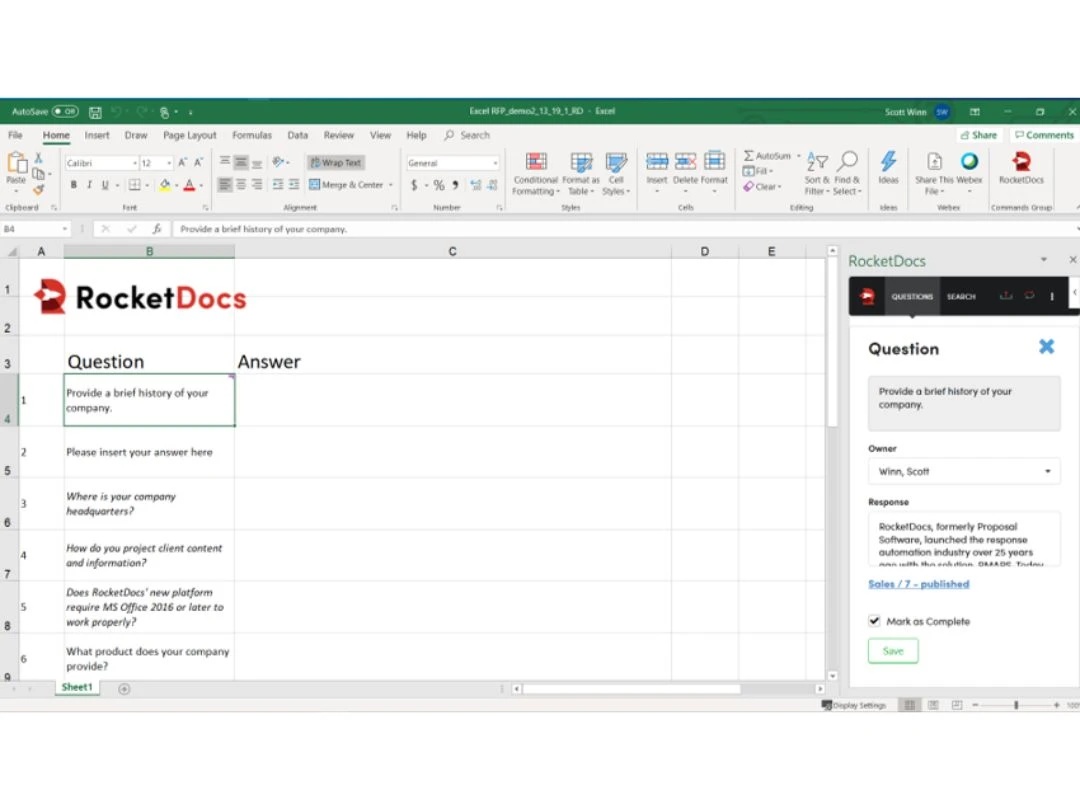
At SAP, the company’s case study describes sales representatives generating proposals in 10 to 15 minutes through a self-service system, compared with four to six hours previously. The interesting change is access: a salesperson can assemble approved material without waiting for the proposal team to build every document.
Office integration is a sensible point of differentiation, though buyers should test their own files. A 2022 G2 reviewer described disrupted search and cumbersome Word insertion after upgrades. RocketDocs replied that the reviewer appeared to be using its legacy platform and suggested migration. The episode shows how quickly a time-saving product can lose goodwill when ordinary document handling becomes awkward.
The price of remembering
RocketDocs sells annual SaaS subscriptions starting at $18,500. Quotes vary with the active response team, modules and configuration; occasional expert reviewers do not count toward the paid core-user total. Users supply their own Microsoft 365 licenses. RocketDocs says most implementations take four weeks, including content migration, permissions, integrations and training.
Illustrative arithmetic: at $100 per staff hour, 185 saved hours equal the base subscription price. Implementation effort, other costs and actual savings still matter.
Loopio, Responsive and Upland Qvidian are established alternatives in response management; newer AI-focused vendors also compete. RocketDocs emphasizes its private processing, Office workflow and regulated-industry experience. The practical comparison is a live questionnaire: retrieval quality, reviewer participation, formatting and total cost reveal more than a row of feature checkmarks.
New owners, a wider orbit
Camden Partners backed the earlier business. In July 2023, RocketDocs announced new investment following a March acquisition by a new ownership group, with Perry Robinson as CEO and chairman. The announcement described spending on product development, customer success and sales. In March 2026, it launched LUMA, extending governed knowledge into marketing, sales proposals and solutions engineering.
Copy the discipline
Even a team using shared folders can borrow the operating habit: assign an owner to each answer, set a review date and distinguish approved text from a draft. Software earns its place when repeated questionnaires, distributed expertise and scrutiny make those habits difficult to sustain manually. With little repetition or neglected source material, the economics and accuracy are less convincing.
The useful thing to copy is the decision to maintain knowledge before the deadline arrives. Brown Advisory’s process made that decision visible. A company that remembers well can spend more of its next proposal explaining why it deserves the business.