In 1984, Robert Young offered to sell his share of Motivational Systems to his business partner, Dave Cowan. The transaction went the other way. Cowan sold his portion to Young. A founder who had proposed an exit ended up with more of the company.
It is an agreeable complication in a business biography. The usual garage story runs in a straight line: two people have an idea, the idea grows, and the garage becomes inadequate. Young's story contains that part too. But it also contains a moment when the person selling the concepts was prepared to sell his own place in the enterprise. The counteroffer changed the direction of his working life.
Today, Young remains founder and chief executive officer of Motivational Systems, Inc., the National City business usually called MSI. Its work includes signs, graphics, sales interiors and architectural models. Its products help other people find a place, understand a development or decide whether to walk into a sales office. Young's own route through the business has been less obligingly signposted.
The artist and the person selling the idea
The beginning was a San Diego garage in February 1975. Young and Steve Scott divided the work according to their different abilities. Scott was the graphic artist. Young sold the concepts and Scott's expertise. Before MSI had a regional footprint or a management team, it had this compact arrangement: one partner could show what something might look like; the other could persuade someone to commission it.
That division matters. A young design business has to make two things happen. Someone must imagine the work, and someone must convince a customer that the work deserves a budget. Young occupied the second position. His founding contribution was commercial, with another person's craft at the center of what he offered.
By May, operations had moved to a Sorrento Valley business park. The garage phase lasted months, rather than becoming a permanent address. Incorporation followed in 1976. In 1978, Young and his then partners bought a building in National City, establishing the physical base that still anchors MSI.
A building also changes the scale of a promise. A concept can be carried into a meeting. A workshop needs people, equipment and a sequence of jobs to keep moving through it. For Young, selling creative work increasingly meant sustaining the organization capable of delivering it.
The counteroffer that kept him there
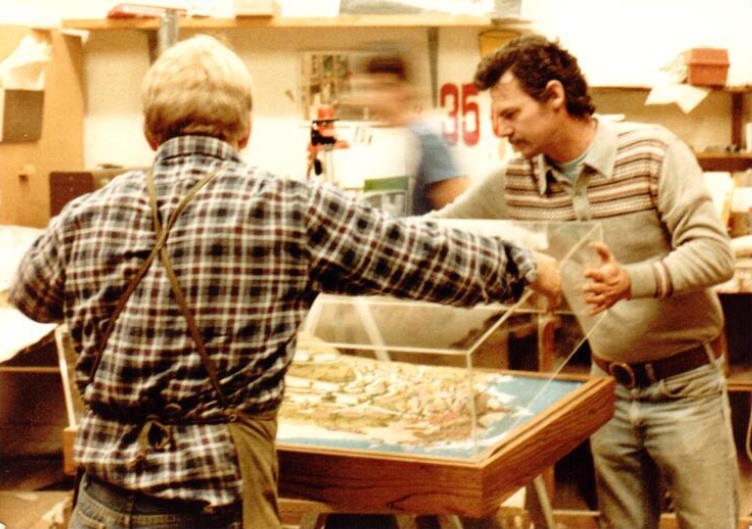
The proposed sale in 1984 is especially interesting because it interrupts the easy picture of a founder proceeding with perfect certainty. Young made an offer to leave his ownership position. Cowan responded by selling to him. The surviving event is a reversal, with Young remaining at the center of the business.
There is no need to supply a dramatic boardroom speech. The transaction is enough. In a company built partly on persuading clients to see possibilities, the founder encountered a possibility pointing back toward his own company. His attempted sale became a purchase.
The years on either side brought expansion. A Corona office opened in 1983 to serve Orange County and Riverside. A South Bay division followed in 1985 and later moved to Livermore. Las Vegas, Fresno, Sacramento and Phoenix would join the network in the next decade. The business Young stayed with was developing a geography beyond its original San Diego market.
Expansion in this trade has a physical consequence. A sign must eventually occupy a particular site. The drawing has to become an object, and the object has to arrive where it belongs. MSI's regional operations brought its business closer to more of those destinations. A concept sold in a meeting acquired a longer journey before anyone could call it finished.
Making room for the better person
The company did not acquire all its capabilities from the founders. Larry Bradford's arrival in 1976 began its scale and architectural model work. Marge Spar brought office administration and processes in 1978. Sue Colburn became its first interior designer in 1980. Each addition answered a different problem that enthusiasm alone could not solve.
Colburn's place in the story is particularly pleasing. She was better at laying out sales offices than Young and Scott. There are less comfortable things for a founder to concede, but few more useful ones. A client buying an interior needs the room to work. The founders' pride does not appear on the floor plan.
This is one way to read Young's career: the original salesman kept gaining things to sell because other people brought skills into the company. Models widened what clients could see. Interior design widened the environments MSI could create. Administration made the growing enterprise more orderly. The people behind those changes had names and distinct responsibilities.
The same pattern continued through operations, design and management. An enterprise that begins with two complementary talents eventually needs many such combinations. Its founder's place changes as that happens. There are more decisions than two people can sensibly make, and more kinds of expertise than two people can credibly claim.
“Conventions used to be a two- to three-day vacation.”
Robert Young, discussing exhibit booths in 1990
Young understood that selling a designed environment involved the business taking place inside it. A booth needs visitors. A sales office needs to make an unfamiliar project comprehensible. A model lets a customer consider a place that may still be taking shape. These objects have jobs to do beyond looking attractive.
A family business with a workshop entrance
Young's brother Tony came into MSI as a sign fabricator and installer. In November 2014, he became president. Between those two roles lies the practical distinction between being related to the founder and learning how the business works. Fabrication and installation put a person close to the point where a sales promise meets materials and a site.
Young's daughter, Jenna Young-Christensen, joined in 2001 as an interior design assistant. She later served as secretary of the board and is now listed as senior vice president. The current leadership team places her alongside her father and uncle, as well as executives responsible for operations, people, sales and technology.
The family connection is visible, but so are the other careers. Joseph Jordan's service dates to 1986. Chris Bazner joined in 1991 and became director of graphic design. Andrew Cabrera entered in estimating in 1993 and is now executive vice president. The company around Young includes people whose working lives span several versions of the enterprise.
That makes longevity more tangible than an anniversary number. It can be measured in the distance between an employee's first assignment and a later responsibility. A founder may supply the opening chapter, but these careers account for much of what happens after the opening.
A toast, and a longer definition of work
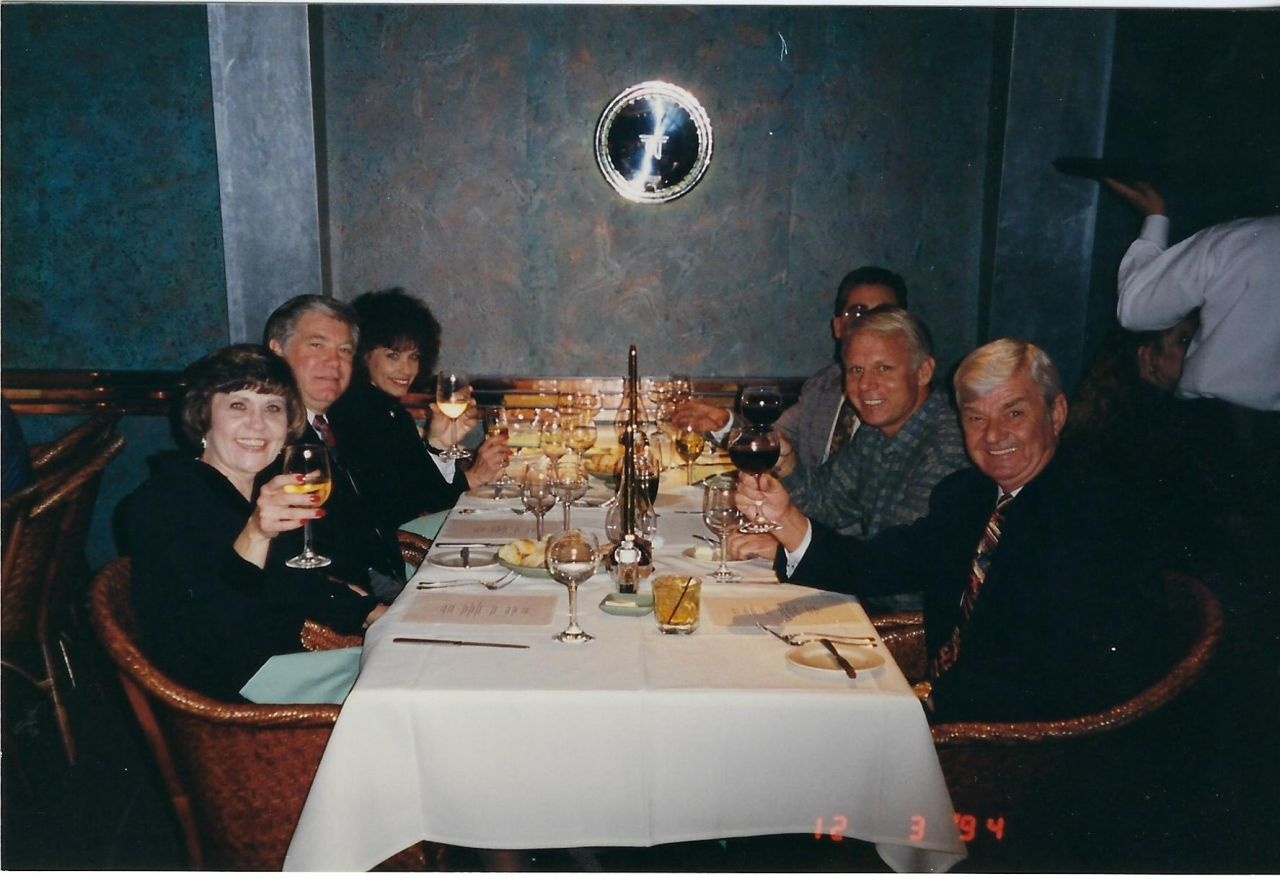
In an archival dinner photograph, people seated around a restaurant table lift their glasses toward the camera. Young appears among them. MSI identifies the gathering as including his second business partner and friend Mike Traxler, Traxler's wife Patty, and Jerry Landes, who helped organize production operations.
The picture offers a different setting from the workshop. Glasses crowd the table; the company has become a social world as well as a commercial arrangement. A photograph cannot establish anyone's management philosophy. It can show the people with whom a working history was shared.
That history extends into Young's community work. He has served on the Mission Valley YMCA board. His biography lists recognition from the Rotary Club of National City and a 2004 Small Business Person of the Year award from the United States Small Business Administration. Those acknowledgments place him in the civic life around the company, alongside his role in building it.
MSI's stated philosophy gathers fairness, attitude, integrity and respect under the acronym FAIR. Such words earn their meaning through repeated dealings. For a company supplying physical work to other businesses, the next order, the returning employee and the introduction to another client are useful places to look for their practical effect.
The work after the anniversary
MSI marked its fiftieth anniversary in 2025. By then, the partnership formed in a garage had become a business serving customers across the United States, with regional divisions in the Southwest and the ability to ship globally. Young still held the chief executive title. The company had outlasted the circumstances in which it began.
Its present offering connects graphic design, fabrication, installation, interiors, displays and wayfinding. That combination gives the original sales role a different scale. Young once sold a partner's concepts and expertise. The organization now carries a much broader collection of expertise into a client's project.
There is a modest pleasure in a career built around things people can point to. The customer can visit the office, inspect the model, follow the direction or stand beneath the installed lettering. However persuasive the meeting, the work eventually has to exist outside it.
Young's story turns on that movement from an idea to something other people can use, and on the people needed to make the movement happen. It also retains the unexpected turn of 1984. He offered to sell. His partner offered him a different future. More than four decades later, Robert Young remains part of the business he once proposed leaving.