The revealing detail is the camera that does not need replacing. In a demonstration shared by Axelera AI in October 2025, Bhagirath Choudhary explains how existing video feeds can become inputs to a system that detects safety helmets and high-visibility vests. Beside the cameras sits a small computer and an AI accelerator. The hardware already on the wall gets another job. Choudhary, the founder and chief executive of Spanidea, is there to explain how the pieces fit.
He chooses a seaport as his example: many people, many activities, an existing camera network. His account moves through the practical sequence of taking those feeds, processing them locally and alerting an administrator. It is an engineer’s explanation of a business problem. The attention goes to the installation, the available equipment and the person who must act on the result.
That sequence offers a useful entrance to his career. Long before he was describing AI demonstrations, Choudhary worked on the software that makes physical devices function. Today, his company’s territory extends from electronics and firmware to wireless networks and enterprise integration. Across those jobs, there is a recurring question: what has to happen before a promising component becomes something somebody can use?
The engineer before the executive
Choudhary’s education followed a computer-science route through Nagpur University and the Indian Institute of Technology Madras. He completed a Bachelor of Engineering in 2001 and a Master of Technology in 2003. His subsequent career included principal engineering roles at Beceem Communications and Broadcom, before Spanidea’s founding in 2011.
Those credentials give the outline. A colleague supplies the texture. Kaiwan N. Billimoria, who worked alongside him for more than a year, describes expertise in embedded firmware, board bring-up, bootloaders and Linux device drivers. In ordinary language, this is the work of getting a board to start, persuading software to communicate with hardware, and making the resulting arrangement behave.
Embedded systems also establish the vocabulary that recurs in his later public statements. The board, the software platform and the application remain connected responsibilities. When he describes taking a customer’s idea into deployment, those stages have precedents in the technical work his colleagues remember. The executive account becomes more concrete when read beside that earlier engineering experience.
Billimoria also remembers his smiling face while explaining difficult technical concepts. Another former colleague, Mahesh D, adds a particularly economical endorsement: “And he is fun to work with.” A professional recommendation can become a small forest of adjectives. This one gets to the point before anyone has time to schedule a meeting about it.
“And he is fun to work with.”
Mahesh D, a former colleague
These are recollections from people who worked with him, and they make the early engineering roles feel less abstract. Technical competence and the ability to explain a problem are separate accomplishments. Both appear in the accounts of Choudhary before the company’s later partnerships and expansion plans enter the picture.
Nagpur University
IIT Madras
Engineering becomes a business
Board bring-up is a revealing item in that recollection. It concerns a device at the beginning of its working life, when the board and its software must be made to operate together. A bootloader belongs near that beginning too. These were among the concrete responsibilities colleagues associated with Choudhary, rather than general descriptions of an interest in technology.
Wireless needs a whole supporting cast
By October 2021, Spanidea was joining the Telecom Infra Project’s OpenWiFi effort. Choudhary described the company’s focus as next-generation wireless and broadband, including Wi-Fi, LTE and 5G. The work involved the software around those technologies, where reliability depends on components cooperating across organizational boundaries.
The company’s offering included integration, validation and certification work, with OpenSync-based gateway and mesh services involving semiconductor platforms from Qualcomm and Broadcom. For the customer, the relevant outcome was equipment that could proceed toward production and deployment. A wireless specification does not, by itself, install a functioning network. There remains a considerable amount of engineering between the document and the connection.
In March 2022, Spanidea added a research collaboration with IIT Roorkee and IIIT Bangalore. Professors Ekant Sharma and Prem Singh were associated with the effort, whose stated objective included algorithms for the physical uplink control channel under the 3GPP Release 15 specification. It was a tightly defined research problem inside the much larger category called 5G.
The specificity matters. Choudhary was discussing wireless applications and service-provider needs while academic collaborators described a particular part of the radio system. The partnership put both kinds of work in the same undertaking. Research had an implementation problem to address; an engineering business had academic expertise to draw upon.
The research objective also gives his partnerships a useful scale. The physical uplink control channel is one part of communication from a device toward a network. Designing algorithms for it sits inside a larger chain of development, testing and integration. Spanidea’s announced offering included physical-layer building blocks, other protocol layers, a test bench and ongoing support. The collaboration addressed a particular engineering task within that chain.
A different address for ambition
Weeks later, the company’s plans brought another kind of distance into view. In April 2022, Spanidea announced an expansion of its Jodhpur delivery center, with a proposed ₹100 crore investment over three years. Site leader Pallav Maheshwari described a plan to increase the local team from 100 people to 500 during that period. Those figures were announced investment and hiring targets.
Choudhary’s explanation was direct: “Jodhpur is home to good engineering talent.” He wanted local people to have opportunities for professional growth without moving to a tier-one city. The center had begun with an agreement with IIT Jodhpur, and Professor Sandeep Yadav was guiding its team in areas including artificial intelligence and machine learning.
Proposed investment over three years
Historical plans, not a statement of completed investment or current headcount.The proposed hiring pool included IIT Jodhpur, NIT Jaipur and MBM Jodhpur. Its work spanned AI research, wireless implementation and 5G development. The argument joined an employment proposition to a technical one: build engineering capability near people who might otherwise leave to find it.
For a company serving customers across borders, that is a consequential choice of address. The delivery center becomes a place where international work can arrive, rather than a reason for every engineer to depart.
Thirteen years, and a bouquet
By April 2024, Spanidea’s thirteenth-anniversary celebrations had reached the Jodhpur team. The photographs show colleagues gathered together, including a group presenting a bouquet. It is a pleasingly physical detail in a business usually explained through software stacks and wireless acronyms. Somebody still has to remember the flowers.
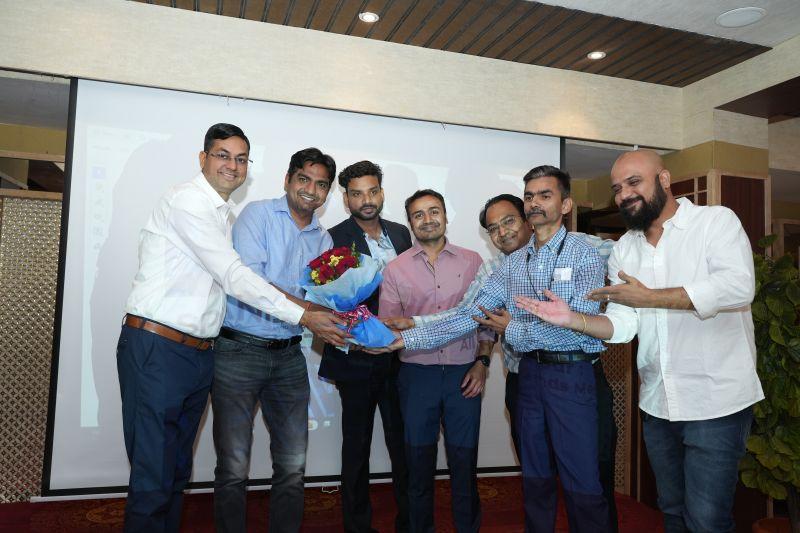
The anniversary message described a workforce of approximately 1,000 at that time. Choudhary credited the team’s combined efforts and spoke about the difficulties encountered along the way. The emphasis belonged to the people doing the work. The photograph gives that collective language faces, a room and a slightly crowded presentation of the bouquet.
From the chip to the person who needs the answer
The same company now appears in STMicroelectronics’ partner ecosystem, with capabilities covering embedded software, connectivity, sensors, cloud integration and edge AI. Its listed offerings include a real-time operating system called silRTOS and engineering services across the life of an internet-connected device. Choudhary is named as the company’s primary contact.
That range helps explain why his work resists a tidy description as either hardware or software. A sensor supplies a measurement. Firmware operates the device. Connectivity moves information. Applications make it useful. Each stage has its own engineering problems, and the interfaces create further ones. A product can accumulate excellent parts and still require considerable persuasion to work as a whole.
The ST relationship makes those interfaces tangible. Its partner listing connects Spanidea’s services with microcontrollers, microprocessors and automotive components, alongside work in embedded security and industrial control. These are actual classes of hardware around which software must be designed. The company’s role includes building on a semiconductor vendor’s platform and adapting it for the needs of the finished product.
At ISC West 2026, Spanidea’s protective-equipment detection appeared inside a wider Axelera demonstration. Other contributors supplied synthetic training data, object-detection work and face-recognition capabilities. Spanidea’s part identified helmets and high-visibility vests. Several specialist contributions ran within one system. The demonstration made the partnership model visible: different teams bring different skills, and integration supplies the shared working environment.
Choudhary’s April 2026 response to Spanidea’s alignment with Workato applied similar thinking to enterprise automation. He emphasized the connection from device to edge to cloud, and the importance of integration as businesses adopt AI. Here the path continues beyond a camera or a board into the software through which an organization coordinates its work.
The next idea still needs an implementation
In September 2026, Choudhary appeared among the partner voices in Axelera AI’s Europa launch announcement. His description began with an unusually serviceable sentence: “Spanidea takes customers from idea to implementation.” He then named the stages: hardware design, platform software, AI models, system integration and deployment.
It is a compact account of what he has spent his professional life moving between. The engineer who worked on firmware now leads a business assembling capabilities across several layers of a product. His public ambitions encompass both what those systems can do and where the engineers building them can work.
The cameras in the demonstration, the academic research collaboration and the Jodhpur delivery center belong to different parts of that story. Each connects resources that are already there with work still to be done. An idea attracts attention quickly. The last mile takes people who know how to make the connections hold.