Tilak Sharma wants to see the spreadsheets. The ones supervisors pass around, the trackers tucked away on desktops, the files that keep an operation moving when its official software runs out of answers. He has described them as a place to look for undocumented rules, awkward exceptions and accumulated risk. It is a telling preference for someone who sells technology: begin with the improvised tools that people already depend on.
A spreadsheet has few social advantages. It rarely gets invited to the product launch. Yet a useful one can explain why Tuesday went wrong more clearly than a polished presentation. Sharma's attention to these small acts of improvisation offers an entry into his larger business: understanding how work actually gets done, then deciding what to build around it.
As founder, president and CEO of MDI NetworX, Sharma has built a career around business operations and software. His company dates to 2014. Its more recent chapters include a new Pune facility, an acquisition in Kansas, workforce analytics software and a standing council of clients. Across those developments runs a practical question: how does a growing organization stay close enough to the work to improve it?
A physics degree, then the business of work
Sharma's education spans two different ways of examining a problem. He earned a Bachelor of Science in physics at Fergusson College and an MBA at Northwestern University's Kellogg School of Management. His professional background includes a vice presidency at The TriZetto Group before MDI NetworX. He is also identified as a director of Lotus Professional Consultancy, which dates to 2013.
Those credentials establish the outline of a career that crosses scientific education, management and enterprise services. They also place MDI within a longer professional history. By the time Sharma founded the company in 2014, he had already worked inside another technology business. His entrepreneurial story begins with experience of organizations that have customers, established processes and work that must continue while the software changes.
That last constraint makes operations an unusually demanding place to introduce a new idea. A promising feature still has to fit into somebody's working day. A manager must understand it. A team must use it. The ordinary questions arrive quickly: who receives the task, who checks it, and what happens when it needs another look? Much of MDI's product work addresses precisely those questions.
The software meets the working day
InsightPro, MDI's workforce analytics platform, brings together workload distribution, production planning, real-time analytics and quality assurance. Its functions include multiple levels of review, error feedback and trend analysis. Contact center tools cover call management, shared information across departments and access to call histories. These are features built around the movement of work between people.
The appeal is easy to understand from the supervisor's chair. A queue can grow because more tasks have arrived, because available capacity has changed, or because work needs to be done again. Each explanation calls for a different response. A number on a screen becomes useful when a manager can connect it to a decision. MDI positions InsightPro around making those connections visible.
For Sharma, this puts product development close to the operational business he already leads. MDI offers services as well as software, so its proposition joins the people performing the work with tools intended to organize and examine it. That combination gives the company a specific implementation challenge: the technology must make sense to the teams expected to use it, as well as to the executives buying it.
Growth acquires an address
In March 2024, MDI announced a new office in Pune, India. Spread across two floors, the facility was designed to support multi-shift operations for 1,200 associates. Its purpose included both business management support and product development. Sharma described the expansion as a way to draw on Pune's talent and serve an expanding client base.
The detail about product development matters. An office supporting operational delivery and software work gives the expansion two jobs. There is the immediate business of accommodating people and client demand, and there is the continuing business of developing the tools those services depend on. The announcement presented the facility as part of both efforts.
Then, in November 2025, came a different kind of expansion. MDI announced the acquisition of Cobalt MedPlans, also known as Clarity Performance Solutions. The transaction added locations in Overland Park and Fort Scott, Kansas. Approximately 250 US employees were to join MDI, with the company reporting a resulting global workforce of more than 7,500.
The integration plan included investment in technology, processes and workforce enablement, with InsightPro intended to play a central role. Sharma framed the deal around combining operational teams with software. Buying a business supplies an announcement date; integrating its work supplies the calendar that follows. In this case, MDI explicitly tied its acquisition strategy to the tools it was already developing.
US employees joining MDI through the Cobalt MedPlans acquisition, alongside two additional Kansas locations.
Giving clients a recurring appointment
Another part of Sharma's expansion story concerns who gets heard. On January 16, 2025, MDI announced its Client Innovation Council, following the formation of a Board of Advisors the previous year. Client leaders would meet quarterly, offer feedback on services, examine forthcoming initiatives and share their experience of running operations.
A quarterly meeting is a modest invention. Its value lies in recurrence. Feedback has a place on the calendar, and the people using a service have a defined route into conversations about its development. The council's stated remit includes previewing and validating new ideas. That gives customers an opportunity to influence a proposal before it becomes a finished product.
In March 2025, MDI added a person responsible for connecting that discussion to its executive agenda. Margaret, known as Peggy, Smith became its first Chief Client Officer. Her responsibilities included leading client strategy and the new council. Sharma's welcome emphasized her operational experience and understanding of client needs.
By September, George Stiles, president of Planned Administrators, Inc., had joined the council. The appointment extended a structure already taking shape through the year. Read together, the council and Smith's role show a concrete management choice: customer input receives an ongoing forum and an executive owner. Someone has to carry the conversation back into the business.
A booth, a table, a longer conversation
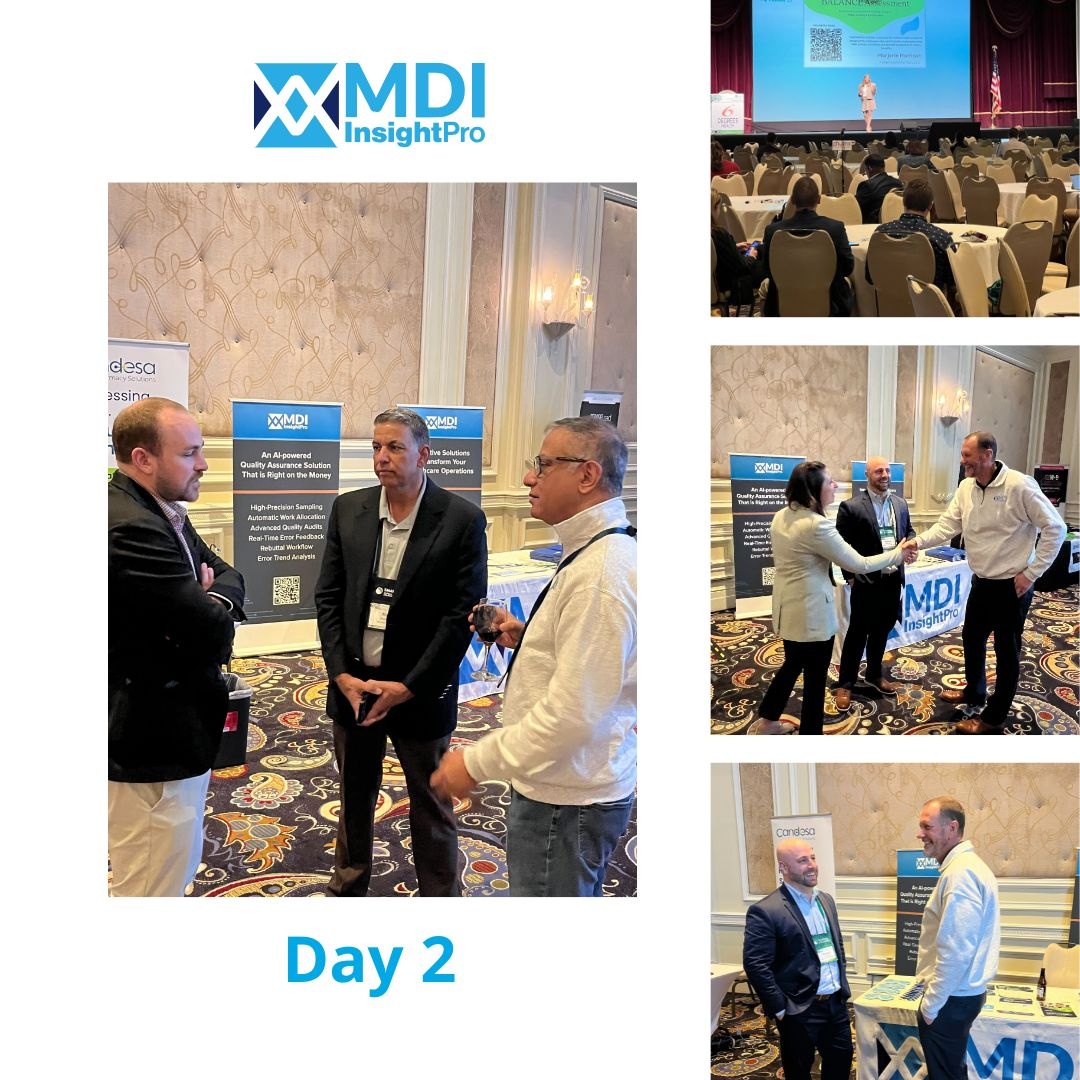
Sharma also appears in MDI's conference life. At SIIA's September 2024 gathering in Phoenix, the leadership group included chairman Brij Sharma, COO Partha Bose and product and sales executive Jeff Cook. InsightPro was a focus of the team's conversations at Booth 417. It was a chance to put a product in front of people who knew the work it was meant to support.
At the 2025 HCAA Executive Forum in Las Vegas, Sharma and Bose met with Mark Larsen, CEO of Connexure. MDI's account of the event also describes discussions with WLT executives Scott Borden and Ryan Van Etten. The meetings place Sharma within a network of operating executives and software businesses whose work intersects with his own.
These exchanges give a human scale to a company described through offices and platforms. There is a founder standing at a conference table, talking with another executive about a problem they both recognize. The company can organize a council and build a product roadmap; it still needs people to explain where the friction is. A booth number is occasionally a useful business address.
The rankings, and the people behind them
MDI appeared at No. 100 on Inc.'s Mid-Atlantic regional list in 2024 and No. 74 in 2025. In 2025 it also entered the national Inc. 5000 at No. 3,727. These are company growth rankings, and they give Sharma's period of expansion an external reference point alongside the offices, appointments and acquisition announcements.
His response stressed accountability, consistency and choosing where to automate. “We've never chased growth for its own sake,” he said. That is a founder's account of the company's priorities. The concrete decisions around it are more revealing: additional delivery locations, investment in InsightPro and a formal mechanism for client feedback. Growth brought more relationships and more work to coordinate.
“We've never chased growth for its own sake.”
Tilak Sharma · September 2025
In September 2026, MDI reported recognition across Avtar workplace listings covering women's advancement, inclusion and environmental, social and governance practices, including recognition among companies for women in ITES. Sharma credited the collective work of employees. His comments focused on creating opportunities, welcoming different perspectives and making room for people to develop their careers.
That same month, the company appointed Katrina Huynh as Director of Strategic Partnerships & Growth. Her remit included partnerships, client relationships and support for InsightPro's expansion. For Sharma, the next phase of the business again involved adding experience around the table while extending the reach of its software.
There is a consistent management problem running through these chapters. More offices require coordination. More software requires feedback. More clients require relationships that survive beyond the sale. Sharma has put people, meetings and products around those demands. The interesting measure of that work is what happens in an ordinary working day: whether a task reaches the right person, whether a correction travels back, and whether the next decision gets easier.