The first thing Robert Wachen helped deliver, long before a rack of AI hardware, was a birthday cake. In 2015, he and his sister Allison co-founded a Montgomery County chapter of Birthday Cakes 4 Free. Volunteers baked cakes for children and older people who might otherwise go without one. Robert, then a teenager, made the website and the cards and helped organize the operation. It began at roughly a dozen cakes a month. By the time a local reporter visited in 2016, the group had already delivered its 500th cake.
There is a useful test hidden in that modest story. A birthday cake is an unambiguous product: either it arrives for the birthday or it does not. You can admire the mission, the volunteers, the cheerful frosting; the delivery still matters most. A decade later, Wachen is president and co-founder of Etched, a company making the chips, memory systems, software, and racks used to run AI models. Its first rack went to Jane Street in 2026. The objects have changed beyond recognition. The need to get them into someone else's hands has not.
Before the silicon, there were people
The Maryland project began with Allison's wish to help families celebrate. Robert supplied technical and organizational work. The charity's own history names four teenage cousins at the start: Allison and Robert Wachen, Sawyer and Summer Steinmiller. Robert and Sawyer later served as co-presidents from 2018 to 2020. The group outgrew its original chapter structure and still runs as Birthday Cakes 4 Free Maryland. The lesson for a future hardware founder was unusually concrete: build a system small enough to start, then make it reliable enough that others can join.
At Harvard, Wachen studied decision science, a self-designed field. He described himself during those years as interested in technology and culture and fond of what he called “pragmatic chaos.” The phrase is more revealing than a row of prizes. It suggests someone drawn to the untidy space where a plan meets actual people. His honors include a 2019 Best Soloist award at an Essentially Ellington regional jazz festival, a 2020 U.S. Presidential Scholar honor, and a Bryan Cameron Impact Scholarship. The résumé was already varied before the chip company entered it.
Wachen co-founded Mentor Labs, a virtual college counseling venture acquired by Crimson Education in 2022. He also co-founded Prod, a student incubator that gathered aspiring founders from Harvard and MIT. By 2023, Prod had helped more than 70 students move from pre-idea status into full-time founding. The figures attached to Prod have since grown, but the more interesting fact is the shape of the work: Wachen kept building places where ambitious young people could find one another and try things.
A weekend that changed the assignment
Gavin Uberti and Chris Zhu, friends from Harvard, had been working on the research idea that would become Etched. Wachen knew Uberti from their first week at school. In a public talk, Wachen recalled helping the pair finish a seed round, then inviting himself along to a weekend sales boot camp in New York. The night before, he built an AI agent at a hackathon with another friend. The project won a lunch with Reid Hoffman. Wachen missed it: he was across town with Uberti and Zhu, listening to what they were trying to build.
The decision was less cinematic than a single flash of inspiration. Wachen had spent a summer in San Francisco using his savings to make and ship small products with different collaborators. He said they produced about two dozen, most of which failed to catch on. The exercise made the difference in scale plain. The weekend's web app could be built quickly. Etched's proposal would take years, a substantial team, and a willingness to bet that AI inference would need different hardware. He chose the longer assignment.
His parents, both lawyers, needed convincing that leaving Harvard was a reasonable risk. Wachen has remembered arguing that staying in school was the riskier option for him. Then he arrived in the Bay Area without an office or a settled apartment. He slept on a friend's floor in an unfurnished house and used a towel as a blanket. For a while, Etched's chip-design servers lived in an early employee's garage. When one needed rebooting, the employee called his wife to press the button. The origin story had rather more domestic improvisation than a chip design diagram can show.
“We had no idea how hard it was going to be.”Robert Wachen, on Etched's early years
The rack is the product
Etched was founded in 2022 by Wachen, Uberti, and Zhu. The company's early public pitch centered on Sohu, a chip specialized for transformer models. The current offering is broader: an inference cluster designed across chips, memory, interconnect, software, cooling, and racks. Wachen explained the engineering in a 2026 interview by dividing inference into two stages. First, the system reads the prompt and its context, a compute-heavy phase called prefill. Then it generates the answer token by token, a phase called decode, where moving and holding model data becomes crucial.
How an answer moves through inference
The distinction sounds tidy on paper. In a data center, it becomes a thicket of physical constraints. Lower voltage may reduce heat. Shared memory may let chips exchange information faster. A promising chip still needs power delivery, cooling, manufacturing, software, and the patient process of making the whole rack work. That is why Wachen's role fits the company. The person who once coordinated a cake operation and later a founder community now has to coordinate specialists across a supply chain.
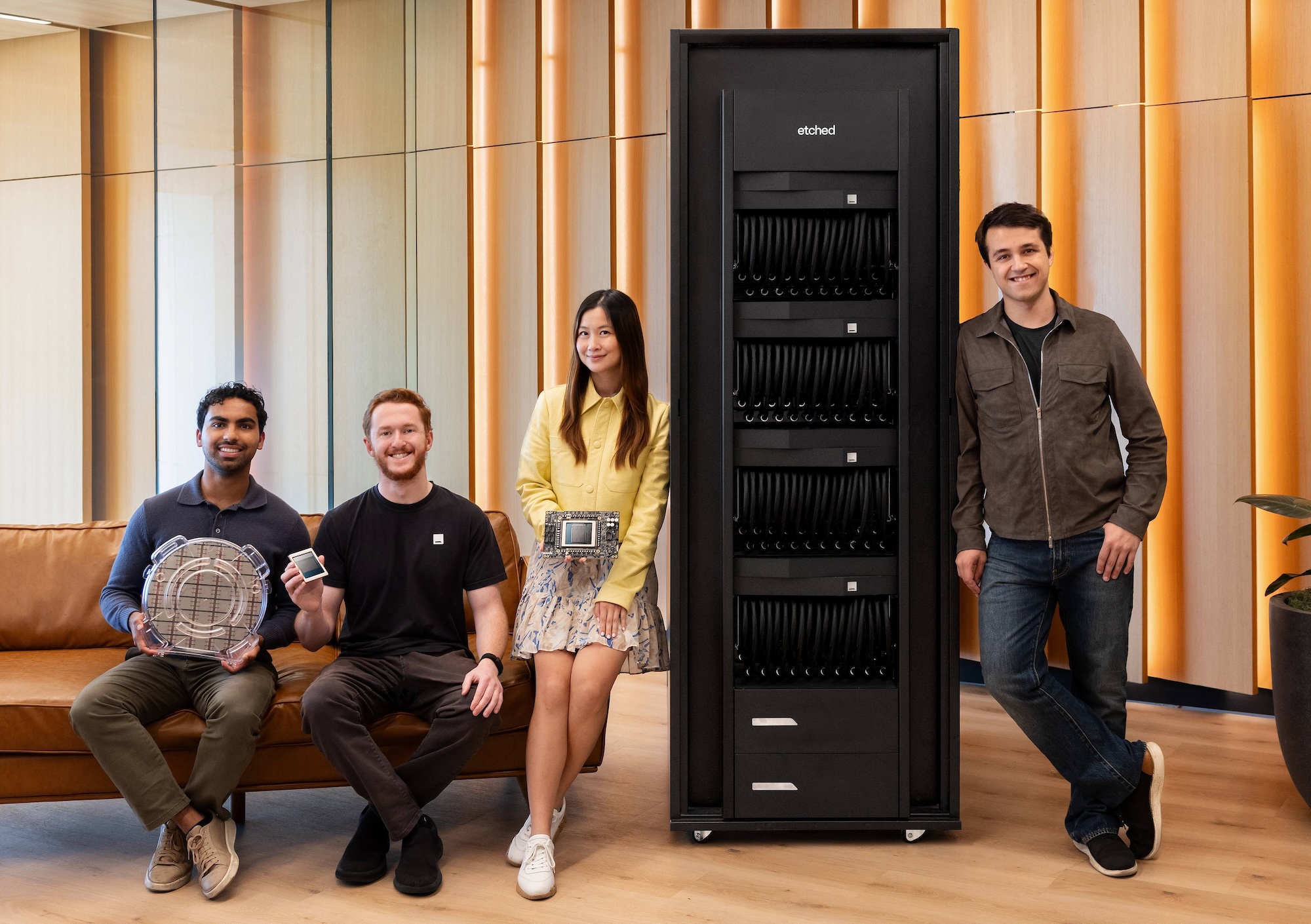
In July 2026, Etched said it had successfully manufactured its first silicon and was testing full systems with customers. It reported more than $1 billion in customer contracts and a team of more than 400. A $300 million Series C valued the company at $10.3 billion. It also opened an 80,000-square-foot, 10-megawatt facility in Milpitas near its San Jose office. These are company milestones, and the crucial distinction is physical: a contract records a promise; a delivered rack lets a customer test the promise under its own conditions.
The customer who asked hard questions
Wachen remembers a meeting in New York with Jane Street engineers when he and Uberti were 22. The young company had contacted many AI businesses and struggled to be taken seriously. Jane Street's team dug into the details: PCIe round-trip latency, heat flux at the cold plate, and other points at which a chip pitch becomes a systems problem. At drinks afterward, one engineer told Wachen that if they could build this, they could build anything. Wachen later called it the first time a customer truly believed in them.
That memory makes the next announcement easier to understand. In August 2026, Etched said Jane Street had tested the hardware, received Etched's first rack, and begun putting it to work in its data center. Jane Street also led a $700 million financing that valued the company at $21 billion. The valuation is eye-catching, but the delivered machine is the more telling detail. The same customer that once tested the founders with questions now had their equipment.
The episode does not close the story. One rack is one rack, and producing many of them will be a different job from producing the first. Wachen has been frank about that gap. In July, he said the founders still had to be humbled by what scaling would take. Etched's own August announcement listed factories, global supply chains, fleet software, and other work ahead. He has spoken of a mission to expand access to frontier models. For him, the ambition seems to live in the operational details as much as in the slogan.
“I think we still have to be humbled by what it will take to actually get to scale.”Robert Wachen, July 2026
What keeps arriving
The easy way to tell Wachen's story is as a jump from small things to enormous ones: cakes to chips, a student group to a multibillion-dollar company. That misses the pattern inside the jump. He has repeatedly worked on projects where a group of people must make a specific promise credible. The cake has to arrive. The student has to become a founder. The rack has to run in someone else's data center.
There is also a sense of humor in how he narrates the less polished chapters. Recalling the night under the towel, he joked that he now has a blanket and a mattress, “and a pillow even. Multiple pillows.” It is a funny line because it refuses the usual solemnity of startup hardship. The floor was real. So is the possibility of laughing at it once you have a bed.
Wachen's trajectory has no neat ending yet. Etched has delivered an initial system and raised capital to produce more. The company still has to prove that its machines can be made, installed, and used at the scale it proposes. Wachen, who once thought in dozens of cakes and dozens of failed summer prototypes, now thinks in racks and data centers. The test remains strikingly familiar: at the end of the day, what did the team actually deliver?