Breaking
Gavin Uberti's Etched raises $500M at $5B valuation Sohu chip claims 20x speed advantage over Nvidia H100 Harvard dropout becomes AI hardware's boldest bet Etched hits 340 employees and counting Peter Thiel backs Etched for the second time One 8-chip Sohu server claims to replace 160 H100 GPUs 500,000+ tokens per second on Llama 70B - Etched claims Gavin Uberti named MIT Technology Review Innovator Under 35 Gavin Uberti's Etched raises $500M at $5B valuation Sohu chip claims 20x speed advantage over Nvidia H100 Harvard dropout becomes AI hardware's boldest bet Etched hits 340 employees and counting Peter Thiel backs Etched for the second time
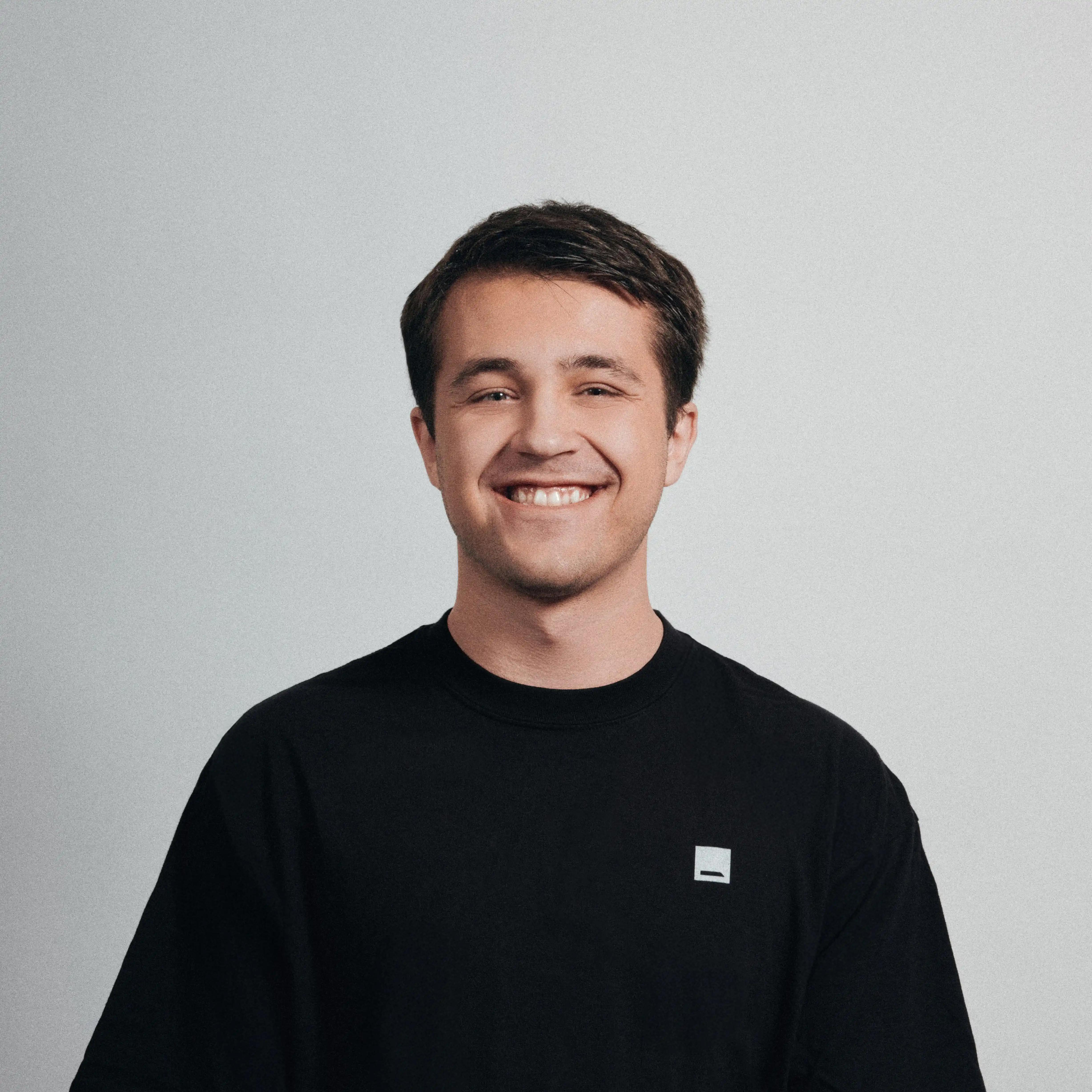
Gavin Uberti, CEO of Etched
Gavin Uberti / CEO, Etched / San Jose, CA
AI Hardware Founder
Gavin Uberti
The 25-year-old who dropped out of Harvard to build the one chip Nvidia doesn't want to discuss at dinner parties.
CEO & Co-Founder Thiel Fellow Etched / Sohu ASIC Builder MIT Innovator U35
$5B
Valuation
$625M
Total Raised
20x
vs H100
340
Employees

Before ChatGPT launched, Gavin Uberti was writing matmul kernels for an open-source compiler called Apache TVM. Not running AI companies. Not raising venture rounds. Writing the low-level math that makes matrix multiplication fast - the kind of work that happens three levels below where most people think about AI at all.

That detail matters. When Uberti and his Harvard classmates Chris Zhu and Robert Wachen decided, somewhere around 2022, that transformer architecture was going to be the foundation of virtually all meaningful AI for the foreseeable future - it wasn't a Twitter hot take. It was an inference drawn from people who had spent time in the machine room.

"We're making the biggest bet in AI. If transformers go away, we'll die. But if they stick around, we're the biggest company of all time." - Gavin Uberti, CEO of Etched

The bet they made was simple and radical in equal measure: build a chip that does exactly one thing. Transformers only. No CNNs. No LSTMs. No SSMs. No Mamba. No other architectures supported, accepted, or entertained. Strip out everything that isn't transformer math, pack in as much HBM3E memory as physically fits, and run inference at speeds that make Nvidia's H100 look like a bicycle next to a freight train.

They named the chip Sohu. It's built on TSMC's 4nm process. It's roughly the largest die that can physically be manufactured - about 800 square millimeters. One 8-chip Sohu server claims to process over 500,000 tokens per second on Llama 70B. Etched says it replaces 160 Nvidia H100 GPUs. Those are Etched's numbers, and Nvidia hasn't countered with a rebuttal that's made headlines.

Uberti dropped out of Harvard in March 2023 - he was taking simultaneous Master's and Bachelor's courses in Computer Science and Mathematics at the time, a schedule that suggests someone who runs toward complexity rather than away from it. One month after leaving Cambridge, he had closed $5.36 million in seed funding and relocated to the Bay Area. By June 2024, Etched had $120 million and a chip announcement. By January 2026, a $500 million round at a $5 billion valuation.

$625M
Total Funding Raised
Seed through Series B
$5B
Valuation (Jan 2026)
Led by Stripes
160
H100 GPUs Replaced
Per single Sohu server
4nm
TSMC Process Node
~800mm² die size

One Architecture. Everything.

The hardware business Uberti is building has a historical precedent he talks about freely: Bitcoin ASICs. For years, people mined Bitcoin on GPUs. Then specialized chips arrived - application-specific integrated circuits built for exactly one task, mining Bitcoin. They were better than GPUs by an order of magnitude. GPU miners disappeared almost immediately.

Uberti's argument is that the same logic applies to AI inference. General-purpose GPUs are flexible by design - they can run transformers, CNNs, LSTMs, and the next architecture someone invents on a Wednesday afternoon. That flexibility has a cost. You're carrying silicon for tasks you'll never run. Sohu carries none of that weight. Every transistor earns its place by doing transformer math, and nothing else.

The risk, of course, is obvious. The entire company requires that transformer-based models remain the dominant approach to AI indefinitely. Uberti doesn't pretend otherwise. "If transformers go away, we'll die," he said plainly in one interview. He just doesn't think they're going anywhere.

The bet is backed by the observation that transformers have proven extraordinarily durable as an architectural choice. GPT, Claude, Gemini, Llama, Mistral, Flux, Sora, Stable Diffusion - text, image, video, code - they're all transformers. Every major AI lab working on next-generation models is working on... a transformer variant.

Uberti watched this happen in real time. "When ChatGPT came out, and Nvidia stock exploded, and especially when every other model coming out would be a transformer too," he noted, "we found ourselves in the right place at the right time."

The timing advantage is something he talks about explicitly. He believes Etched has more than an 18-month head start on any hyperscaler that decides to compete on specialized inference silicon - and that by the time Google or Nvidia could ship a comparable product, Etched will already be on its second generation and deep in customer relationships.

"I think it's a matter of time before Nvidia and Google and hyper scalers begin to compete. But the fact is, it's too late." - Gavin Uberti
The Origin Story
Chapter 01

Writing Kernels at OctoML

Before founding Etched, Uberti spent time building compilers and writing matmul kernels for Apache TVM. Close to the metal. Very close.

2021
Chapter 02

The Harvard Revelation

Three CS/Math students at Harvard start a school project exploring AI at scale. They notice that every important model is a transformer. Every single one.

2022
Chapter 03

Etched Is Born

Uberti, Chris Zhu, and Robert Wachen co-found Etched with a single conviction: transformers win. Build silicon for nothing else.

2022
Chapter 04

Drops Out, Raises $5.36M

March 2023: leaves Harvard mid-semester. April 2023: closes seed round. The gap between decision and capital is 30 days.

2023
Chapter 05

Sohu Goes Public

June 2024: $120M raised, chip announced. Performance claims that rewrite expectations for what inference hardware can do.

2024
Chapter 06

$5 Billion

January 2026: $500M round, $5B valuation. Peter Thiel invests again. The bet is winning - so far.

2026
"We could be the biggest company of all time."
- Gavin Uberti, CEO of Etched
Sohu
World's First Transformer-Only ASIC · TSMC 4nm · Etched, 2024
144GB
HBM3E Memory
~800mm²
Die Size (reticle limit)
90%+
FLOPS Utilization
500K+
Tokens/sec (Llama 70B)
20x
Faster vs. H100
8-chip
Server Configuration
Sohu is designed exclusively for transformer architecture inference. It cannot run CNNs, LSTMs, SSMs (Mamba), or any non-transformer model. This constraint is the source of its speed advantage. All performance figures are Etched's claims.

The Hardware That Does One Thing

The Sohu chip is not a faster GPU. It's a different kind of object entirely. A GPU carries silicon devoted to graphics pipelines, general compute, memory management for dozens of workload types. Sohu carries none of that. The die area that would have been consumed by flexibility is instead devoted entirely to the computational patterns that transformers use - attention mechanisms, feed-forward networks, the specific matrix operations that dominate inference.

The analogy Uberti reaches for is the one from crypto: Bitcoin ASICs did to GPU mining what Sohu intends to do to GPU inference. The moment purpose-built hardware arrived, it was so much faster and cheaper that the alternative became economically indefensible. You didn't need to be a Bitcoin believer to see it happen in real time. You just needed to watch where the hashrate went.

Etched partnered with Decar AI to run Oasis - the first playable AI-generated video game - on Sohu hardware. The game ran 10x faster on Sohu than on competing platforms. It was a demonstration that the chip's theoretical claims translate into real applications. Video generation, real-time voice agents, high-throughput text inference - the use cases that require speed above all else are exactly where Sohu is designed to compete.

From $5M Seed to $500M Round

Seed
Apr 2023
Primary Venture Partners
$5.4M
Series A
Jun 2024
Primary + Positive Sum + Peter Thiel
$120M
Venture
Jan 2026
Stripes + Peter Thiel + Ribbit Capital
$500M

From Intern to $5B Founder

2019
Software Engineer Intern at Xnor.ai - Edge AI inference, before it was a buzzword. First exposure to the hardware-software boundary in machine learning.
2020
Algorithms & Backend Engineer at Coursedog - Builds algorithmic systems. Harvard enrollment ongoing.
2021-2022
Software Engineer at OctoML - Builds compilers. Writes matmul kernels for Apache TVM. Achieves state-of-the-art results on MLPerf Tiny benchmarks. Becomes fluent in the math that AI runs on.
2022
Co-founds Etched with Chris Zhu and Robert Wachen at Harvard. The shared observation: every model that matters is a transformer. Build silicon for transformers only.
March 2023
Drops out of Harvard mid-semester, withdrawing from concurrent Master's/Bachelor's programs in CS and Mathematics.
April 2023
Closes $5.36M seed round led by Primary Venture Partners. Relocates to Bay Area. One month from dropout to funded.
2024
Named 2024 Thiel Fellow alongside co-founders Chris Zhu and Robert Wachen. MIT Technology Review names Uberti an Innovator Under 35.
June 2024
Sohu unveiled publicly. $120M Series A announced. CNBC headline: "Harvard dropouts raise $120 million to take on Nvidia's AI chips." Peter Thiel participates.
January 2026
$500M raised at $5B valuation led by Stripes. Peter Thiel backs again. Ribbit Capital joins. Company reaches 340 employees.

The Harvard Dropout Thesis

The Harvard dropout narrative is true but slightly misleading as a frame. Uberti wasn't bored or disengaged. He was taking simultaneous Master's and Bachelor's courses in two demanding subjects while simultaneously building a semiconductor company. That's not someone who left because academia had nothing to offer. That's someone who ran out of hours.

The Thiel Fellowship - Peter Thiel's program that pays young people $100,000 to drop out of college and build something - went to all three Etched co-founders in 2024. It's rare for an entire founding team to receive the fellowship. It's a data point about how the company presents internally: not as a side project that grew, but as something that was always the main thing.

Before all of this, there's the OctoML chapter that doesn't get enough attention. Uberti spent time writing matmul kernels - the core mathematical operations behind matrix multiplication that determine how fast a model can actually run. It's the kind of work that most AI company founders have never done and couldn't do. It gave him a view of the efficiency gap between what general-purpose hardware could theoretically deliver and what it actually delivered in practice.

Guest lectures at Columbia University and TinyML follow. He has a coherent intellectual narrative that predates the company, which is unusual and probably load-bearing: the conviction that specialized hardware beats general hardware was formed by someone who had worked deep enough in both domains to have an opinion worth taking seriously.

Three Harvard Dropouts, One Bet

CEO & Co-Founder
Gavin Uberti
Former compiler engineer and matmul kernel writer. The technical architecture behind the transformer-only thesis. Dropped out mid-semester, closed seed funding within a month. Drives the product and public vision for Sohu.
CTO & Co-Founder
Chris Zhu
Harvard CS & Mathematics. 2024 Thiel Fellow. Focused on LLM accelerator systems and the deep technical architecture of Sohu. The engineering backbone of Etched's chip design.
COO & Co-Founder
Robert Wachen
Harvard Decision Science. 2024 Thiel Fellow. Brings operational discipline to a deep-tech hardware company. Previous founder experience (Mentor Labs, acquired by Crimson Education). Handles the hard realities of semiconductor supply chains.

The Nvidia Question

The obvious question is: what happens when Nvidia builds a transformer-specialized chip? Uberti's answer is that the window has already closed. He argues that a lead of 18+ months in semiconductor development is nearly insurmountable - new chip generations take years to design, tape out, validate, manufacture, and ship. By the time a hyperscaler could respond with a comparable product, Etched will have shipped a second or third generation Sohu and established customer relationships that would be costly to unwind.

The counterargument, which Uberti acknowledges implicitly, is that Nvidia's software moat (CUDA, the ecosystem of libraries and frameworks built on top of it) gives general-purpose GPU hardware a stickiness that pure performance comparisons don't capture. Enterprises running at scale may prefer the known quantity even at a performance penalty. Etched's response is to build an AI software stack that makes migration easier and to let the economics make the case: if one Sohu server genuinely replaces 160 H100s, the math for large-scale inference operators becomes difficult to ignore.

The Oasis partnership with Decar AI is an early proof point designed to make that math visible. A playable AI-generated video game running 10x faster on Sohu than on alternatives is a demo anyone can understand. It's the same move Intel made with early graphics demos and Apple made with video editing acceleration - pick a workload that feels tangible, run it faster than anyone else, and let the experience make the argument.

"Whether or not you're a fan of cryptocurrency, the Bitcoin mining ASIC companies have been able to do quite well for themselves... the moment that the first ASICs came out, they were better than GPUs by an order of magnitude." - Gavin Uberti, on the Etched playbook

Gavin Uberti In His Own Words

What the Industry Says

2024 Thiel Fellow
MIT Innovator Under 35
$5B Valuation
Peter Thiel - Backed Twice
SEMI Industry Speaker
Stanford MLSys Guest

The Thiel Fellowship is particularly noteworthy as a signal: Thiel's fund backs Etched at Series A with $120M in June 2024, and then Thiel invests again in the $500M January 2026 round. When the person who gave you a $100,000 fellowship to drop out of college subsequently writes a check into your company at a $5 billion valuation, it reads as a vote of confidence that goes beyond normal investor behavior.

Uberti has also become a genuine voice in the technical conversation around AI inference. His Stanford MLSys lecture, his Invest Like the Best appearance with Patrick O'Shaughnessy, and his appearances on Fox Business all reflect a founder who's comfortable making the technical case in public, not just to investors in private. That's rarer than it should be in hardware founding teams.

The Aspiration Is Absurdly Large

Gavin Uberti is 25 years old running a $5 billion semiconductor company with 340 employees, a chip on TSMC's 4nm node, and a stated ambition that the company could become one of the largest in history. The range of outcomes here is genuinely wide: semiconductor hardware is notoriously difficult, and being right about transformers is a necessary but not sufficient condition for Etched to succeed.

What's clear is that the underlying insight - that specialization wins in hardware when you can accurately predict which workload will dominate - is not a controversial idea. It's how Bitcoin ASICs beat GPUs for mining. It's how Google's TPUs work. It's how Apple's Neural Engine functions inside every iPhone. Uberti is applying a proven logic to a new target at an ambitious scale.

The question the market is pricing at $5 billion is whether transformers stay dominant, whether Etched can manufacture and ship at scale, and whether the software stack around Sohu can overcome the switching costs baked into Nvidia's CUDA ecosystem. Uberti has made his position on all three clear. He's not hedging. The chip does one thing. So does the company.

Whether that focus is a fatal constraint or the defining feature of a generational hardware company is the question Etched is spending $625 million to answer.